SEO for Content That Actually Ranks: A Guide Without the Tricks
Search rewards the page that answers the question best. Most SEO advice is about making that easier to detect.

7 min read

Search rewards the page that answers the question best. Most SEO advice is about making that easier to detect.
SEO advice ages badly, and a surprising amount of what people still practise was obsolete a decade ago. Keyword density targets. Repeating an exact phrase a fixed number of times. Publishing thin articles at volume to cover every variation of a query.
All of it was once effective, because search engines were once easy to fool. They are considerably harder now, and the techniques that remain are the ones that were always defensible: understand what someone is actually asking, answer it better than the current results, and remove the technical obstacles between your page and being read.
That is the whole discipline. Everything below is detail on those three things.

The most common reason a well-written page does not rank has nothing to do with the writing. It answers a different question from the one being asked.
Every query has an intent behind it, and pages that mismatch it do not rank regardless of quality. Four types cover almost everything.
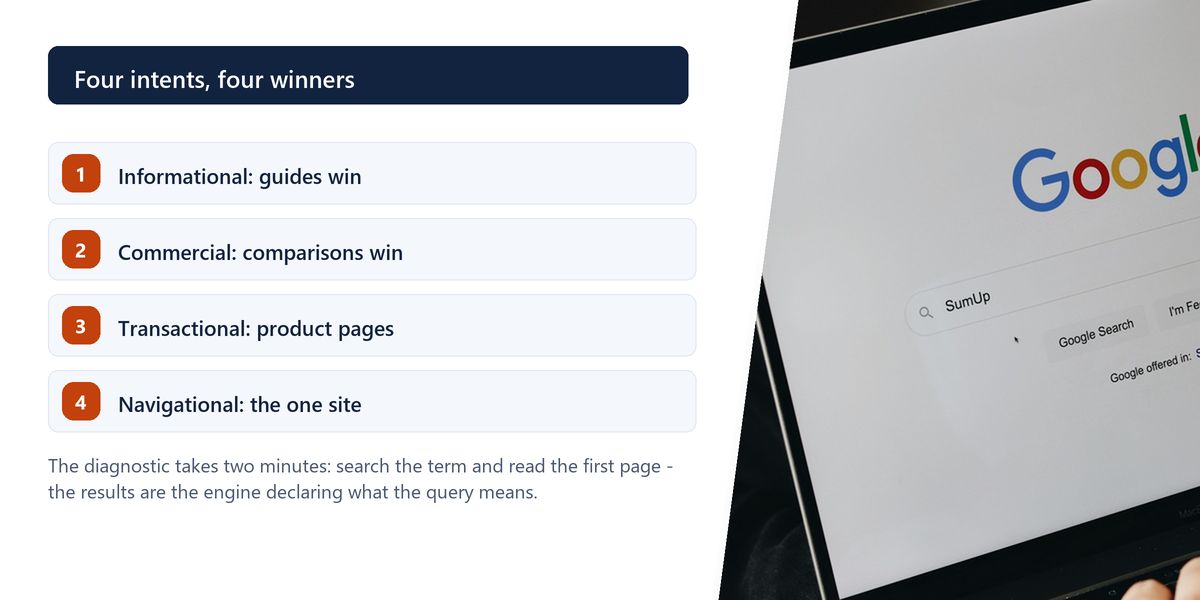
| Intent | The query looks like | What ranks |
|---|---|---|
| Informational | 'how does X work' | explanatory articles and guides |
| Commercial | 'best X for Y' | comparisons and reviews |
| Transactional | 'buy X', 'X pricing' | product and pricing pages |
| Navigational | 'X login' | the official page, nothing else |
The diagnostic takes two minutes: search the term and look at what is already ranking. If the first page is entirely product pages, an explanatory blog post will not break into it no matter how good it is. The results are the search engine telling you what it believes the query means.
Look past the topic to the shape. If every top result is a numbered list, a comparison table or a step-by-step tutorial, that format is what satisfies this query. Publishing a discursive essay against nine tutorials is a decision to lose.
This is not a licence to copy. It means you have learned the expected structure, and your job is to fill it better — with more accurate detail, clearer explanation, or something the existing results all omit.
The instinct to publish frequently produces thin content, and thin content competes with itself. Five 600-word posts on adjacent aspects of one topic split their own signals and rank for nothing.
One thorough page covering the topic properly consolidates that value. It attracts more links, answers more related queries, and gives readers a reason to stay — which is itself a signal.
Depth does not mean length for its own sake. Padding a 900-word answer to 2,500 words makes it worse. It means covering what a reader genuinely needs: the direct answer, the caveats, the edge cases, and the follow-up question they will have next.
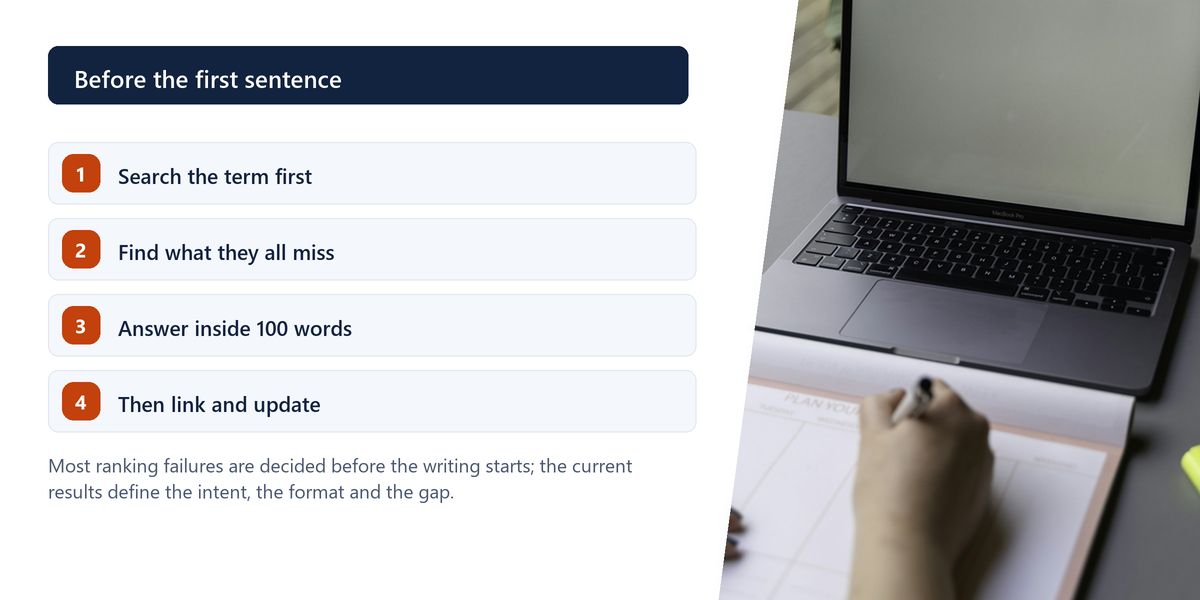
Answer the main question in the first hundred words, then go deeper. Readers who arrive from a search want the answer, not five paragraphs of preamble. Front-loading the answer improves both reader satisfaction and your chances of being used in a featured snippet.
Most sites underuse this dramatically. Internal links tell search engines which pages are important and how topics relate, and they pass authority from your strong pages to your newer ones. You control them entirely — no outreach required.
The practical version: use descriptive anchor text rather than 'click here', link every new article from two or three relevant existing ones, and make sure every page is reachable within a few clicks of the homepage. A page with no internal links pointing to it is effectively orphaned.
Technical SEO rarely wins on its own, and it can comprehensively lose. If a page cannot be crawled, indexed or read on a phone, its quality is irrelevant.
Worth stating plainly, because these practices persist.
Keyword density targets are meaningless and repeating a phrase unnaturally now reads as a quality problem. Buying links carries real penalty risk. Publishing large volumes of thin or automatically generated content is explicitly targeted by ranking systems. Exact-match domains and keyword-stuffed anchor text stopped helping years ago.
The pattern is consistent: anything designed to signal relevance without providing it has been progressively devalued. Anything that genuinely helps a reader has held its value or increased it.
A B2B software company had published two blog posts a week for two years — roughly 200 articles, most of them 600 to 800 words, many covering nearly identical topics from slightly different angles.
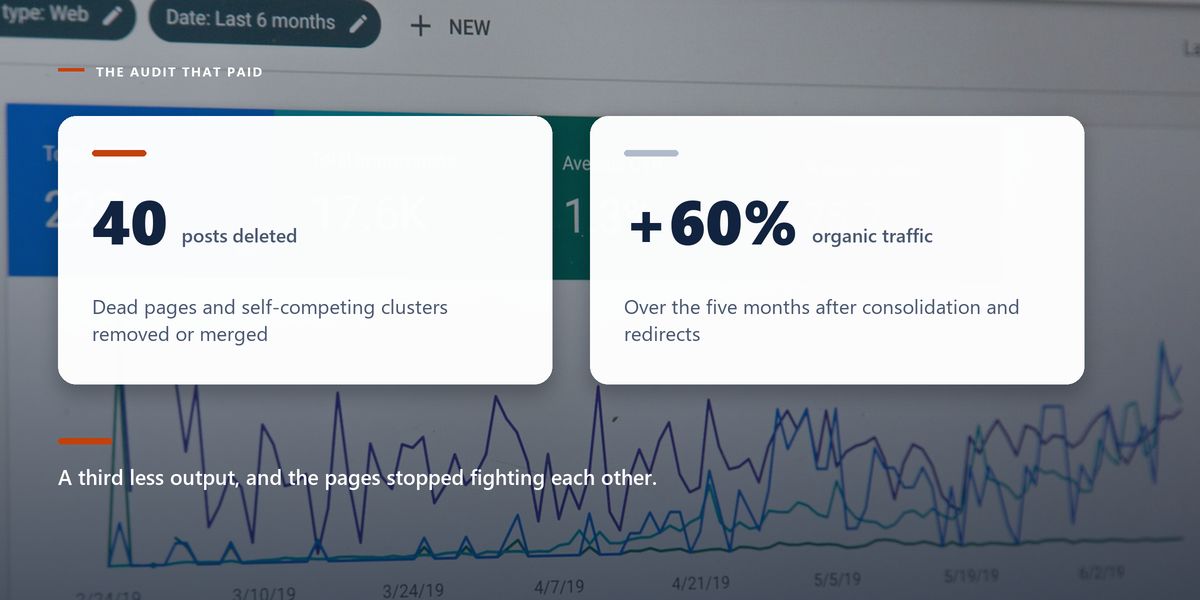
An audit found that 40 posts had received essentially no traffic in twelve months, and that several groups of four or five articles were competing with each other for the same query while none of them ranked.
They deleted the dead pages, consolidated each competing group into one comprehensive article with redirects from the old URLs, and expanded the merged pieces with genuine depth. Total published output fell by roughly a third. Organic traffic rose about 60% over the following five months, and the pages that had been fighting each other started ranking on the first page.
SEO is a slow channel. A new page on a young site can take months to rank, and changes take weeks to show. Judging a strategy after three weeks leads to constant thrashing between approaches, which is worse than any single mediocre strategy applied consistently.
Rankings are a vanity metric on their own — position three for a term nobody searches is worth nothing. Track impressions and clicks per query, which tell you what people actually search and whether your result is compelling enough to click. Watch which pages bring visitors who go on to do something useful.
And check your existing pages regularly. Content decays: facts age, competitors publish better versions, and interfaces you described get redesigned. Updating a page that used to rank well is almost always a better investment than writing a new one.
Write the page you would want to find. Then remove everything preventing a search engine from noticing that you did.
— The whole method in two sentences

Check what already ranks to learn the intent and the format. Write one thorough page rather than five thin ones. Answer the main question immediately. Get titles, headings, URLs and alt text right. Link internally with descriptive anchors. Keep the site crawlable, fast and usable on mobile. Update decaying pages instead of only publishing new ones.
The most durable SEO strategy has been the same for years, which is unusual in this field: be the best available answer to a question people are actually asking, and make that easy to verify.
Everything else is either an optimisation on top of that or an attempt to avoid doing it — and the second category has a consistently poor record.
Tap a star to share what you thought.
No ratings yet
It is the underlying goal behind a query — to learn, to compare, to buy, or to reach a specific site. Pages that mismatch the intent do not rank regardless of quality, which is why checking the current results before writing is the single most useful step.
Long enough to answer the question properly and no longer. There is no target word count; padding a good short answer makes it worse. What matters is covering what the reader needs, including the caveats and the obvious follow-up question.
The topic matters; keyword density does not. Use the terms people actually search naturally in your title, headings and text, and stop counting. Repeating a phrase unnaturally now reads as a quality problem rather than a relevance signal.
Not directly, but it strongly influences whether people click your result, and click-through does matter. Write it as advertising copy for the page rather than as a place to repeat keywords.
It is one of the most underused levers available, and you control it entirely. Internal links signal which pages matter, show how topics relate, and pass authority to newer pages. Use descriptive anchor text rather than generic phrases.
Often yes. Pages with no traffic and no links add little, and several thin articles on the same topic compete with each other. Consolidating them into one comprehensive page with redirects from the old URLs frequently improves overall performance.
Months rather than weeks, particularly on a newer site. Changes take time to be crawled, reassessed and reflected in rankings. Judging a strategy after three weeks leads to constant switching, which performs worse than any consistent approach.
Buying links, keyword stuffing, publishing large volumes of thin or automatically generated content, and exact-match anchor text everywhere. These carry real penalty risk and have been progressively devalued, because they signal relevance without providing it.
Sign in to join the conversation.
Loading responses…
Have a story, idea, or something valuable to share? Join The Blog Story for free, publish your content, reach more readers, and earn a share of advertising revenue from eligible content.
Create quality content. Grow your audience. Grow your earning potential.