Newborn Sleep: What to Expect in the First Months
Nearly everything that feels like a problem in the first twelve weeks is normal development.

6 min read

—Not yet rated
Nearly everything that feels like a problem in the first twelve weeks is normal development.
Everyone tells expectant parents that newborns sleep sixteen hours a day. This is true and profoundly misleading, because it omits the crucial detail: those hours arrive in fragments of forty minutes to three hours, distributed with no regard whatsoever for night and day.
The result is that new parents spend the first weeks convinced something is wrong. Almost always nothing is. Newborn sleep is genuinely different from adult sleep, for reasons that make biological sense once explained.
This is a description of what is normal, what actually helps, and the safety guidance that matters most. It is not medical advice, and your health visitor or paediatrician is the right person for anything specific to your baby.
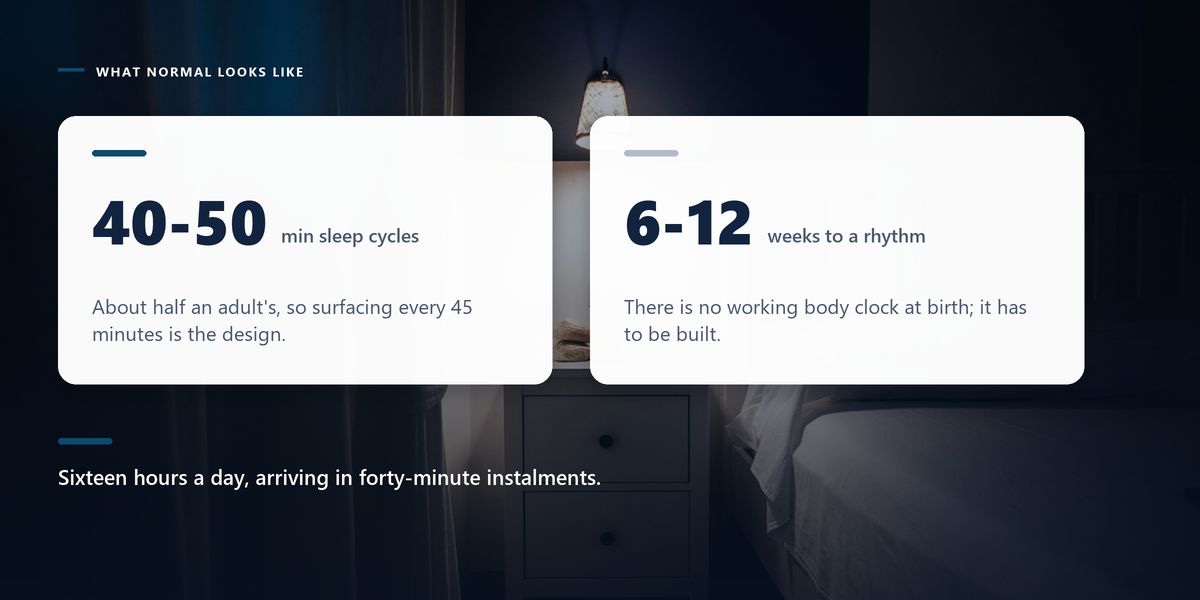
Newborn sleep cycles are much shorter than adult ones — roughly 40 to 50 minutes compared with about 90. Babies also spend a far greater proportion of that time in active, light sleep, during which they twitch, grimace, make noises and appear to be waking constantly.
Both features are useful rather than faulty. Light sleep is thought to support the extraordinary rate of brain development happening in these months, and easy arousal is protective.
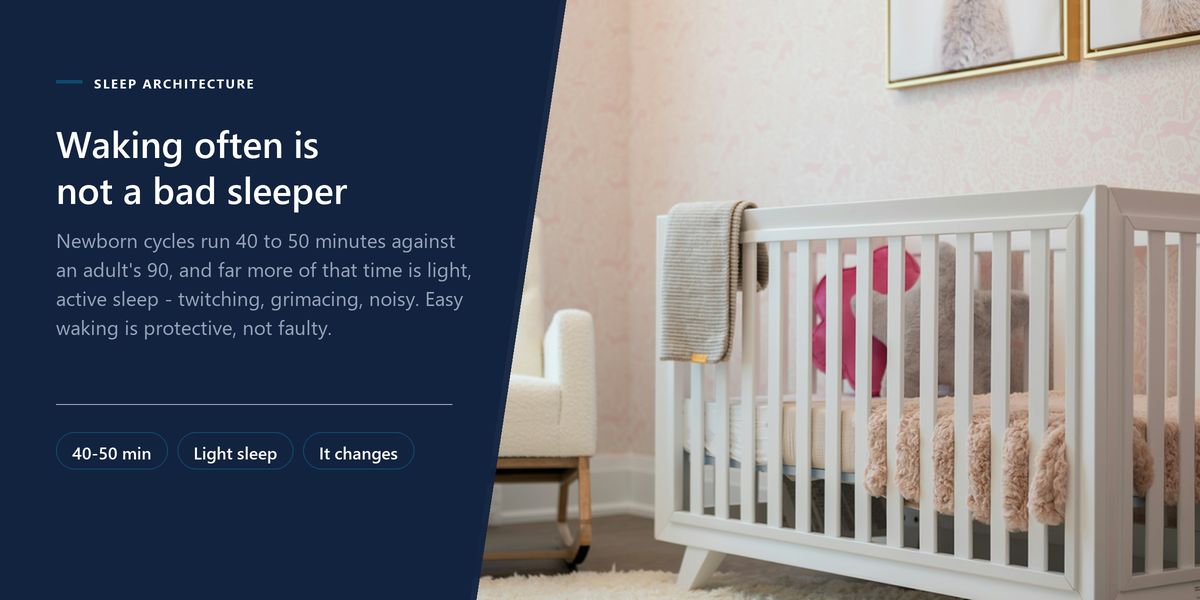
The practical consequence is that a newborn surfacing every 45 minutes is not a bad sleeper. That is what the architecture looks like, and it changes on its own timetable.
Babies are not born with a functioning circadian rhythm. In the womb there is no daylight, and the mother's melatonin does the timekeeping. After birth, the internal clock has to develop, and it typically starts consolidating somewhere between six and twelve weeks.
You can help it along, gently. Make daytime bright and normally noisy — no tiptoeing around naps. Keep night-time feeds dim, quiet and undramatic, with minimal talking and no play. Get outside in daylight when you can; it helps both of you.
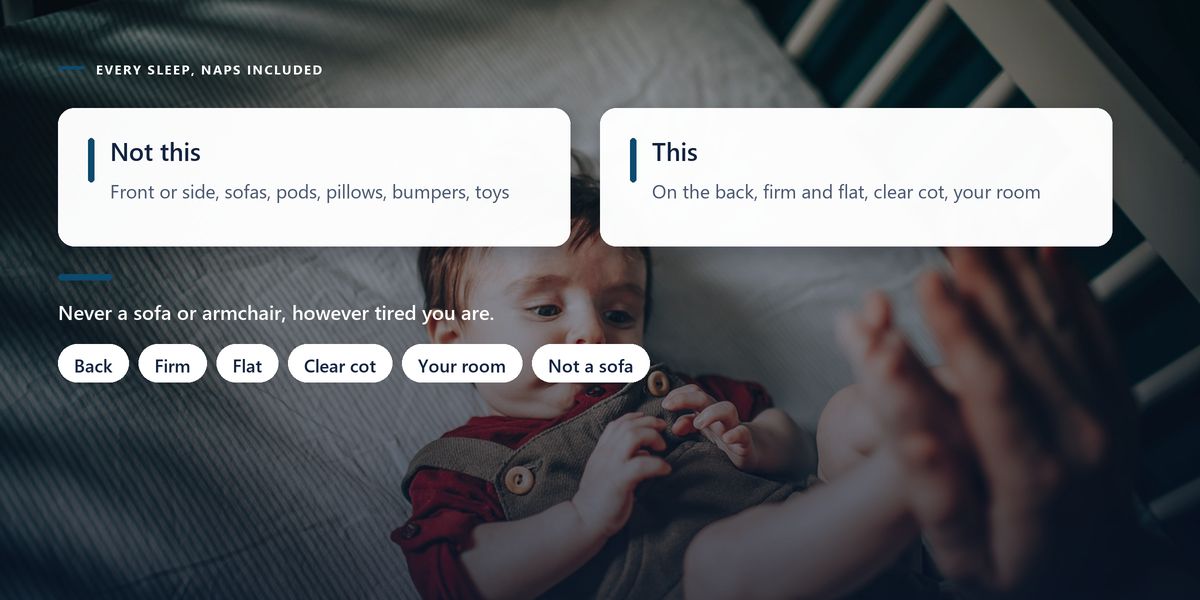
This section is the one to get right, and the guidance is consistent across major health bodies. It applies to every sleep, including short daytime naps and naps away from home.
Discuss feeding at night and any bed-sharing questions with your midwife or health visitor honestly. Guidance varies by circumstance, and an accurate conversation is far more useful than following whatever was said in a forum.
Schedules do not work well in the first weeks because newborns do not have one yet. What works better is watching for tired signs and responding before the baby becomes overtired, which paradoxically makes settling much harder.
| Sign | What it usually means | What helps |
|---|---|---|
| Staring, glazed expression | early tiredness | start settling now |
| Rubbing eyes, pulling ears | getting tired | quiet, dim, wind down |
| Jerky movements, arching | overtired | calm firmly: motion, dark, sound |
| Frantic crying, hard to soothe | well past the window | expect a longer settle; stay calm |
| Rooting, hands to mouth | hunger, or comfort seeking | offer a feed |
Awake windows in the newborn period are very short — often only 45 to 60 minutes including a feed and a nappy change. Many new parents are surprised by how quickly a baby needs to go back down.
Learn the settling techniques that work for your baby and use them without guilt. Movement, a firm hold, dim light and steady sound replicate the environment before birth. You cannot spoil a newborn by responding to them — responsiveness in the early months supports, rather than undermines, later independent sleep.
Rough timelines help, provided they are treated as ranges rather than targets. Individual babies vary enormously and none of this is a performance measure.
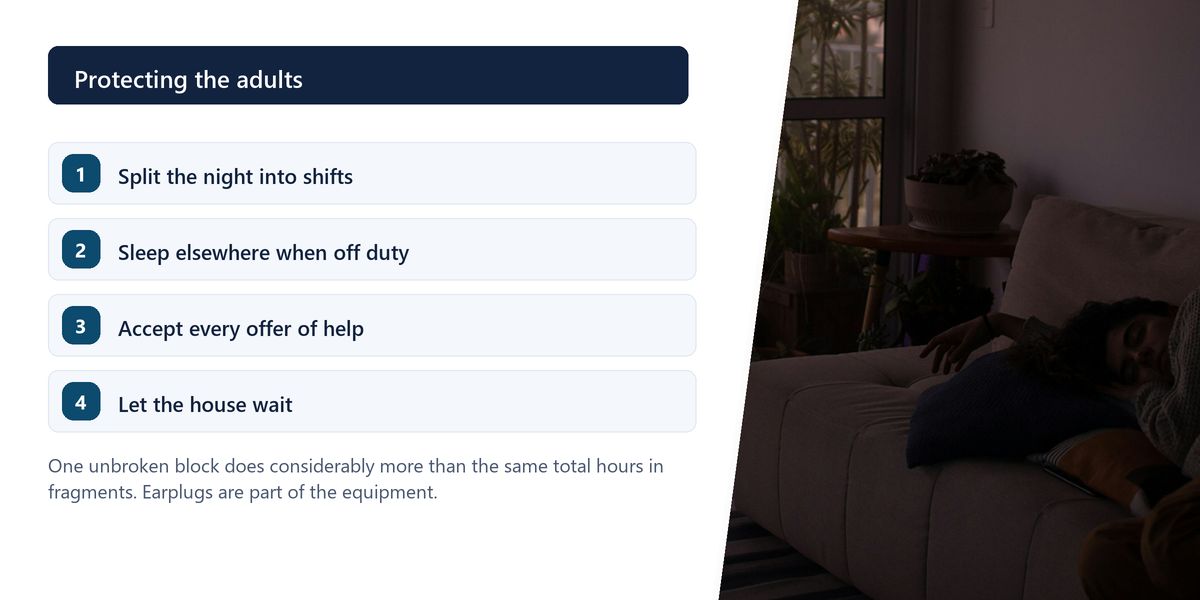
Most newborn sleep advice focuses entirely on the baby, which leaves the actual crisis unaddressed. Severe parental sleep deprivation affects mood, judgement, driving safety and relationships, and it is not something to endure heroically.
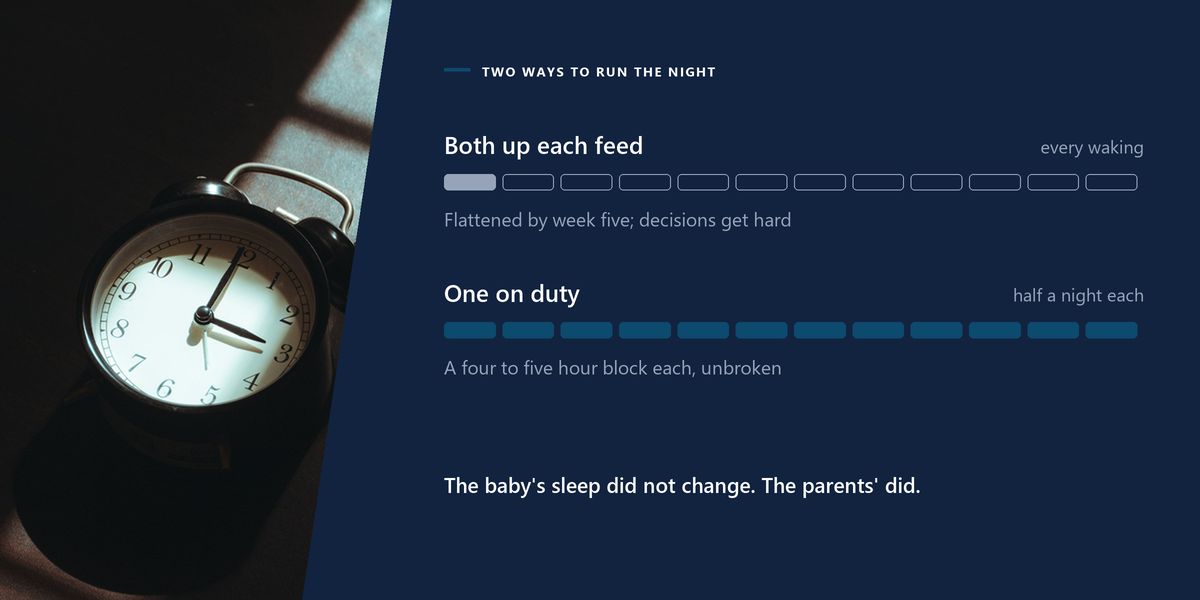
Split the night into shifts where possible, so each parent gets one genuinely uninterrupted block rather than both being woken every time. If you are feeding alone, get help with everything else. Sleep when the baby sleeps is annoying advice and it is also correct — the laundry is not the priority it feels like at 2pm.
New parents were both waking for every feed, on the reasonable theory that it was fairer. By week five both were exhausted, short-tempered and finding ordinary decisions difficult.
They split the night instead: one parent covered until 2am while the other slept in a different room with earplugs, then they swapped. Each got a four to five hour unbroken block.
The baby's sleep did not change at all. Both parents described the difference in how they felt as dramatic — which is the point. One long block does considerably more than the same total hours in fragments.
Contact a doctor or midwife promptly about a baby who is unusually difficult to rouse, feeding poorly, not producing wet nappies, unusually floppy, or running a fever — particularly under three months. And for parents: persistent low mood, anxiety or intrusive thoughts after birth are common and treatable. Tell your health visitor or GP. That conversation is a normal part of postnatal care, not a failure.
Newborn sleep is fragmented because sleep cycles are short and light sleep predominates. Day-night rhythm develops from around six to twelve weeks. Follow safe sleep guidance for every sleep. Watch for tired signs rather than the clock, keep awake windows short, and respond freely. Protect the parents' sleep in deliberate blocks.
The most useful thing to know in the first twelve weeks is that almost nothing about it is a problem to be solved. It is a phase with a biological timetable, and the timetable is not influenced by how well you are coping.
Get the safe sleep basics right, take help wherever it is offered, and be considerably kinder to yourself than the internet suggests. For the years after this, our guide on teenagers and screen time is a long way off — but it is coming.
Tap a star to share what you thought.
No ratings yet
Typically around 14 to 17 hours in 24, but distributed in short blocks of roughly 40 minutes to three hours with no regard for night and day. The total is high; the continuity is not, and that is normal.
Newborn sleep cycles last about 40 to 50 minutes rather than an adult's 90, and babies spend more of that time in light, active sleep. Frequent surfacing is a feature of newborn sleep architecture rather than a problem with your baby.
There is a very wide normal range. Circadian rhythm begins developing around six to twelve weeks, longer stretches usually appear gradually after that, and many babies do not sleep through consistently until well into the first year or beyond.
On the back, on a firm flat separate surface, with nothing else in the sleep space, in the same room as a parent for the first six months, in a room that is not too warm, and never asleep with an adult on a sofa or armchair.
Often only 45 to 60 minutes in the early weeks, including feeding and changing. Watching for tired signs — staring, jerky movements, eye rubbing — works better than the clock, since an overtired baby is much harder to settle.
No. Responding to a newborn's needs supports their development and does not create bad habits. Comfort, movement and closeness are how babies regulate in the early months, and responsiveness is associated with better rather than worse sleep later.
Sign in to join the conversation.
Loading responses…
Have a story, idea, or something valuable to share? Join The Blog Story for free, publish your content, reach more readers, and earn a share of advertising revenue from eligible content.
Create quality content. Grow your audience. Grow your earning potential.