Teenagers and Screen Time: A More Useful Conversation Than 'Get Off Your Phone'
What they are doing on the screen matters far more than how long they are on it.

6 min read

—Not yet rated
What they are doing on the screen matters far more than how long they are on it.
The screen time argument in most households follows a script. A parent says a number of hours is too many, a teenager points out that everyone else has more, both sides feel unheard, and nothing changes except the temperature.
Part of the reason it goes badly is that the metric is wrong. Total hours lumps together homework, a video call with a grandparent, a hobby, a group chat that is their entire social life, and three hours of algorithmic scrolling — as though those are the same thing.
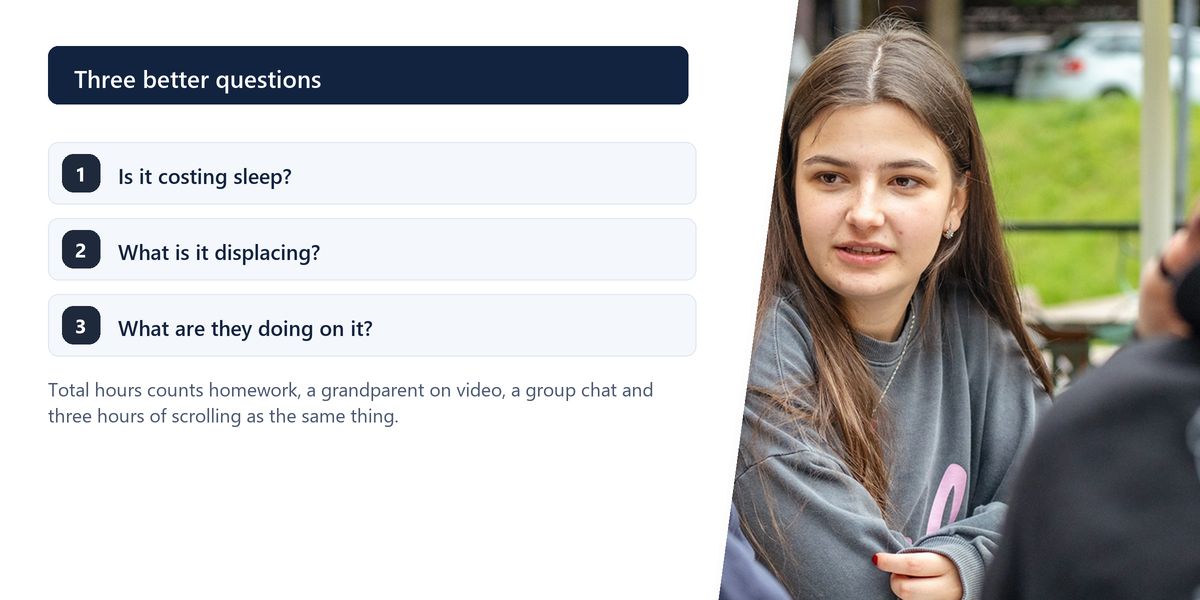
A more useful conversation asks three questions instead: is it displacing sleep, is it displacing other things that matter, and what specifically is happening on the screen?
If you enforce one rule, make it this one. Adolescents need roughly eight to ten hours of sleep, and their biology naturally shifts them later — teenagers genuinely do not feel sleepy at ten o'clock, and this is developmental rather than defiance.
Because school start times do not move, any evening screen use that delays sleep further comes directly out of an already tight budget. And the mechanism is not mainly blue light: it is that the content is engaging and social, so there is always a reason to stay up ten more minutes.
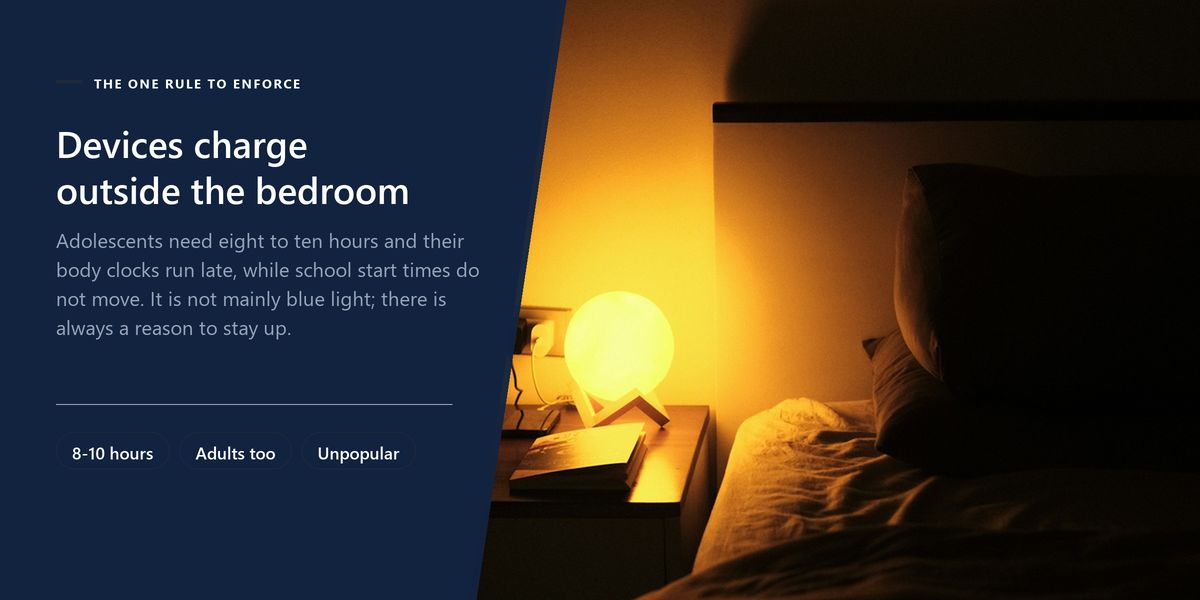
The most effective single intervention is devices charging outside the bedroom overnight. It is unpopular, it works, and it is far easier to introduce as a household rule that applies to parents too.
Screen time is only meaningful in relation to what it replaces. Three hours in the evening after homework, exercise, dinner with the family and time with friends is a different situation from three hours that has eaten all of those.
So instead of counting hours, check the essentials: sleep, school, physical activity, in-person friendships, family contact and at least one interest that is not on a screen. If those are all intact, the number matters much less than it appears to.
| Type of use | What it tends to do | Reasonable stance |
|---|---|---|
| Creating — music, video, code, art | builds skills and confidence | encourage it |
| Socialising with known friends | supports real friendships | largely fine |
| Gaming with friends | social and cooperative | manage timing, not existence |
| Passive algorithmic scrolling | displaces most, returns least | the one worth limiting |
| Homework and research | necessary | watch for tab-switching, not duration |
| Contact with strangers | genuine safety concern | discuss openly and specifically |
Research on adolescent wellbeing consistently finds that the type of use matters more than the amount, and that heavy passive consumption of social feeds shows the least favourable associations. That is the category worth focusing your limited authority on.
Negotiate the rules together and write them down. Teenagers follow rules they helped set far more reliably than rules imposed on them, partly because the reasoning is understood and partly because agreement is harder to argue with later. Include the consequences in the negotiation too.
Teenagers respond considerably better to being treated as intelligent people than to being told a number. Most are genuinely interested when you explain how infinite scroll, autoplay, streaks and variable rewards are engineered to be difficult to stop.
Framing it as these apps are designed by very well-paid people to take your attention, and that is worth understanding lands far better than you are addicted to that phone. One invites them to be an ally against a system; the other makes them the problem.
This is also more honest. The pull is not a character flaw, and adults are not conspicuously better at resisting it.
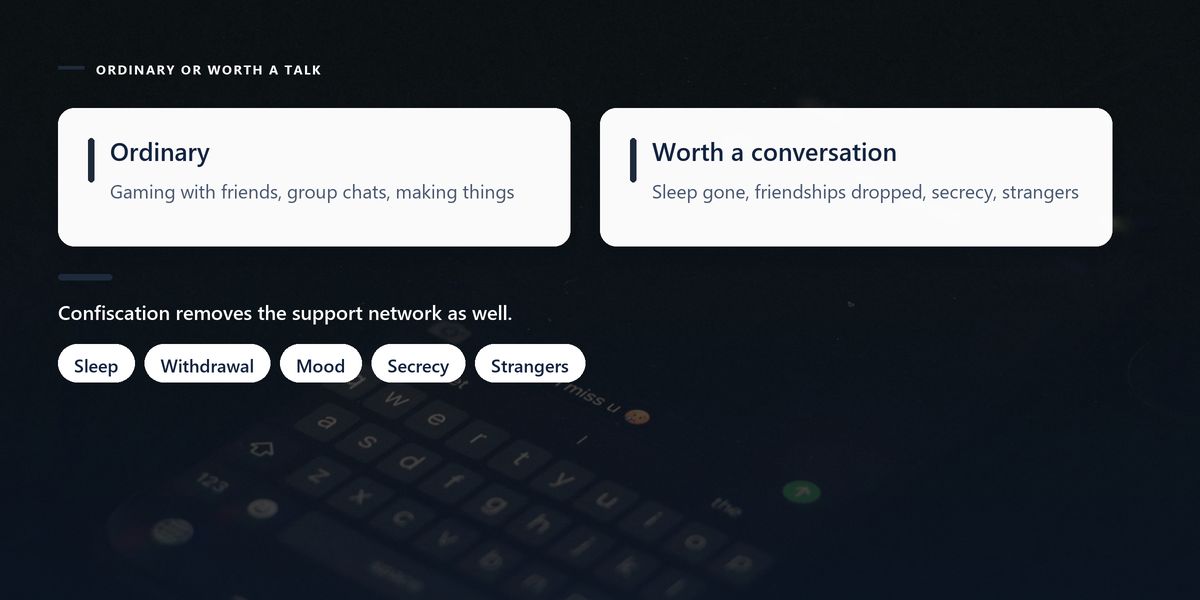
Distinguishing normal teenage screen use from something that needs intervention matters, because treating everything as an emergency uses up credibility you will need.
Any of these is a reason for a calm, direct conversation and, if it persists, for involving a GP or the school. Confiscating a device in response to distress usually removes the support network alongside the problem.
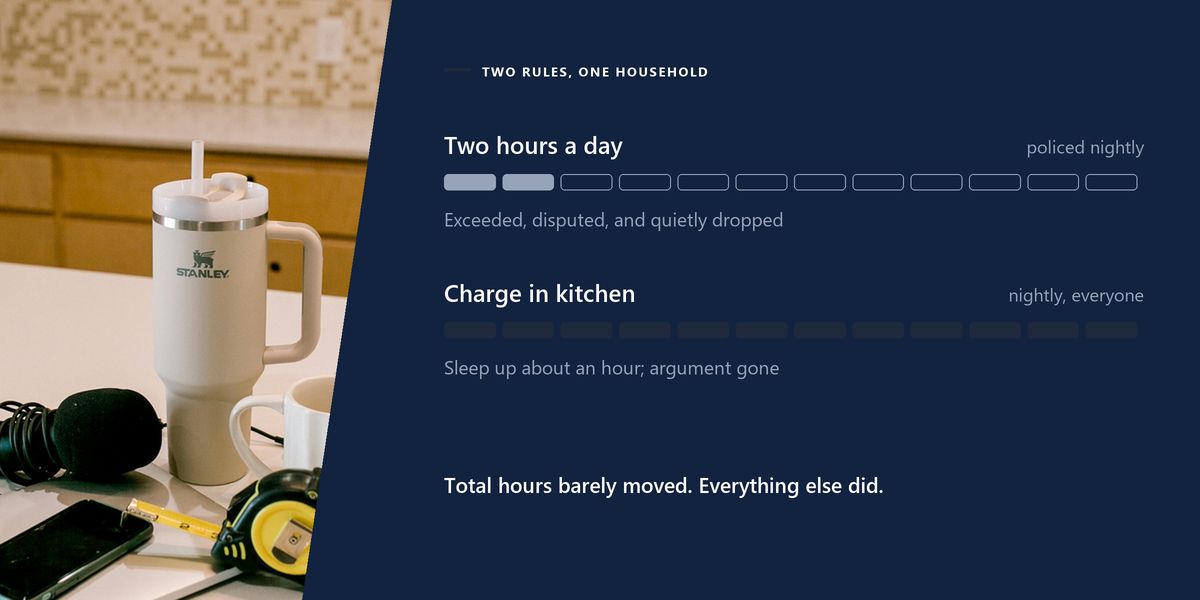
A family had the same row most evenings about a fifteen-year-old's phone. The parents' rule was two hours a day, enforced by asking, and it was routinely exceeded and disputed.
They renegotiated. In exchange for dropping the daily limit entirely, the household agreed three things: all phones charge in the kitchen overnight, no devices at dinner, and the rules applied to both parents as well.
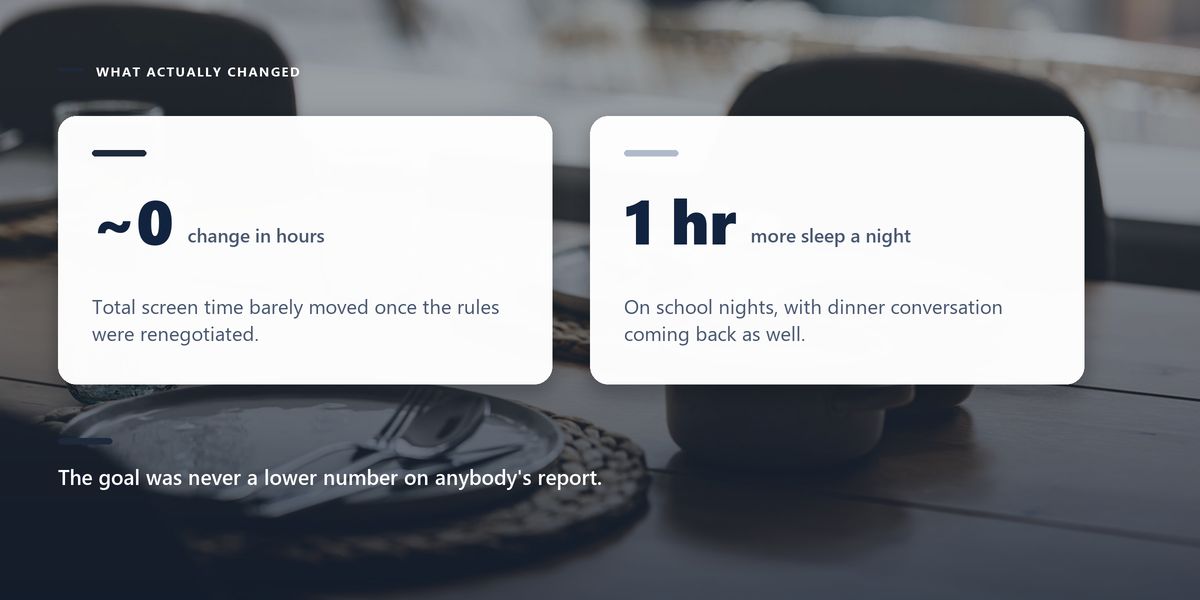
Total screen hours barely changed. Sleep improved by roughly an hour on school nights, dinner conversation returned, and the nightly argument disappeared — because there was nothing left to negotiate each evening.
Blanket confiscation as punishment for unrelated things tends to backfire with teenagers, because for most of them the phone is where their entire social life lives. It reads as disproportionate, it damages trust, and it makes them less likely to come to you when something genuinely goes wrong online — which is the outcome you most need to preserve.
Protect sleep first, with devices charging outside bedrooms. Judge screen use by what it displaces rather than by total hours. Distinguish creating and socialising from passive scrolling. Negotiate rules together, write them down, apply them to adults too, and talk about how the apps are designed rather than about willpower.
The goal is not a lower number. It is a teenager who sleeps enough, has friendships outside a screen, and can eventually manage their own attention without you standing behind them.
That last part only develops through practice, which means gradually handing over control rather than holding it until they leave. Uncomfortable, and it is the actual objective.
Tap a star to share what you thought.
No ratings yet
Major health bodies have moved away from fixed hour limits for adolescents, because what the time displaces and what is being done matters more. Protecting sleep, school, physical activity and in-person friendships is a more useful standard than a number.
No. Creating things, doing homework and socialising with known friends look very different from passive scrolling through algorithmic feeds, which shows the least favourable associations with wellbeing. Focus limits on the last category.
Devices charging outside bedrooms overnight. It protects sleep, which is the outcome most strongly linked to adolescent wellbeing, and it works far better when it applies to the whole household including parents.
Negotiate them together and write them down. Teenagers follow rules they helped design substantially more reliably, and agreeing consequences in advance converts a nightly negotiation into a single conversation you can refer back to.
They can help with younger teenagers, particularly for content filtering and bedtime cut-offs. For older ones, covert monitoring tends to damage trust more than it protects, and an open conversation about what you are using and why works better.
Withdrawal from in-person friendships, consistently sacrificed sleep, marked mood changes tied to being online, abandoning all previous interests, or contact with unknown adults. Those warrant a calm direct conversation and, if persistent, involving a GP or the school.
Sign in to join the conversation.
Loading responses…
Have a story, idea, or something valuable to share? Join The Blog Story for free, publish your content, reach more readers, and earn a share of advertising revenue from eligible content.
Create quality content. Grow your audience. Grow your earning potential.