Why Your Cake Went Wrong: A Troubleshooting Guide
Baking is chemistry with a nice smell. Most failures have one specific, fixable cause.

On this page
Cooking forgives improvisation. Baking does not, and this catches people out — a cake is a chemical reaction with a fairly narrow set of tolerances, and the ingredients are not suggestions.
The good news is that cake failures are unusually diagnosable. A sunken middle means something specific. A dome means something else. Once you can read the result, you stop guessing and start correcting.
Here are the common failures, what each one is telling you, and what to do differently.
It sank in the middle
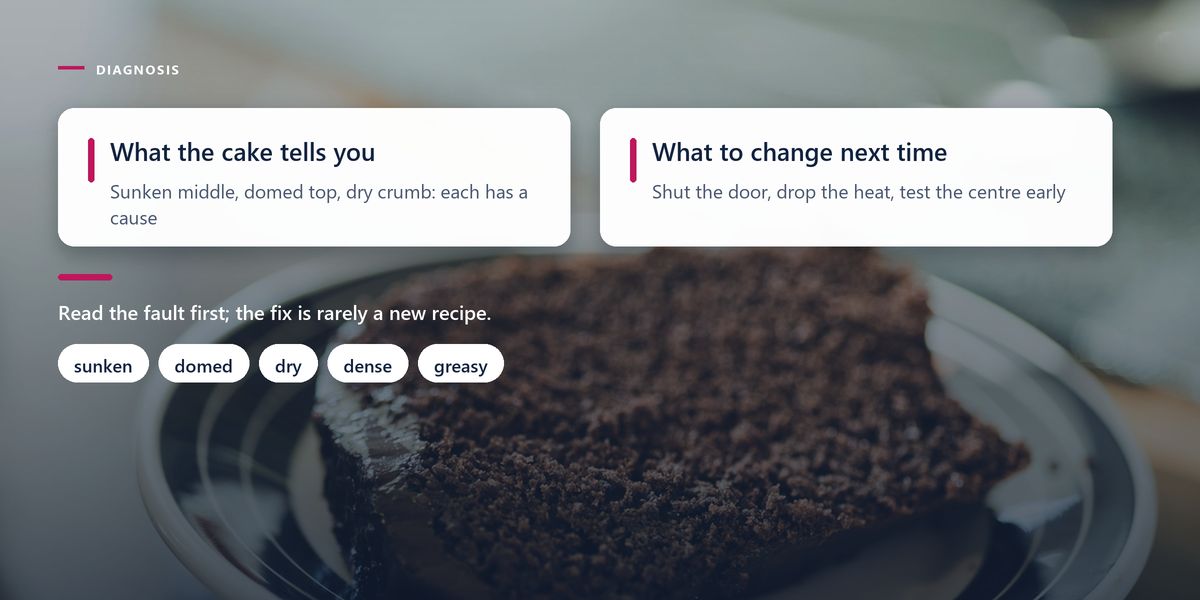
The most common and most demoralising outcome, and it has three usual causes.
The first is opening the oven too early. A rising cake has a structure that has not yet set, and a rush of cool air collapses it. Do not open the door for at least the first two thirds of the baking time — and never in the first half.
The second is too much raising agent. It sounds counter-intuitive, but excess baking powder makes a cake rise faster than its structure can support, and then fall. More lift is not better lift.
The third is simply under-baking. A cake that looks done on top can be liquid at the centre, and it collapses as it cools. Test the middle, not the edge.
It domed and cracked on top
This is usually an oven that is too hot, or a tin that is too small. The outside sets before the centre has finished rising, so the middle pushes up through the crust and splits.
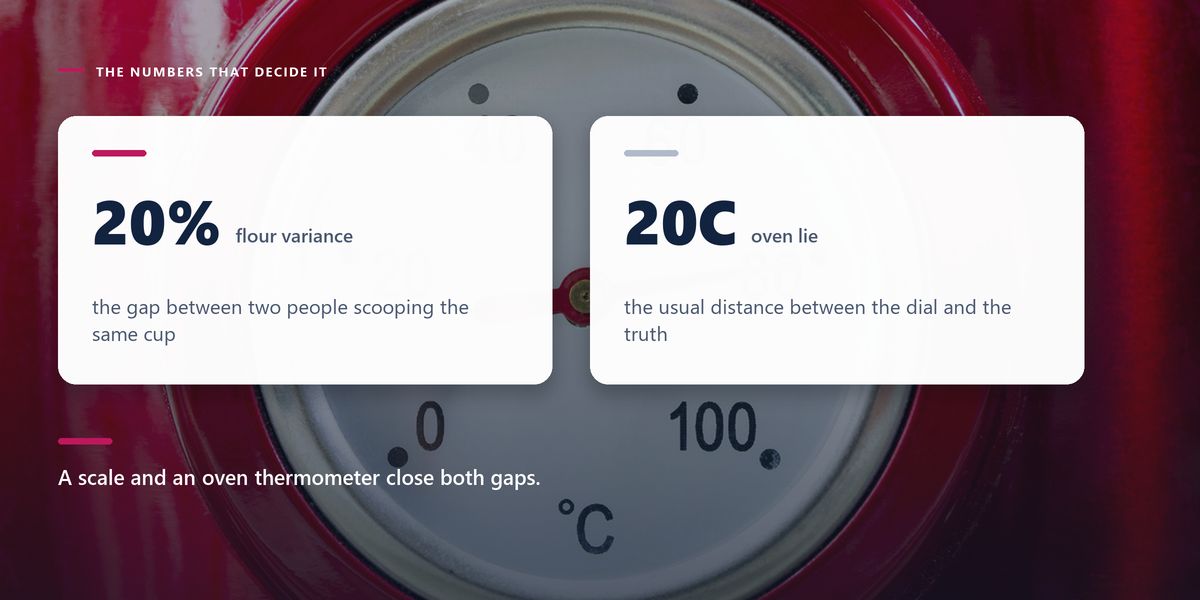
Drop the temperature by around 10 to 20 degrees Celsius and bake a little longer. Many domestic ovens run noticeably hotter than the dial claims, which is why an oven thermometer is one of the cheapest useful things in a kitchen.
- Weigh ingredients — cup measurements vary enormously depending on how you fill them.
- A sunken middle usually means the oven was opened early, or the cake was under-baked.
- A domed, cracked top usually means the oven is too hot.
- Dryness is nearly always over-baking, not too little liquid.
- Over-mixing after the flour goes in makes cakes tough and dense.
It came out dry
Almost always over-baking, even by a few minutes. Cakes continue cooking in the residual heat of the tin after they leave the oven, so a cake that is perfect when tested will be slightly dry by the time it cools.
Test earlier than the recipe says. A skewer should come out with a few moist crumbs clinging to it, not perfectly clean. Perfectly clean means you have gone a little too far.
The second cause is measuring flour by volume. Scooping a cup directly from the bag compacts it and can add 20% more flour than the recipe intended, which produces a dry, heavy cake from a perfectly good recipe.
| Problem | Most likely cause | Fix next time |
|---|---|---|
| Sunken middle | oven opened early, or under-baked | wait; test the centre properly |
| Domed and cracked | oven too hot | reduce by 10 to 20°C, bake longer |
| Dry crumb | over-baked, or too much flour | test early; weigh the flour |
| Dense and tough | over-mixed after adding flour | fold until just combined |
| Greasy edges | butter too soft or over-creamed | butter at cool room temperature |
| Overflowed the tin | tin too small, or too much raising agent | fill to two thirds; measure carefully |
| Uneven rise | oven hot spots | rotate halfway, once it is set |
It is dense and heavy
The usual culprit is over-mixing after the flour is added. Flour contains gluten-forming proteins, and while gluten is what you want in bread, in cake it produces toughness. Once the flour goes in, mix only until it disappears.
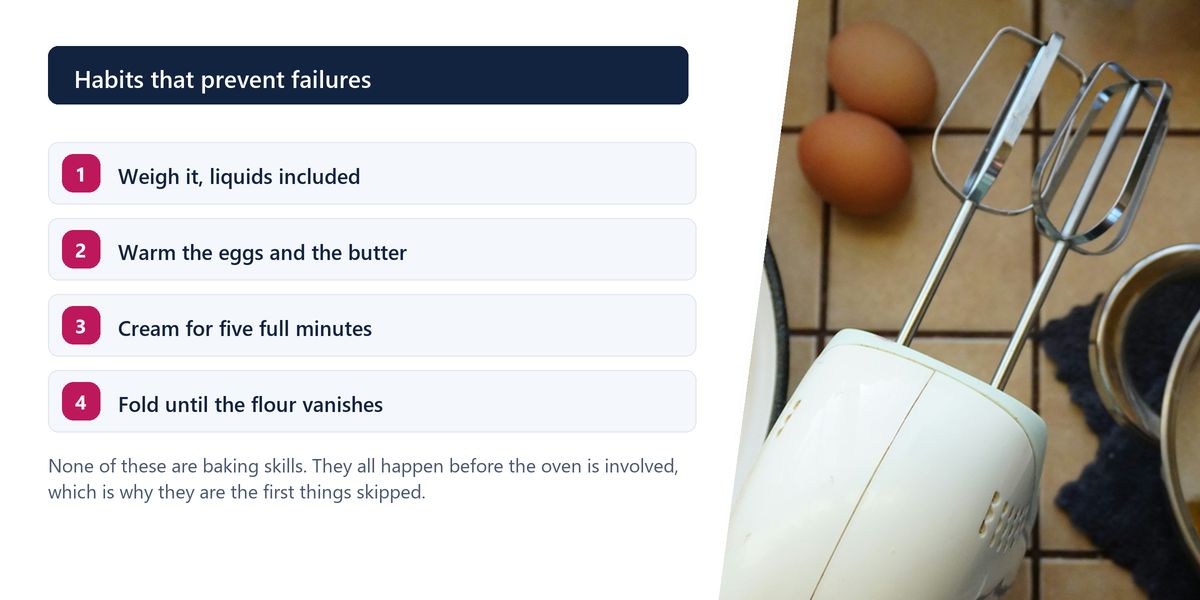
The other frequent cause is ingredient temperature. Cold eggs added to creamed butter cause the mixture to split, which loses the air you spent five minutes beating in. Take eggs, butter and milk out of the fridge an hour beforehand — this small step improves texture more than most people expect.
Weigh everything, including liquids. Volume measurements vary by how the ingredient is packed, and flour is the worst offender — the same cup can differ by 20% between two people. A digital scale removes the single largest source of inconsistency in home baking.
The things recipes assume you know
- 'Room temperature butter' means cool and pliable, holding a finger dent without being greasy — around 18 to 20 degrees, not melted.
- 'Cream until light and fluffy' takes four to five minutes with a mixer, not thirty seconds. This step is where a lot of the cake's lift comes from.
- 'Fold in' means a gentle cutting and turning motion, not stirring. The point is to combine without knocking out air.
- Baking powder and bicarbonate of soda are not interchangeable. Bicarbonate needs an acid in the recipe to work; baking powder brings its own.
- Raising agents expire. A tin opened two years ago has lost most of its power, and the cake will be flat through no fault of yours.
A baker made the same sponge repeatedly at home with disappointing results — always a little dry, always slightly domed — while the identical recipe worked perfectly when she made it at her sister's flat.
The difference was the oven. Hers ran roughly 20 degrees hotter than the dial indicated, which she discovered for a few pounds with an oven thermometer.
Reducing the setting by 20 degrees and testing ten minutes earlier fixed both problems at once. The recipe had never been the issue, and neither had she.
Do not open the oven in the first half of the bake, however tempting. The structure is still liquid and setting, and the temperature drop from an open door is exactly what causes the sunken middle you are checking for.
Summary
Weigh ingredients rather than measuring by volume. Bring eggs and butter to room temperature. Cream properly, then fold gently once the flour is in. Check your oven's real temperature. Do not open the door early, and test for doneness a little before the recipe says.
Conclusion
Cakes fail in patterns, which makes them one of the easier things in a kitchen to get systematically better at. The same cake, made three times with one deliberate change each time, teaches more than ten different recipes.
Buy a scale and an oven thermometer. Between them they solve most of the problems on this page. For a different kind of baking, our beginner's guide to bread covers the yeasted side.