A Beginner's Guide to Baking Bread That Is Actually Good
Four ingredients, one variable that matters most, and rather more patience than skill.

6 min read
—Not yet rated
Four ingredients, one variable that matters most, and rather more patience than skill.
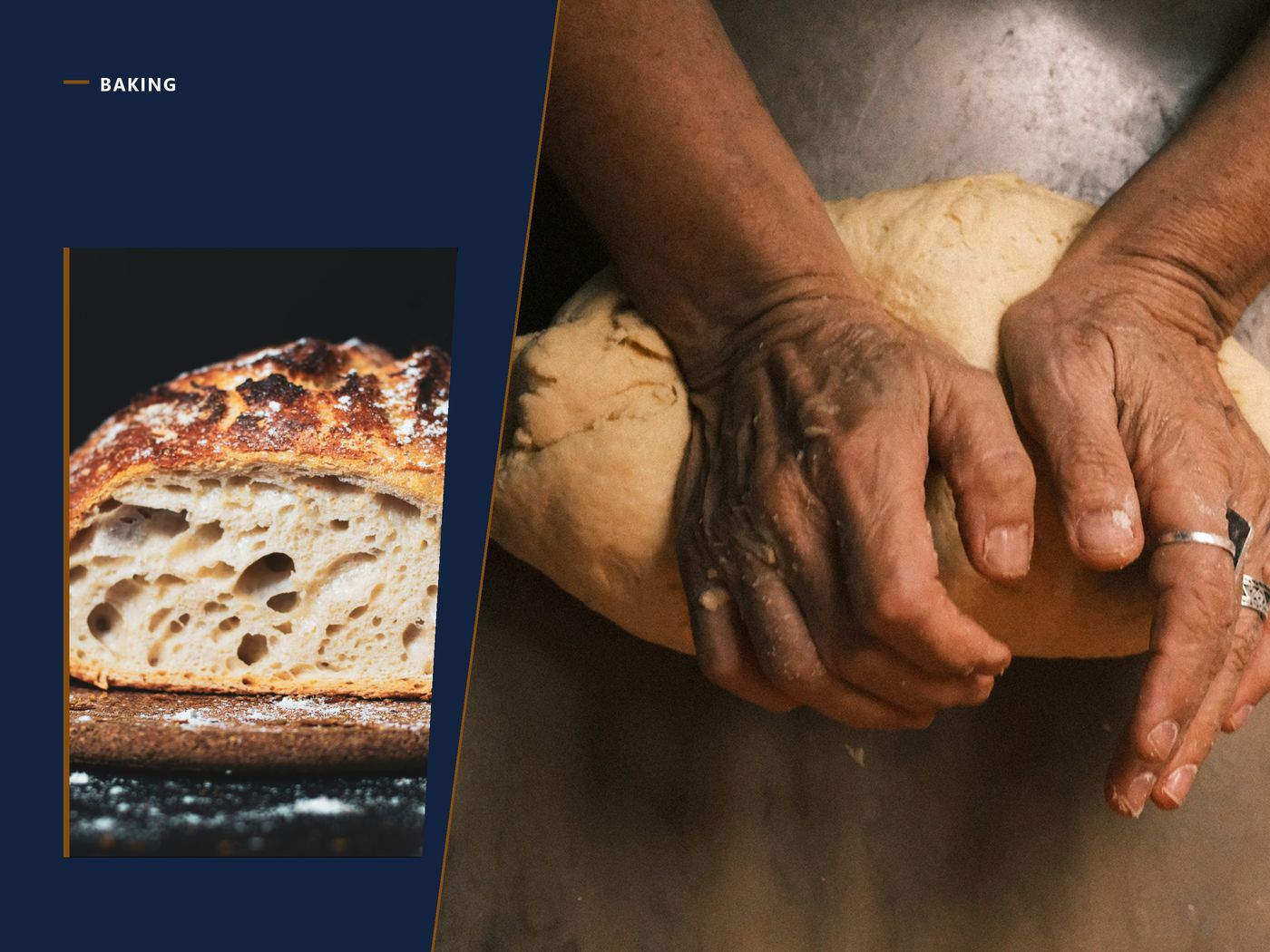
Bread has acquired a reputation for difficulty that it does not entirely deserve. It has four ingredients, no equipment requirement beyond an oven and a bowl, and it has been made successfully by people with no training for several thousand years.
What makes it feel hard is that the recipe is not really the instruction. Bread responds to temperature, to the flour you happened to buy, and above all to time — none of which a recipe can pin down for your kitchen.
So rather than another recipe, here is what each variable does. Understand these and almost any recipe becomes adjustable, which is the actual skill.
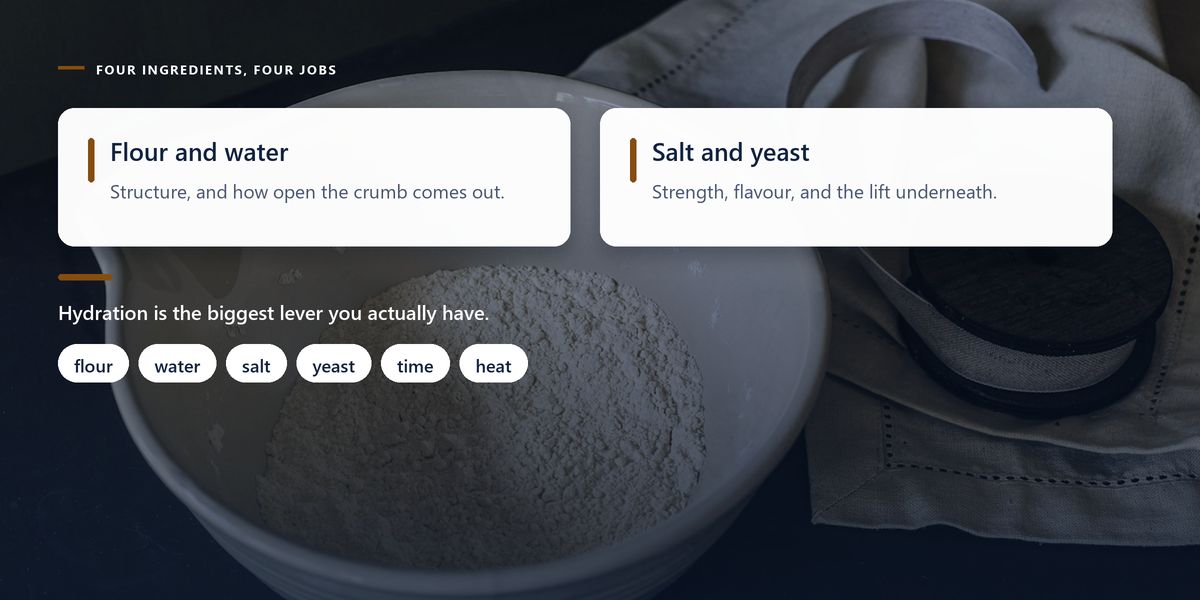
Flour provides the structure, via protein that becomes gluten when hydrated and worked. Bread flour has more protein than plain flour, which is why it produces a chewier, better-risen loaf. You can make bread with plain flour; it will simply be softer and flatter.
Water hydrates the flour and controls how open the crumb becomes. More water gives a more irregular, airy interior and a stickier, harder-to-handle dough. This ratio — the hydration — is the single biggest lever you have.
Salt is not optional and not merely for taste. It tightens the gluten structure and slows fermentation, which improves flavour. Bread made without salt is noticeably flabby and tastes strangely of nothing.
Yeast eats sugars in the flour and produces carbon dioxide, which inflates the dough, plus a range of compounds that create flavour. Less yeast and more time produces better bread than more yeast and less time, almost without exception.
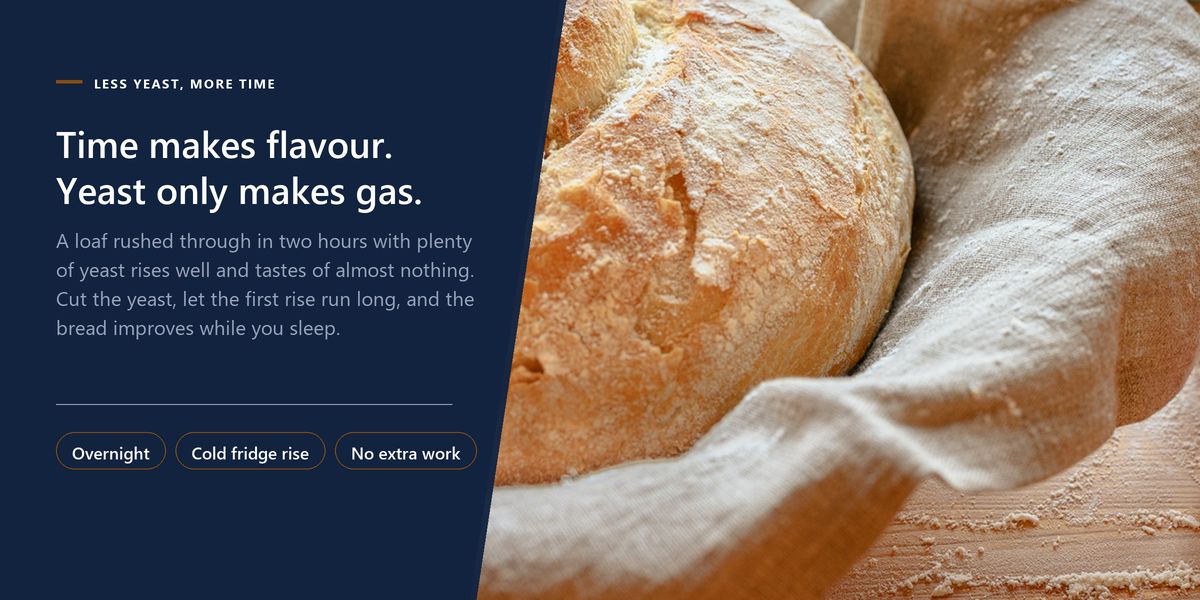
If there is one idea to take from this, it is that flavour in bread comes from fermentation, and fermentation takes time. A loaf rushed through in two hours with a large quantity of yeast will rise perfectly well and taste of very little.
The easiest possible improvement to any bread recipe is to reduce the yeast substantially and let the first rise happen slowly — several hours at room temperature, or overnight in the fridge. You do nothing during that time. The bread gets better while you sleep.
Try a cold overnight first rise. Mix the dough in the evening, leave it in the fridge until the following afternoon, then shape and bake. It requires no extra work, makes the dough easier to handle, and produces noticeably better flavour than any same-day version.
Kneading develops gluten by aligning the proteins. It is not the only way to do that — time does it too, and so does a gentler technique of stretching and folding the dough a few times during the first hour.
For a wet dough, stretching and folding is easier and produces a better result than trying to knead something that sticks to everything. Wet your hands, lift one edge of the dough, stretch it up and fold it over, rotate the bowl, repeat four times. Do that three or four times, spaced twenty to thirty minutes apart, and then leave it alone.
This is where most home bread goes wrong, and the reason is that recipes give times while dough responds to temperature. A dough that takes an hour in a warm kitchen may take three in a cold one. Following the clock in the wrong kitchen produces under-proved or over-proved bread.
| Stage | What to look for | What goes wrong |
|---|---|---|
| First rise done | roughly doubled, jiggly, domed | too short: dense; too long: sour and slack |
| Shaped and ready | puffy, slowly springs back when poked | too short: bursts open; too long: collapses |
| Ready for the oven | an indent fills back about halfway | guessing from the clock alone |
| Baked through | deep brown, hollow when tapped underneath | pale crust means under-baked |
The poke test is the most reliable tool you have. Press a floured finger gently into the shaped dough. If the dent springs back immediately, it needs longer. If it stays completely, it has gone too far. If it fills back roughly halfway, bake it.
Home ovens are the main disadvantage amateurs face, on two counts: they are not hot enough and they are too dry. Both are fixable.
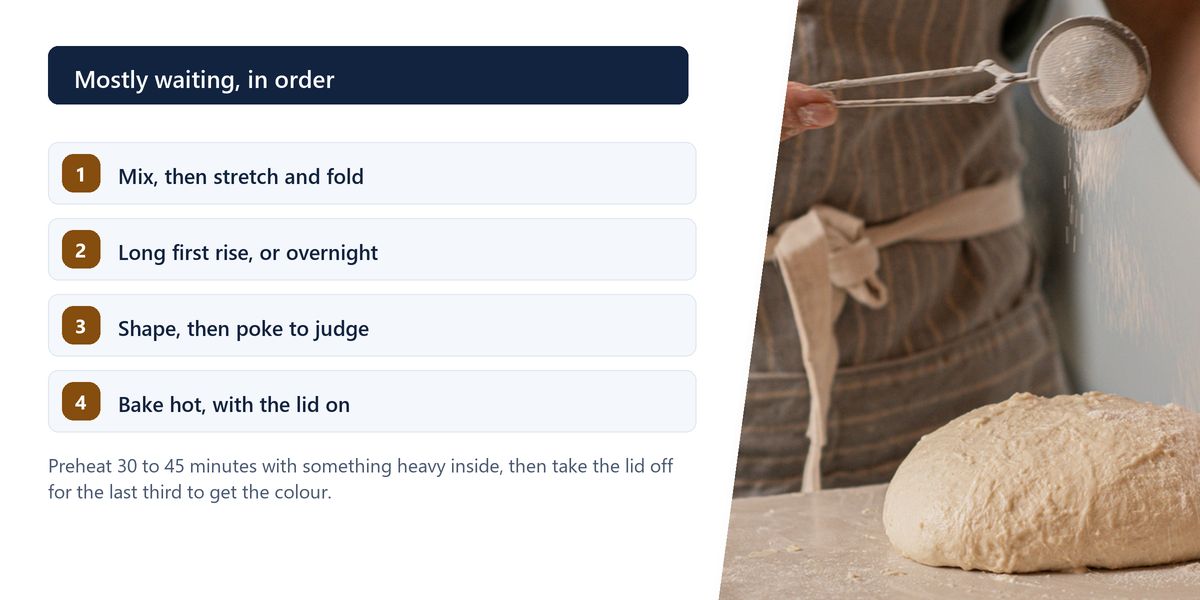
Preheat far longer than feels necessary — a full 30 to 45 minutes at maximum temperature, ideally with a heavy tray or stone inside to store heat. The initial blast is what produces oven spring, the dramatic final rise that happens in the first minutes.
For steam, the simplest reliable method is to bake inside a preheated lidded casserole dish. The dough's own moisture is trapped, keeping the crust soft long enough for the loaf to expand fully, and removing the lid for the final third produces the colour. It works better than spraying water into an oven that immediately vents it.
A first-time baker made the same recipe three weekends running. The first loaf was pale, dense and slightly gummy inside. The second was better but flat and spread sideways on the tray.
Nothing about the ingredients changed. The third time she preheated the oven for 45 minutes instead of 10, baked in a lidded casserole, and used the poke test rather than the recipe's stated 90 minutes — which turned out to be nearly two and a half hours in her cold kitchen.
The third loaf rose properly, had a crackling crust and an open crumb. The recipe had been fine all along; the kitchen was the variable nobody had told her about.
Cutting into a hot loaf is the last common mistake. The interior is still setting as it cools, and slicing early gives you a gummy, compressed crumb from bread that was actually baked correctly. Wait at least an hour. It is genuinely worth it.
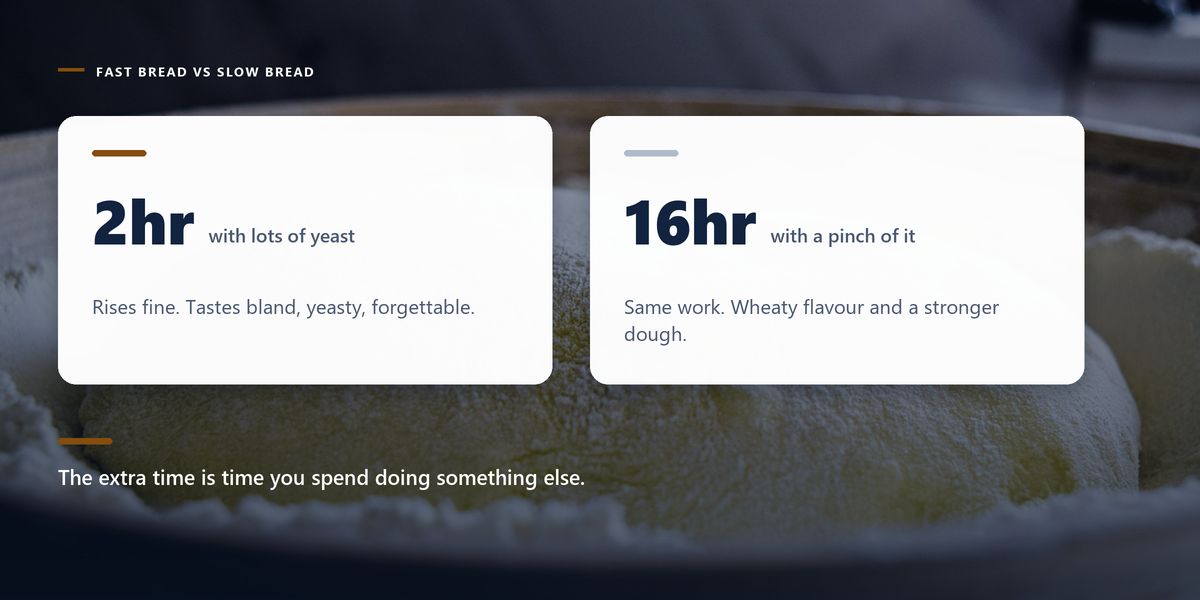
Flour gives structure, water controls the crumb, salt gives strength and flavour, and yeast provides lift. Use less yeast and more time. Stretch and fold rather than fighting a sticky dough. Judge proving by the poke test rather than the clock. Preheat hard, bake with steam, and let it cool before cutting.
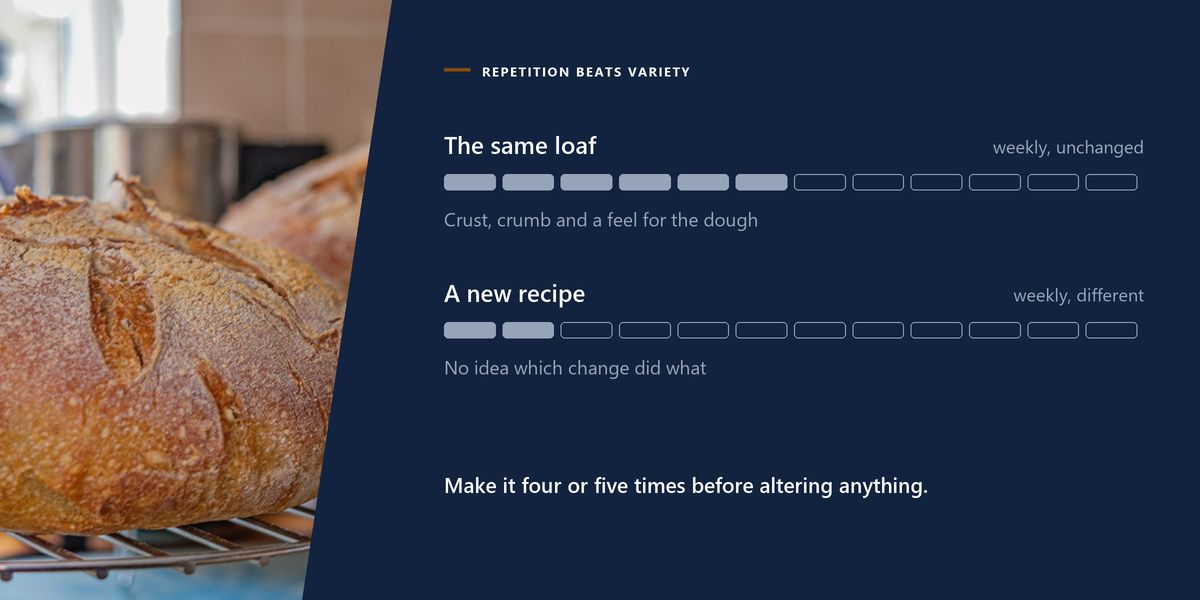
Good bread is not the reward for technical skill. It is the reward for patience and for paying attention to the dough rather than the recipe.
Make the same loaf four or five times before changing anything. Repetition is what turns a set of instructions into a feel for it — and the feel is the part that makes every subsequent loaf good. For everyday cooking, our weeknight cooking system takes the same approach.
Tap a star to share what you thought.
No ratings yet
Plain flour makes perfectly edible bread, just softer and flatter. Bread flour has more protein, which forms more gluten and gives a chewier texture and better rise, so it is worth using once you are baking regularly.
Usually under-proving or under-developed gluten. Judge the rise by how the dough looks and responds to a gentle poke rather than by the time in the recipe — cold kitchens can double or triple stated proving times.
Not necessarily. Gluten develops through time as well as through work. A series of stretch-and-fold movements during the first hour, combined with a long rise, produces excellent structure with far less effort, especially for wet doughs.
Bake in a fiercely preheated lidded casserole dish. Trapping the dough's own steam keeps the crust soft long enough for the loaf to expand, and removing the lid for the last third of the bake develops colour and crispness.
Press a floured fingertip gently into the shaped dough. If the dent springs straight back it needs more time; if it stays completely the dough is over-proved; if it fills back about halfway it is ready to bake.
Usually not. Sourdough adds an unpredictable variable — the starter — on top of everything else you are learning. Master a simple yeasted loaf with a long cold rise first, then move to sourdough once reading the dough feels natural.
Sign in to join the conversation.
Loading responses…
Have a story, idea, or something valuable to share? Join The Blog Story for free, publish your content, reach more readers, and earn a share of advertising revenue from eligible content.
Create quality content. Grow your audience. Grow your earning potential.