
—Not yet rated
Loading…
Almost every failed balcony garden begins the same way: someone buys the plants they would like to eat, puts them somewhere convenient, and waters them when they remember. By August there are three leggy survivors and a lot of expensive compost.
The order is backwards. In a small space, light is the fixed constraint and everything else adapts to it. Decide what to grow after you know what you have, not before.
Done that way, a balcony produces a genuinely useful amount — herbs all summer, salad continuously, and a real crop of one or two things you chose well.
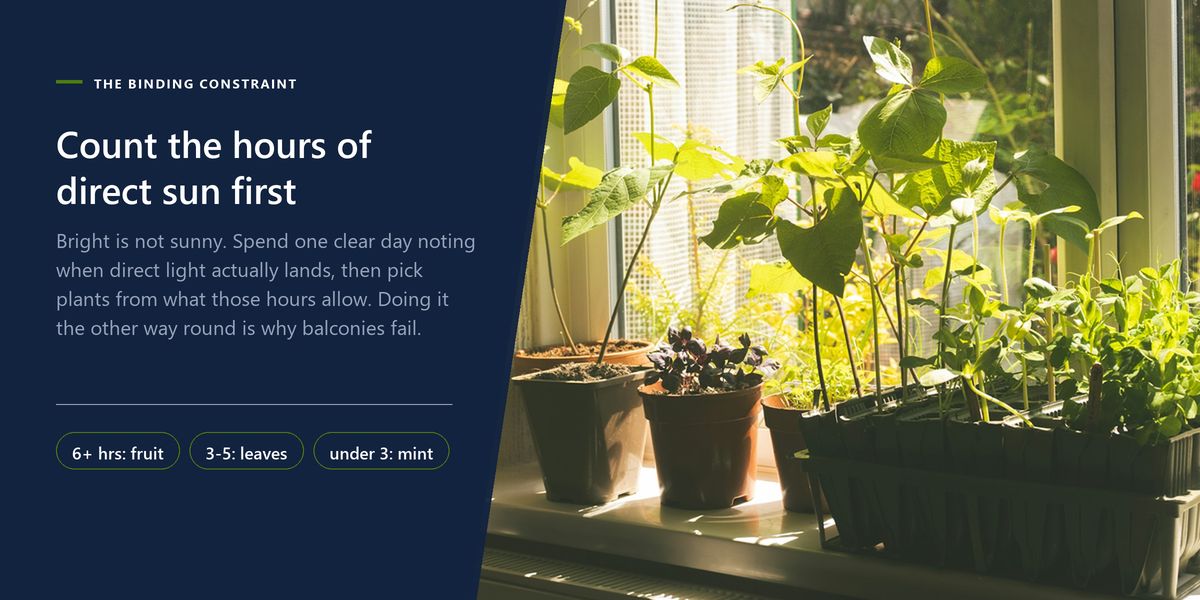
Spend one sunny day noting when direct sunlight actually hits the space and for how long. Not brightness — direct sun. A north-facing balcony can feel perfectly bright and receive almost no direct light at all, and that distinction decides everything.
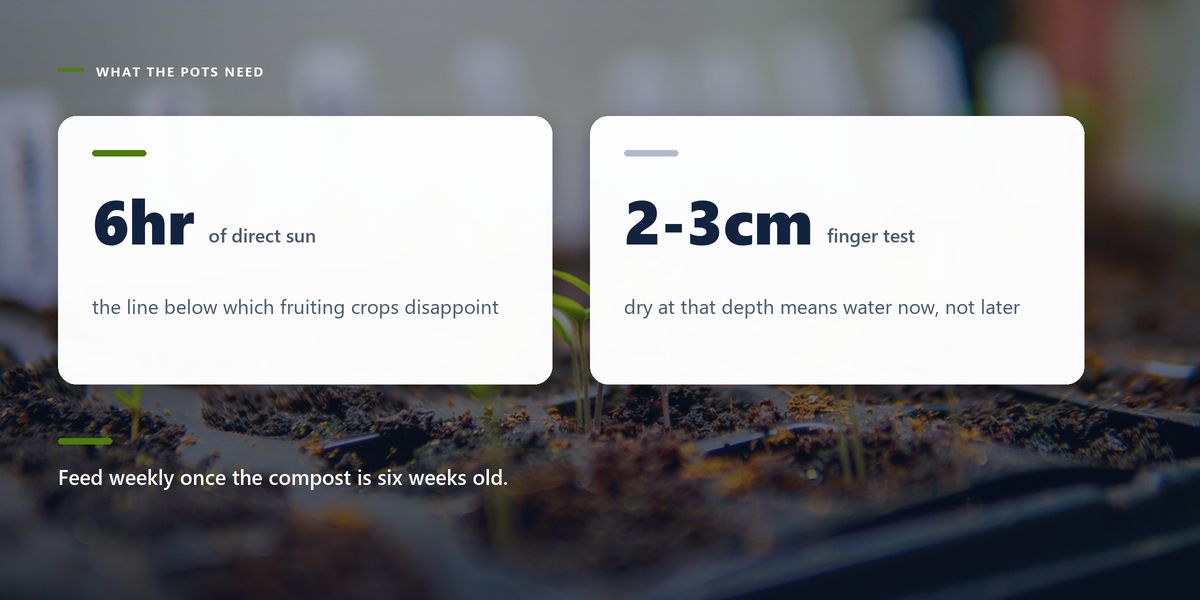
Then match honestly. Six or more hours of direct sun opens up tomatoes, peppers, chillies and most fruiting crops. Three to five hours suits leafy greens, herbs and root vegetables. Under three hours means salad leaves, mint, chives and shade-tolerant ornamentals — which is a perfectly good garden, just a different one.
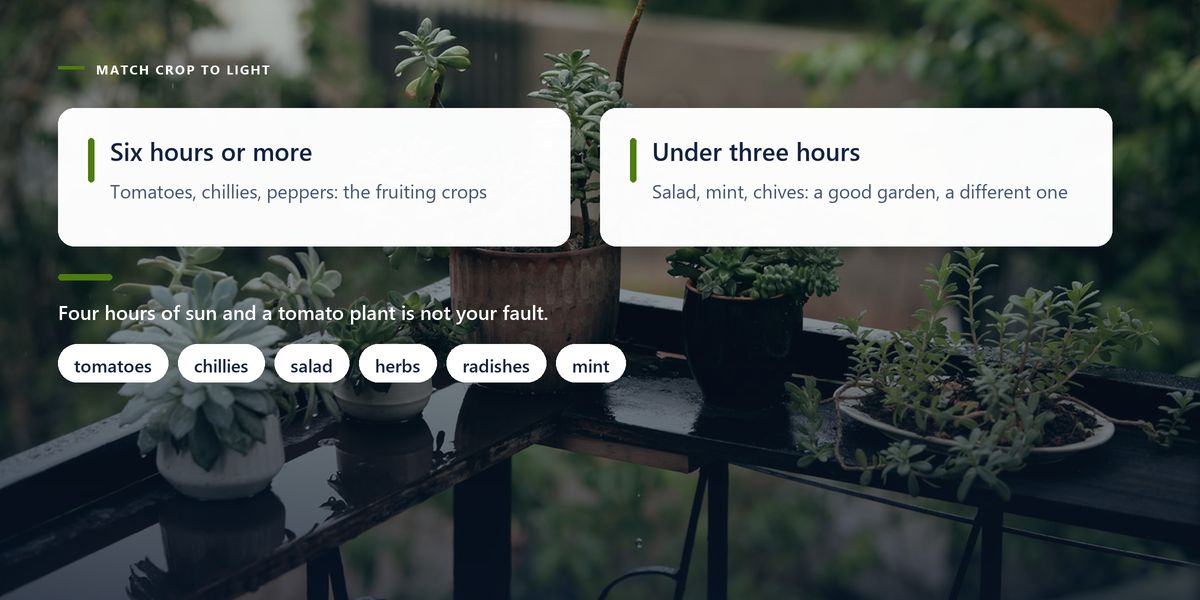
Trying to grow tomatoes in four hours of sun is the most common small-space disappointment. The plant will grow, flower and produce three small fruits in October, and it is not your fault.
The most common small-space mistake after light is using pots that are too small. A small pot holds little water, heats up quickly and dries out within hours in summer, which means the plant lurches between drought and flood.
Bigger containers are more forgiving in every direction: more water storage, more root room, more stable temperature. If you are choosing between a beautiful small pot and a plain large one, take the large one.
| Crop | Minimum pot size | Notes |
|---|---|---|
| Herbs (basil, parsley) | 2 to 3 litres | several can share a window box |
| Salad leaves | shallow tray, 15cm deep | cut and come again for weeks |
| Chillies and peppers | 10 litres | needs the sunniest spot you have |
| Tomatoes | 20 to 30 litres | one plant per pot, and stake it |
| Potatoes | 30 litres or a sack | surprisingly reliable and satisfying |
| Mint | its own pot, always | will strangle anything it shares with |
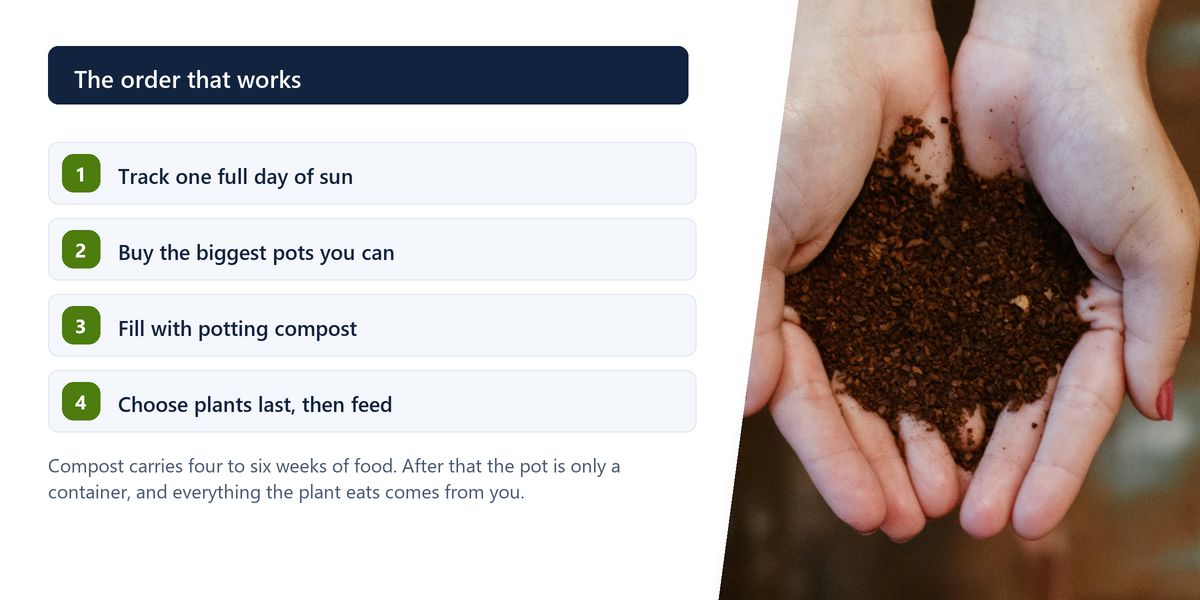
Use proper potting compost rather than soil dug from a garden. Garden soil compacts in containers, drains poorly and brings weed seeds and pests. Compost is designed to hold structure and air when confined, which is exactly the problem a pot creates.
Container plants depend entirely on you, and both over- and under-watering kill. The reliable test is your finger: push it two or three centimetres into the compost. If it is dry at that depth, water. If it is damp, wait.
When you do water, water thoroughly — until it runs from the drainage holes. Frequent light watering wets only the surface and encourages shallow roots, which makes the plant more vulnerable rather than less.
And every container must drain. A pot without holes is a slow drowning, and it is the single most common way houseplants and balcony plants are killed by attentive owners.
In the ground, plants draw nutrients from a very large volume of soil. In a pot they have a few litres, and every watering washes some of it out of the bottom.
Most potting compost contains enough feed for roughly four to six weeks. After that, plants need feeding — a general liquid feed every week or two through the growing season, and a high-potassium tomato feed once fruiting crops start to flower.
Yellowing lower leaves on a plant that is otherwise healthy and well-watered is usually hunger rather than disease.
What to avoid at first: sweetcorn and squash (too big), carrots (need depth and even moisture), and anything sold as a novelty grafted plant, which tends to need more attention than a beginner space allows.
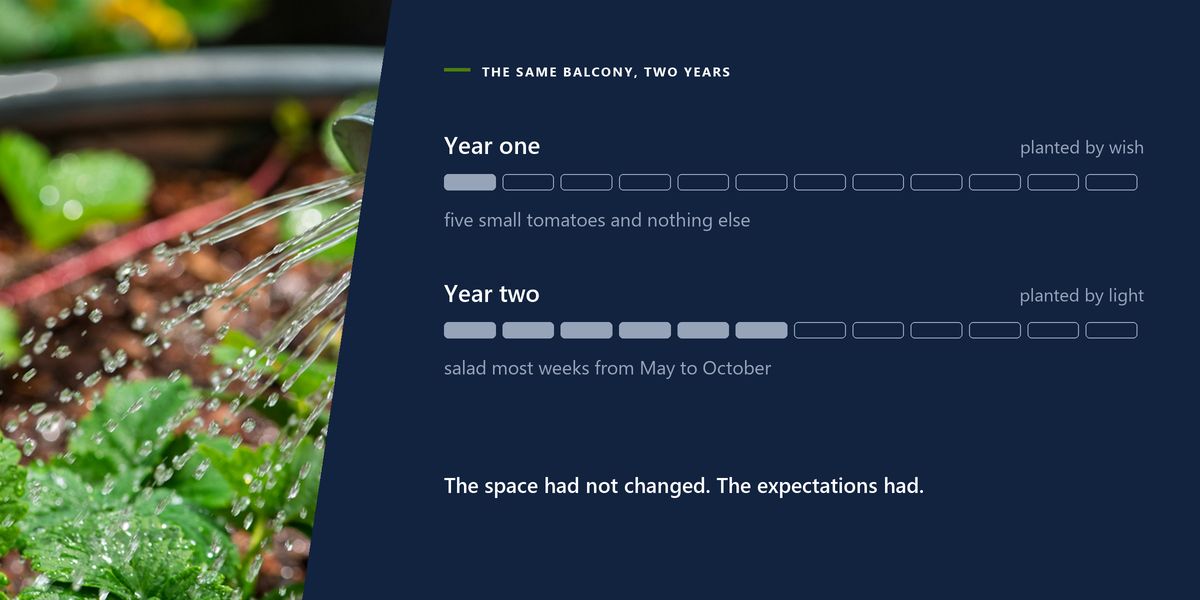
A flat renter spent a first summer growing tomatoes, courgettes and aubergines on a balcony that received about four hours of morning sun. She harvested five small tomatoes and nothing else, and assumed she had done something wrong.
The following spring she tracked the light properly and rebuilt around it: two large troughs of salad leaves and rocket, a big pot of mixed herbs, chives and spring onions, and a single chilli plant in the one genuinely sunny corner.
She cut salad most weeks from May to October, stopped buying supermarket herbs altogether, and got about forty chillies from one plant. The space had not changed; the expectations had.
Check what your balcony can carry before filling it with large containers. Wet compost is heavy — a 30-litre pot can weigh over 30 kilograms once watered — and if you are renting, water running off a balcony onto the flat below is a reliable way to have a difficult conversation. Use saucers or trays.
Small spaces reward succession rather than a single planting. Sow a short row of salad every two or three weeks instead of all at once, and you get a continuous supply rather than a glut followed by nothing.
In colder months, hardy herbs, winter salad and spring bulbs keep the space alive. A balcony that is bare from October to April is usually a planning gap rather than a limitation of climate.
Count your hours of direct sun and choose plants to match. Use the largest containers you can, filled with proper potting compost and drilled for drainage. Water deeply when the compost is dry a few centimetres down, feed regularly after the first month, and start with salad, herbs and one ambitious crop.
Small-space gardening rewards realism far more than enthusiasm. The balcony that produces something every week belongs to whoever matched their plants to their light, not to whoever wanted it most.
Start with the light, start small, and add one more ambitious plant each year. If you are also making the indoors work harder, our guide to renter-friendly interior design takes a similar approach.
Tap a star to share what you thought.
No ratings yet
Salad leaves, spinach, chard, mint, chives, parsley and many ornamentals do well in three hours of direct sun or less. Fruiting crops like tomatoes and peppers genuinely need six hours or more, and will disappoint in shade regardless of care.
Bigger than most people expect. Herbs manage in two to three litres, but tomatoes want 20 to 30 litres and potatoes around 30. Larger containers hold water longer and buffer temperature, which makes them far more forgiving.
Better not to. Garden soil compacts in pots, drains poorly and can introduce weed seeds and pests. Potting compost is formulated to keep structure and air space when confined, which is exactly what a container needs.
Test rather than schedule. Push a finger two or three centimetres into the compost and water thoroughly only if it is dry at that depth. In hot weather small pots may need daily watering; in cool weather, far less.
If watering is correct and the lower leaves are yellowing, it is usually nutrient depletion. Potting compost carries about four to six weeks of feed, after which container plants need a regular liquid feed through the growing season.
Salad leaves and herbs. They tolerate partial shade, grow quickly enough to be encouraging, need only shallow containers, and replace something you would otherwise buy — which makes the whole thing feel worthwhile within weeks.
Sign in to join the conversation.
Loading responses…
Have a story, idea, or something valuable to share? Join The Blog Story for free, publish your content, reach more readers, and earn a share of advertising revenue from eligible content.
Create quality content. Grow your audience. Grow your earning potential.