Running Your First 5K: A Plan for People Who Do Not Consider Themselves Runners
Nearly everyone starts too fast. That single mistake accounts for most abandoned attempts.

5 min read

—Not yet rated
Nearly everyone starts too fast. That single mistake accounts for most abandoned attempts.
There is a specific memory a lot of people carry: trying to start running, being spectacularly out of breath within about four minutes, and concluding that running is for other people with different lungs.
That experience is almost universal, and it is not evidence of anything except pace. The overwhelming majority of beginners run far too fast, because the pace that feels like running is well above what an untrained aerobic system can sustain.
Slow down enough and something surprising happens: the distance stops being the limiting factor. Here is how to get to 5K from a standing start.
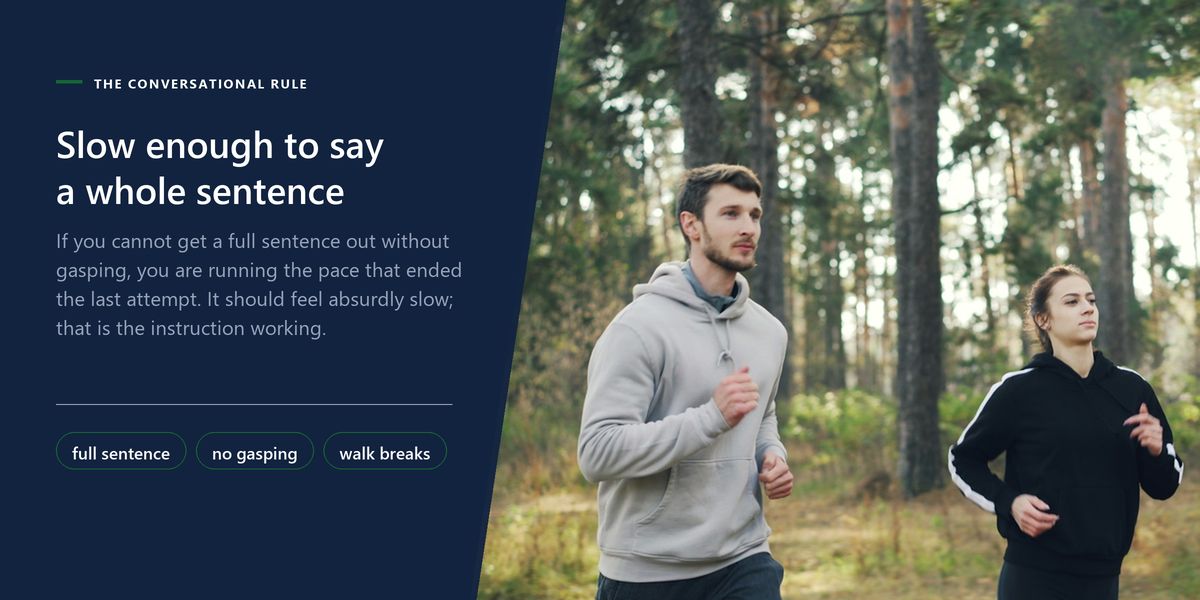
The single most useful instruction for a new runner: you should be able to speak a full sentence while running. Not comfortably, not while singing, but a complete sentence without gasping.
For most beginners this pace feels absurdly slow — barely faster than a brisk walk, and often slower than walking briskly downhill. That feeling is the point. It is the pace at which your body builds aerobic capacity rather than accumulating fatigue faster than it can clear it.
Almost everyone who says they hate running has only ever run at a pace they could not sustain. It is genuinely a different activity at conversational effort, and much of the misery disappears.
Alternating running and walking is a legitimate, well-established training method, not a beginner's compromise to be escaped as quickly as possible. It lets you accumulate far more total running time at a manageable effort than trying to run continuously would.
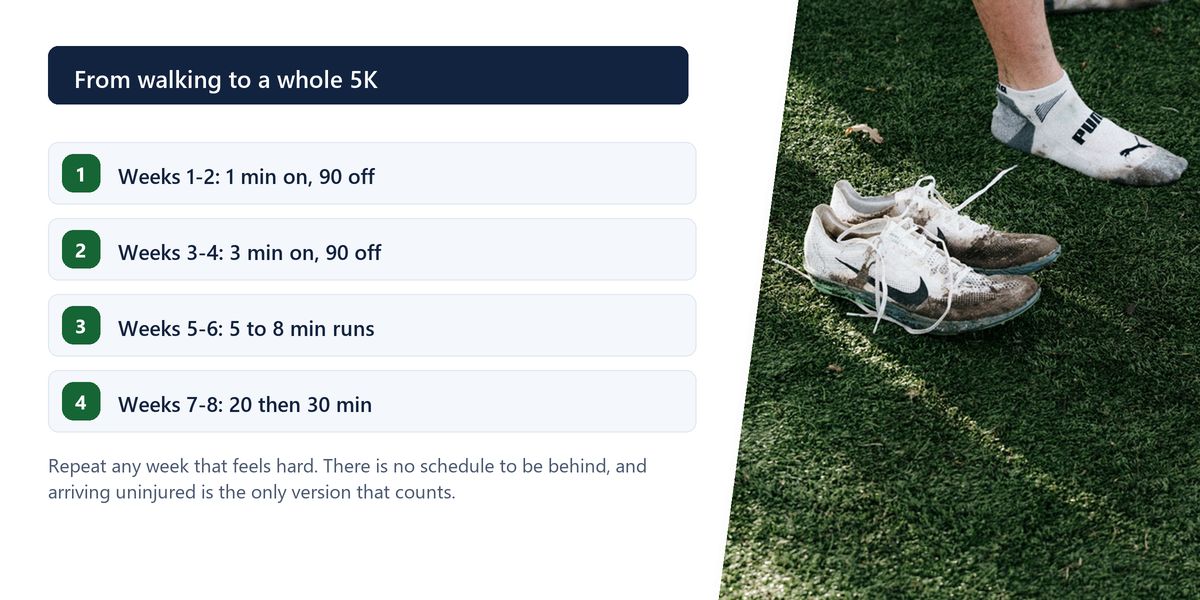
A typical progression starts with something like one minute of running and ninety seconds of walking, repeated for twenty minutes. Over several weeks the running intervals lengthen and the walking ones shrink, until the walk disappears — which happens naturally rather than through force.
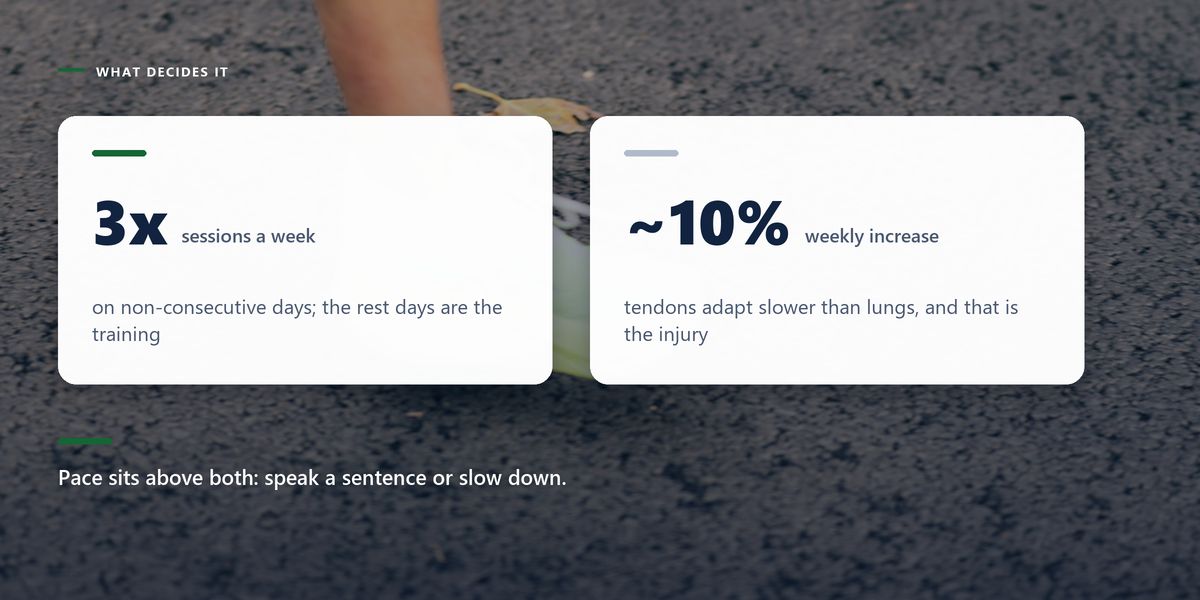
Any sensible programme follows the same logic: run three times a week on non-consecutive days, keep the effort conversational, and extend the running intervals gradually.
| Weeks | Session structure | Total time |
|---|---|---|
| 1 to 2 | 1 min run / 90 sec walk, repeated | about 20 minutes |
| 3 to 4 | 3 min run / 90 sec walk, repeated | about 25 minutes |
| 5 to 6 | 5 to 8 min run / 2 min walk | about 28 minutes |
| 7 | 20 minutes continuous, slowly | about 30 minutes |
| 8 | 25 to 30 minutes continuous | 5K, or close to it |
The rest days matter as much as the sessions. Adaptation happens during recovery, not during the run, and running on consecutive days early on is one of the more reliable routes to an overuse injury.
If a week feels hard, repeat it rather than progressing. There is no schedule you are behind. Repeating week four twice and arriving injury-free is a far better outcome than pushing through and losing a month to a sore shin.
A widely used guideline is to increase weekly running volume by no more than about 10%. It is not a precise law, and it points at something real: the aerobic system adapts faster than tendons, ligaments and bones do.
This mismatch is why enthusiastic beginners get injured. Your lungs feel ready for more well before your connective tissue is, and the feeling of being capable is not the same as being adapted.
Practically: increase either how long you run or how hard, never both in the same week, and treat any new persistent ache as a signal to hold steady rather than push.
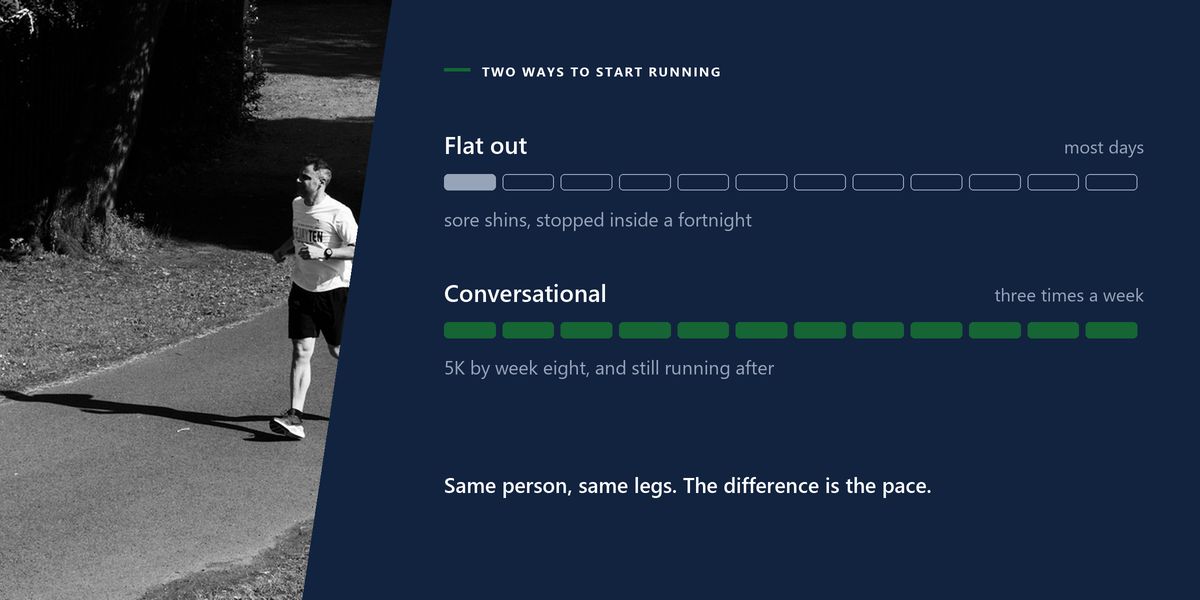
A graphic designer had twice tried to take up running and twice stopped within a fortnight, both times after a week of sore shins and the settled conclusion that she was not built for it.
The third attempt changed only one thing. She ran at a pace slow enough to recite her address out loud, which felt, in her words, faintly ridiculous — several people walking briskly overtook her in the first week.
She reached a continuous 5K in nine weeks without ever being properly out of breath. Her pace at the end was considerably faster than the pace at which she had failed twice before.
Distinguish general muscle soreness from localised pain. Aching legs a day after a run are expected. Sharp or persistent pain in a specific spot — particularly the shin, knee or the underside of the heel — means stop and rest, and see a physiotherapist if it does not settle within a week or two of easier activity.
The main risk after finishing is a sudden increase in ambition — signing up for a half marathon the following month, or trying to run every day. Both are common and both are how people who have just succeeded end up injured.
A better next step is consolidation: keep running 5K comfortably three times a week for a month before extending anything. Boring, and it is what turns a completed challenge into a lasting habit.
Run slowly enough to speak in full sentences. Use run-walk intervals without treating them as a compromise. Train three times a week with rest days between. Progress gradually, repeating weeks that feel hard. Buy comfortable shoes and ignore the rest of the kit industry.
Almost nobody is genuinely unable to run 5K. What most people are unable to do is run 5K at the pace they instinctively start at, which is a completely different statement and one worth separating.
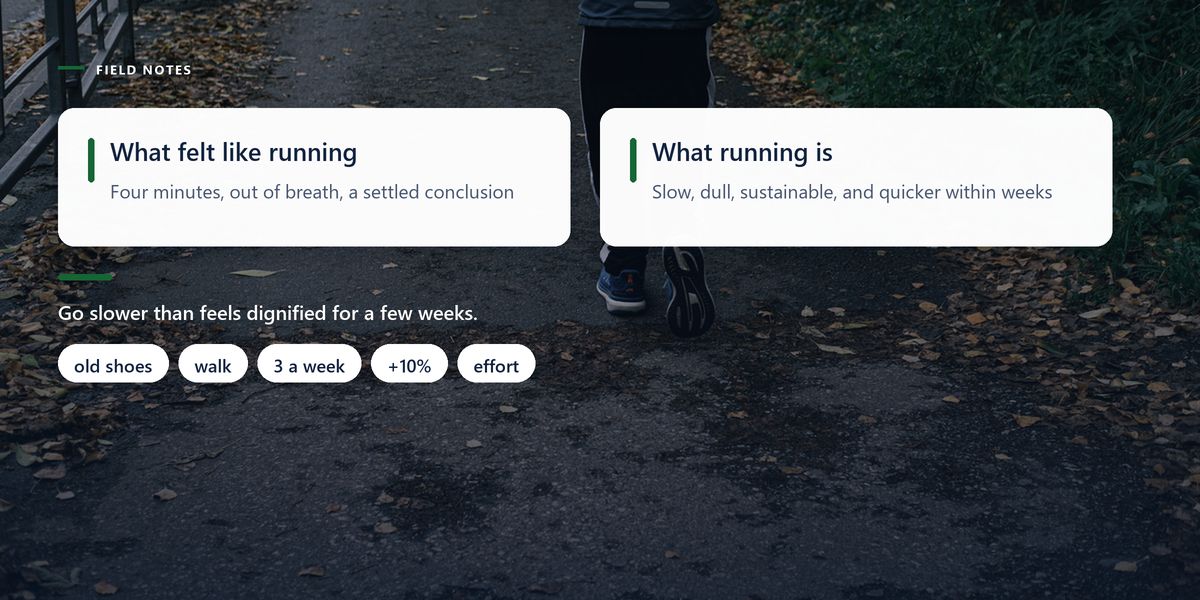
Go slower than feels dignified for a few weeks. The speed arrives on its own afterwards. If keeping the habit is the harder part, our guide to building an exercise habit that lasts covers exactly that.
Tap a star to share what you thought.
No ratings yet
Slowly enough to speak a full sentence without gasping. For most beginners this feels absurdly slow, sometimes barely faster than brisk walking, and that is exactly the pace at which aerobic fitness is built rather than fatigue accumulated.
Yes — run-walk is an established training method used by experienced runners too, not a beginner's compromise. Alternating lets you accumulate far more running time at a sustainable effort than attempting continuous running would.
Three sessions on non-consecutive days is ideal for a beginner. Adaptation happens during recovery rather than during the run, and running on consecutive days early on is a common route to overuse injuries.
Around eight to ten weeks for most people following a gradual run-walk progression three times a week. Repeating a week that feels hard is entirely normal and better than pushing through and picking up an injury.
You need shoes that are comfortable on your feet. Comfort is a better guide than technical features, and there is no strong evidence that expensive stability shoes reduce injury. Replace them when the cushioning feels flat, roughly every 500 to 800 kilometres.
Stop and rest rather than running through it. Shin pain is usually a sign that load increased faster than your bones and connective tissue adapted. If it does not settle within a week or two of easier activity, see a physiotherapist.
Sign in to join the conversation.
Loading responses…
Have a story, idea, or something valuable to share? Join The Blog Story for free, publish your content, reach more readers, and earn a share of advertising revenue from eligible content.
Create quality content. Grow your audience. Grow your earning potential.