Building an Exercise Habit That Survives a Bad Week
Motivation is a starting fuel, not an engine. Design for the days you do not feel like it.

6 min read

—Not yet rated
Motivation is a starting fuel, not an engine. Design for the days you do not feel like it.
The pattern is so common it is almost a genre. Someone starts training in January with real enthusiasm, goes four times a week for three weeks, then has one difficult week — a deadline, a cold, a family thing — and never quite starts again.
The instinct afterwards is to blame willpower. Almost always the real problem is design. The plan was built for a version of life in which nothing goes wrong, and life is mostly the other kind.
What follows is not a training programme. It is the set of structural decisions that determine whether any programme survives contact with an ordinary year.

The single most reliable predictor of whether someone is still training in six months is not how hard they trained in week one. It is how easily they could repeat it in week two.
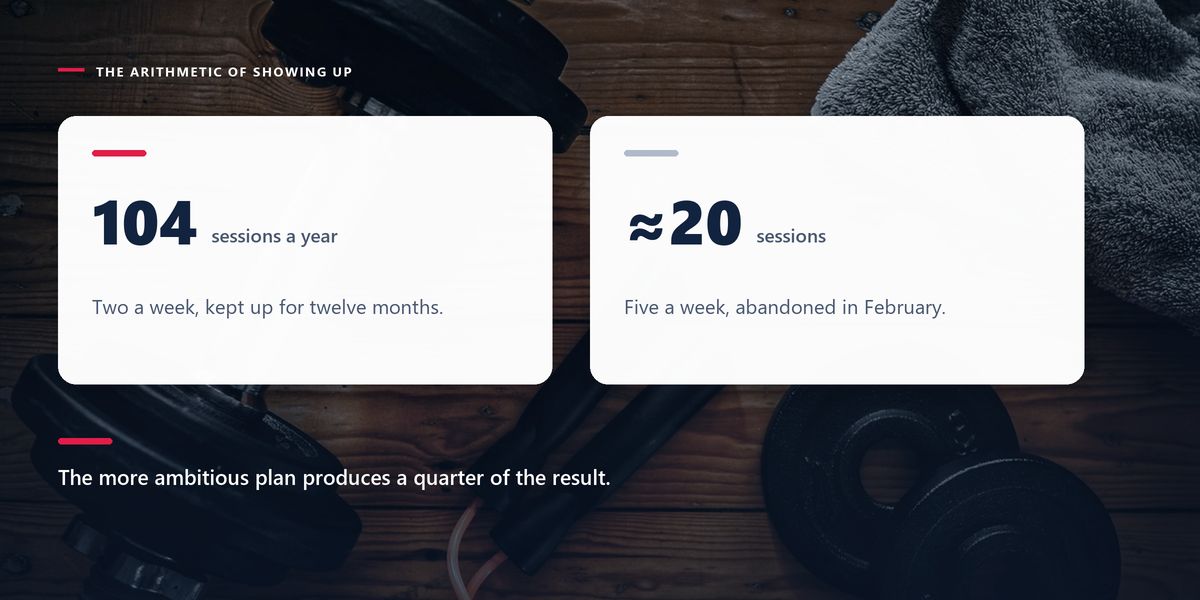
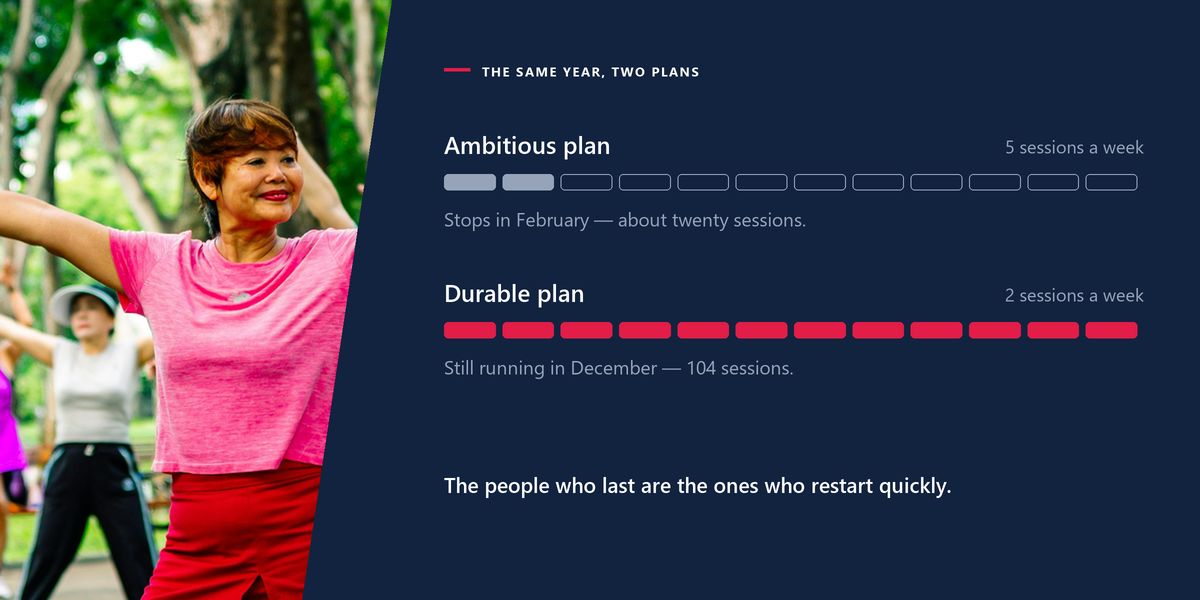
Two sessions a week, done for a year, is 104 sessions. Five sessions a week, abandoned in February, is about twenty. The second plan feels more ambitious and produces a quarter of the result. Ambition that does not survive is not ambition; it is a rehearsal.
Start at roughly half what you think you can sustain. If it feels slightly too easy after a month, you have a foundation to build on — which is a far better problem than rebuilding from zero in March.
This is the single most useful idea in habit formation, and it is barely about exercise at all. Decide in advance what the smallest acceptable version of a session looks like: ten minutes, one set of three exercises, a walk around the block.
The minimum session exists for the days when the full one is not happening. Its purpose is not fitness — ten minutes will not transform anyone. Its purpose is that you do not become a person who skipped.
On a bad day, do the minimum session rather than nothing, and do not treat it as a failure. The habit is the asset. Protecting the chain of showing up is worth far more than any individual workout you could have done instead.
A plan to exercise when there is time is a plan to exercise rarely, because time does not appear — it is claimed. The habits that stick are attached to something already fixed in the day.
Before breakfast. Immediately after the school drop-off. Straight from work, without going home first, because going home first is where the plan quietly dies. The anchor matters more than the hour.
The same applies to friction. Kit laid out the night before, a gym on the route you already travel, a session that needs no decisions when you arrive. Every choice you have to make at the moment of starting is a place the habit can fail.
Missing one session is entirely normal and means nothing. What matters is what happens next, because the second consecutive miss is where a break becomes a stop.
So make one rule: never miss twice in a row. If Tuesday did not happen, Wednesday is not optional, even if Wednesday is only the minimum session. This single rule does more work than any amount of self-criticism.
| Situation | The instinct | What works better |
|---|---|---|
| Missed one session | make it up with a double | carry on with the next scheduled one |
| Missed a whole week | restart the plan from week one | resume at roughly 70% and rebuild |
| Too tired to train | skip entirely | do the minimum session |
| Bored of the routine | abandon it | change the exercises, keep the schedule |
| Sore from last time | push through hard | train something else, or move gently |
Bodies adapt to what they repeatedly do, then stop adapting if nothing changes. That is the entire principle behind progressive overload, and it does not require complicated tracking.
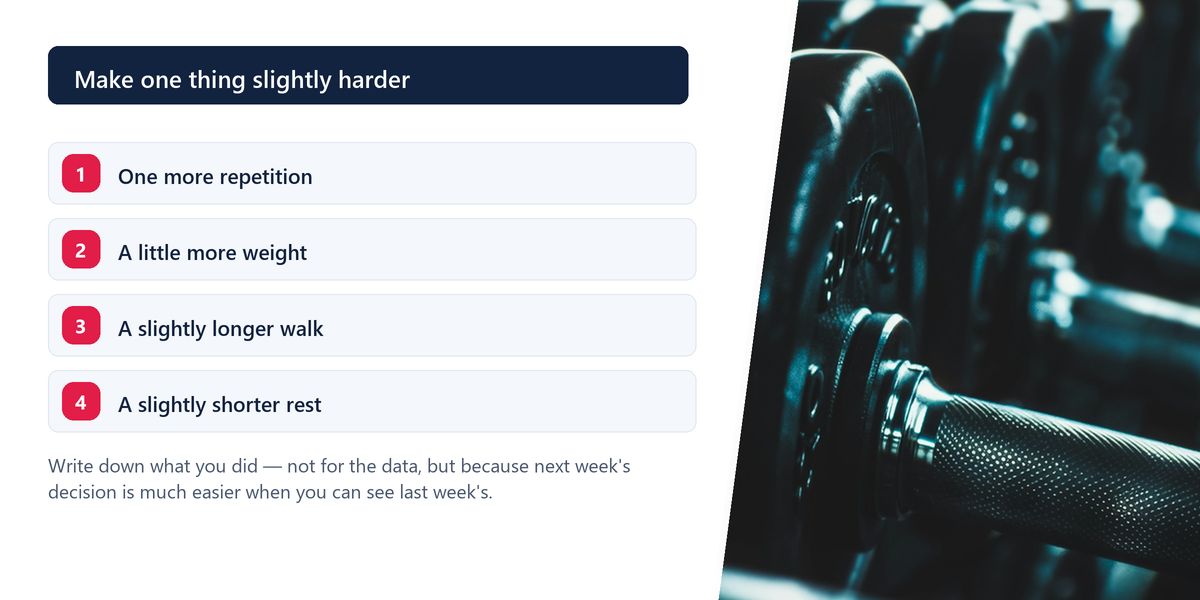
Each week, make one thing slightly harder: one more repetition, a little more weight, a slightly longer walk, a slightly shorter rest. Small and boring, repeated, is what produces the change people hope to get from dramatic sessions.
Write down what you did. Not for the data, but because memory is unreliable and next week's decision is much easier when you can see last week's.
The most effective exercise is not the theoretically optimal one. It is the one you will still be doing in a year. If you loathe running, running is a poor choice regardless of how efficient it is.
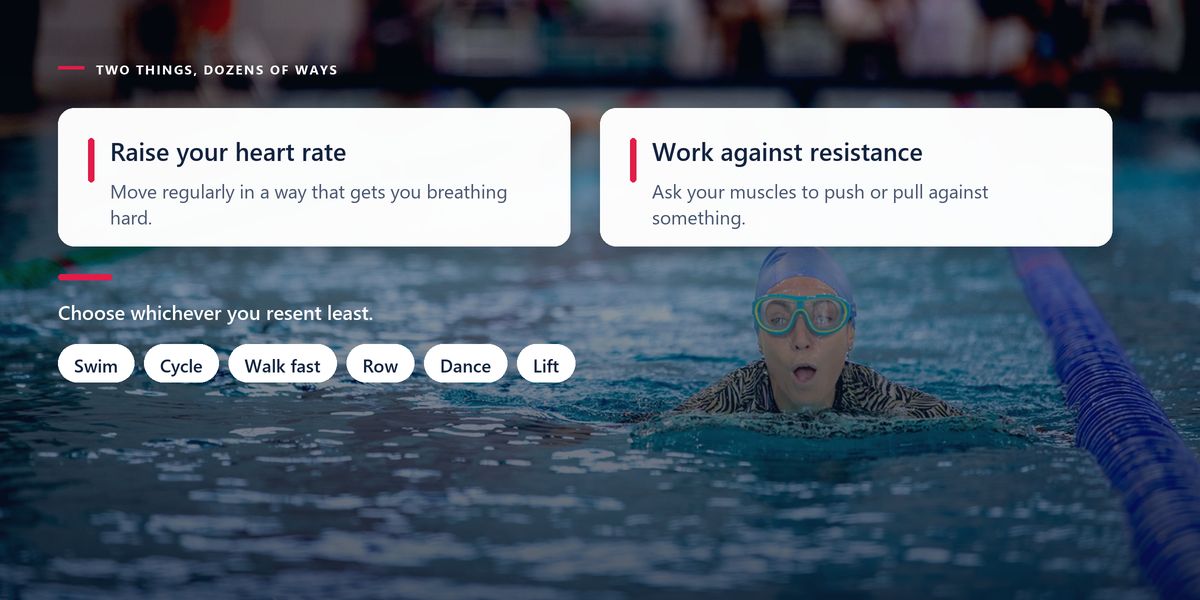
Most general health benefits come from a mix of two things: moving your body regularly in a way that raises your heart rate, and asking your muscles to work against resistance. There are dozens of ways to do both. Choose whichever you resent least.
A teacher had tried to establish a gym routine three times in two years, each time with a four-day plan she had found online. Each attempt lasted between three and six weeks and ended during a busy period at work.
The fourth attempt used two sessions a week, both 35 minutes, both immediately after work on fixed days, with a ten-minute home version defined for the days that went wrong. It felt, in her words, embarrassingly unambitious.
Fourteen months later she had not missed two weeks in a row once, had gradually added a third session, and was lifting roughly double what she started with. The plan she stuck to was the least impressive one she had ever written.
Pain is different from effort. Muscle soreness a day or two after a hard session is normal; sharp pain during a movement, or joint pain that persists, is not. If something hurts in a way that feels like damage rather than fatigue, stop and get it looked at — training through a real injury reliably costs more time than resting it.
Begin at half of what you think you can manage. Define a minimum session for bad days. Attach training to a fixed anchor and remove decisions from the moment of starting. Never miss twice in a row. Make one thing slightly harder each week, and choose an activity you do not dread.
The people who are still training in five years are rarely the ones who started hardest. They are the ones who built something small enough to survive a difficult week, and who treated a missed session as weather rather than as evidence about their character.
Design for the bad weeks. The good ones look after themselves. If sleep is part of what makes your weeks hard, our guide to sleeping better is the natural companion to this one.
Tap a star to share what you thought.
No ratings yet
Two or three sessions a week is a sound starting point for most people, and far more likely to survive than five. The goal in the first months is repeatability rather than intensity — you can always add volume once the habit is stable.
Carry on with the next scheduled one rather than trying to make it up with a double. One miss is unimportant. Apply a single rule instead: never miss twice in a row, even if the second session is only ten minutes.
Most general health benefits come from doing some of both — raising your heart rate regularly and working your muscles against resistance. If you must pick one to start with, choose the one you are more likely to keep doing.
Strength and endurance typically improve noticeably within four to eight weeks, while visible changes in body composition take considerably longer and depend heavily on diet and sleep. Tracking reps, weight or distance gives you evidence of progress long before a mirror does.
Mild muscle soreness a day or two after a session is normal and usually fine to train through, ideally working a different area or moving more gently. Sharp pain during a movement or persistent joint pain is a reason to stop and get it assessed.
Do not rely on motivation. Rely on a fixed schedule, low friction, a minimum session for bad days, visible progress in a number you track, and ideally someone who expects you to turn up. Motivation is a starting fuel, not an engine.
Sign in to join the conversation.
Loading responses…
Have a story, idea, or something valuable to share? Join The Blog Story for free, publish your content, reach more readers, and earn a share of advertising revenue from eligible content.
Create quality content. Grow your audience. Grow your earning potential.