Recognising Burnout Before It Recognises You
Burnout is not ordinary tiredness, and a holiday does not fix it.

6 min read
—Not yet rated
Burnout is not ordinary tiredness, and a holiday does not fix it.
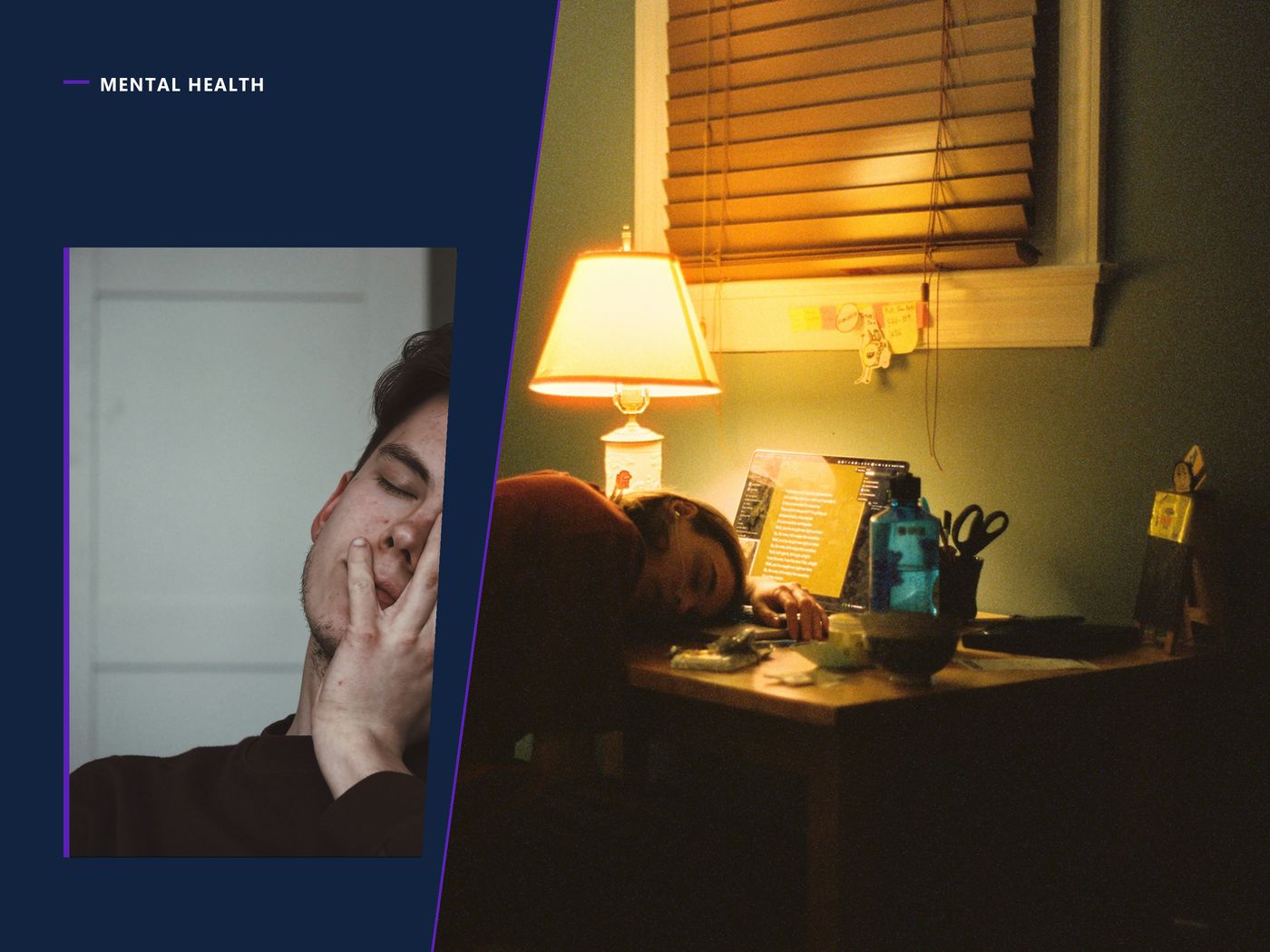
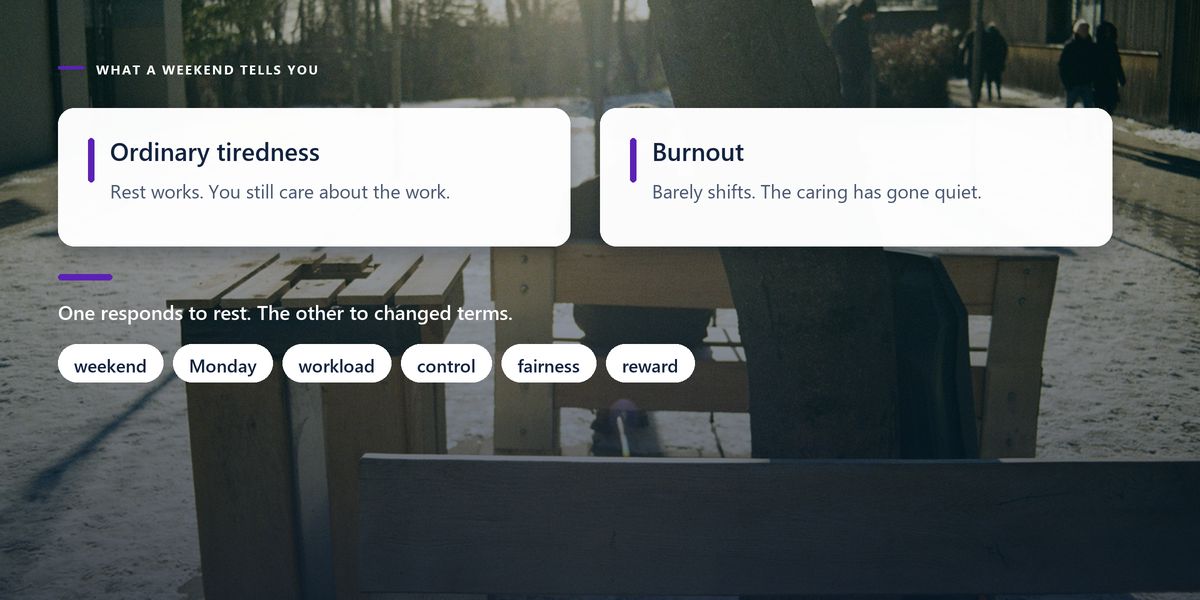
People tend to describe burnout as being very tired, which undersells it considerably. Ordinary tiredness responds to a weekend. Burnout is the state where a weekend makes almost no difference, and you begin to wonder, quietly, whether you have simply become worse at your job.
It has a recognisable shape, and knowing that shape matters, because burnout caught early responds to modest changes. Caught late it tends to require something much larger.
This is not a substitute for professional support, and anyone in genuine distress should seek it. It is a description of the pattern and what tends to help.

Burnout is generally described as having three parts, and it is the combination that distinguishes it from being busy.
Not sleepiness — depletion. The sense that your reserves are gone and that rest does not refill them the way it used to. Small tasks start to feel disproportionately heavy.
A growing distance from the work and from the people in it. Things you used to care about start to feel pointless, and you may notice yourself becoming irritable or dismissive in ways that are not like you.
This is the one people rarely see as a symptom, and it is often the cruellest. You start to feel that you are bad at your job, that your contribution is worthless — not as a passing doubt but as a settled conclusion. It arrives at exactly the moment your capacity is lowest, and it feels like evidence rather than a symptom.
The feeling that you have become incompetent is not usually information about your ability. It is one of the three defining features of burnout, arriving on schedule.
— Worth remembering when it happens
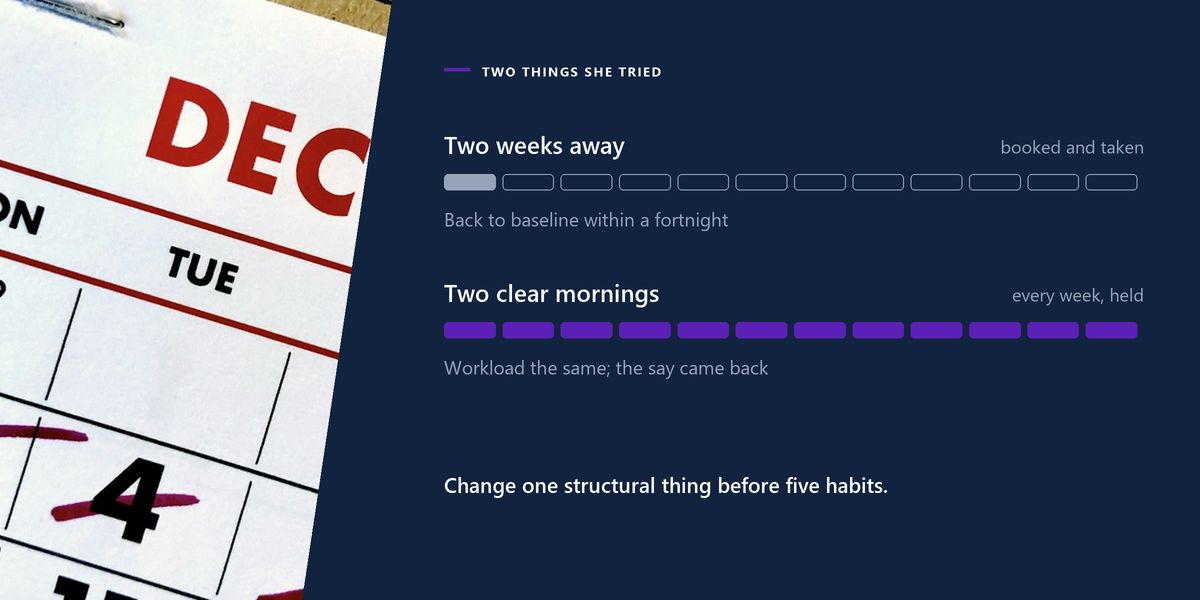
Almost everyone tries this first, and the result is remarkably consistent: two weeks away, feeling genuinely better by the end, and back to baseline within about a fortnight of returning.
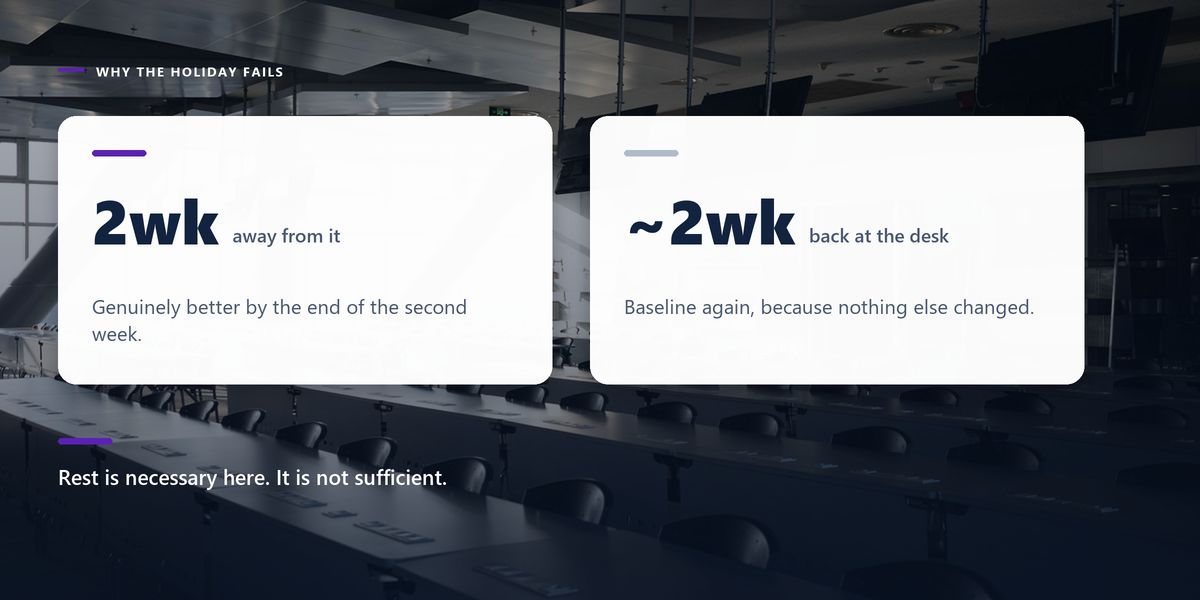
The reason is that burnout is a response to conditions rather than a deficit of rest. Removing yourself from the conditions temporarily relieves the symptoms; returning to unchanged conditions reproduces them. Rest is necessary and it is not sufficient.
This is worth knowing in advance, because the failed holiday is often interpreted as proof that something is deeply wrong with you — when it is actually the expected result.
Research on workplace burnout points repeatedly at a handful of conditions, and notably, unmanageable workload is only one of them.
| Driver | What it looks like | What helps |
|---|---|---|
| Workload | sustained demand beyond capacity | reduce scope, not just speed |
| Lack of control | no say over how or when work is done | claim autonomy somewhere, even small |
| Insufficient reward | effort that nobody notices | make contributions visible; seek feedback |
| Unfairness | inconsistent rules or favouritism | name it, or reduce exposure to it |
| Value conflict | being asked to work against your principles | usually the hardest, often the decisive one |
| Weak community | isolation, or a hostile team | one genuine ally changes a great deal |
This matters because the standard self-care response — sleep more, exercise, meditate — addresses your capacity to absorb the conditions rather than the conditions themselves. Those things genuinely help, and on their own they amount to asking someone to get better at tolerating what is harming them.
Change one structural thing before changing five personal habits. Dropping a recurring commitment, handing over a project, or reclaiming two protected hours a week does more than a new morning routine — because it changes the input rather than your tolerance for it.
A nurse manager took on a senior role she had wanted for years. Eighteen months later she was sleeping badly, dreading Mondays from Saturday evening, and had started to believe she was fundamentally unsuited to the work she had done well for a decade.
Her workload had grown, but the sharper change was control. Her previous role had autonomy over daily decisions; the new one was mostly responding to demands set elsewhere, on timelines she did not influence.
The change that helped most was not a holiday, though she took one. It was negotiating two mornings a week with no scheduled meetings and delegated escalations. The workload barely fell. The sense of having a say returned, and with it, gradually, the rest.
Burnout and depression share several features, and treating one as the other delays help. If low mood is persistent, if you have lost interest in things outside work as well as in it, or if you are having thoughts of harming yourself, that is a reason to contact a doctor or a crisis service now rather than to keep adjusting your schedule.
The uncomfortable truth is that the people most vulnerable are often the conscientious ones — those who absorb extra work, who find it hard to say no, and whose sense of self is closely tied to doing the job well.
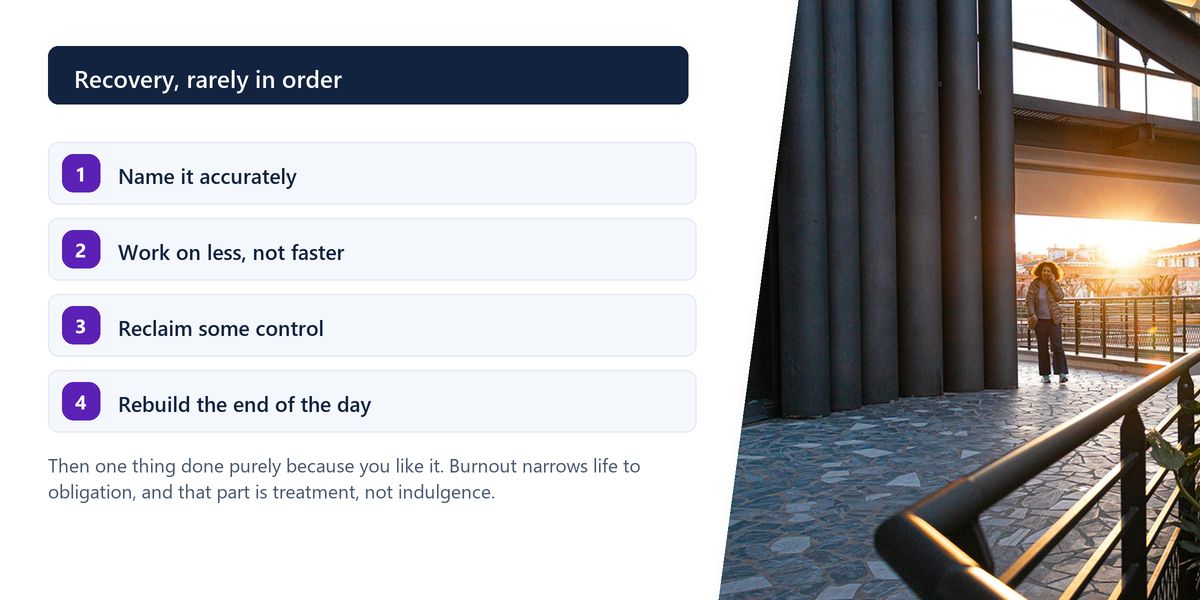
Prevention therefore is mostly about maintaining limits during the periods when things are going well, rather than discovering them during a crisis. Regular recovery built into the ordinary week, protected time that is not negotiable, and an honest early-warning signal you actually watch for — usually the return of cynicism, which tends to arrive before the exhaustion does.
Burnout is exhaustion, cynicism and a collapsed sense of competence together, driven by conditions rather than by a lack of rest. A holiday relieves without resolving. Recovery needs a structural change — less load, more control, firmer boundaries — alongside rest, and often professional support.
The most important thing to hold onto is that the feeling of having become incompetent is a symptom, not a finding. It arrives reliably, it is convincing, and it is wrong.
Treat it as a signal to change something structural rather than to try harder. Trying harder is what got you here. If protecting focused time is part of the answer, our guide to protecting focused working time covers the scheduling side.
Tap a star to share what you thought.
No ratings yet
Ordinary tiredness improves noticeably after a weekend or a good night's sleep. Burnout involves exhaustion that rest does not resolve, growing cynicism about work you used to care about, and a collapsed sense of your own competence — the three together, persisting over months.
Because burnout is a response to conditions rather than a rest deficit. Time away relieves symptoms temporarily, but returning to unchanged workload, control and expectations reproduces them, usually within a couple of weeks.
Consistently identified drivers include unmanageable workload, lack of control over how work is done, insufficient recognition, unfairness, conflict between the work and your values, and isolation. Workload is only one of several, which is why reducing hours alone often disappoints.
No, though they overlap and can occur together. Burnout is tied specifically to work or caregiving conditions, while depression affects mood and interest across life generally. Distinguishing them is a job for a professional rather than for self-diagnosis.
Something structural rather than personal — dropping a commitment, handing over a project, or reclaiming protected time. Changing the input matters more than improving your tolerance for it, though rest and exercise genuinely help alongside.
It varies widely and is rarely linear, but recovery is substantially faster when the underlying conditions change rather than only the person. Caught early, modest adjustments often suffice; left long, it can take many months and usually needs professional support.
Sign in to join the conversation.
Loading responses…
Have a story, idea, or something valuable to share? Join The Blog Story for free, publish your content, reach more readers, and earn a share of advertising revenue from eligible content.
Create quality content. Grow your audience. Grow your earning potential.