Deep Work for Developers: Protecting the Only Resource That Matters
Four uninterrupted hours produce more than a ten-hour day sliced into fragments.

6 min read

—Not yet rated
Four uninterrupted hours produce more than a ten-hour day sliced into fragments.
Ask a developer what they need to work well and almost none will say a better chair or a faster laptop. They will say a few hours where nobody needs anything from them.
The reason is specific to the work. Programming means holding a model of a system in your head — how the pieces connect, what state things are in, which assumptions you are currently relying on. That model takes time to assemble and collapses instantly when something demands attention elsewhere.
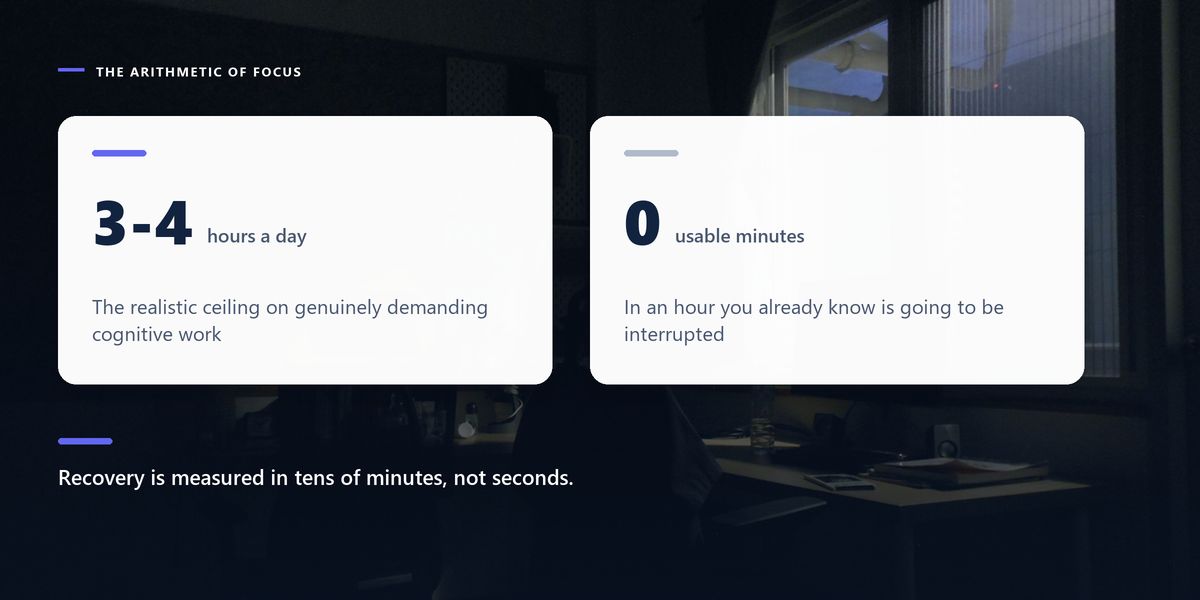
Research on interruption consistently finds recovery times measured in tens of minutes, not seconds. Which means a schedule with a meeting every ninety minutes contains almost no usable programming time at all, regardless of how many hours it spans.
Consider two eight-hour days. The first has one three-hour block in the morning and two hours in the afternoon. The second has five one-hour gaps between meetings.
The second day contains the same number of working hours and produces a fraction of the output. Each gap is largely consumed by reloading context, and knowing an interruption is coming prevents you from starting anything that requires sustained thought — so the hour gets spent on email and small tasks instead.
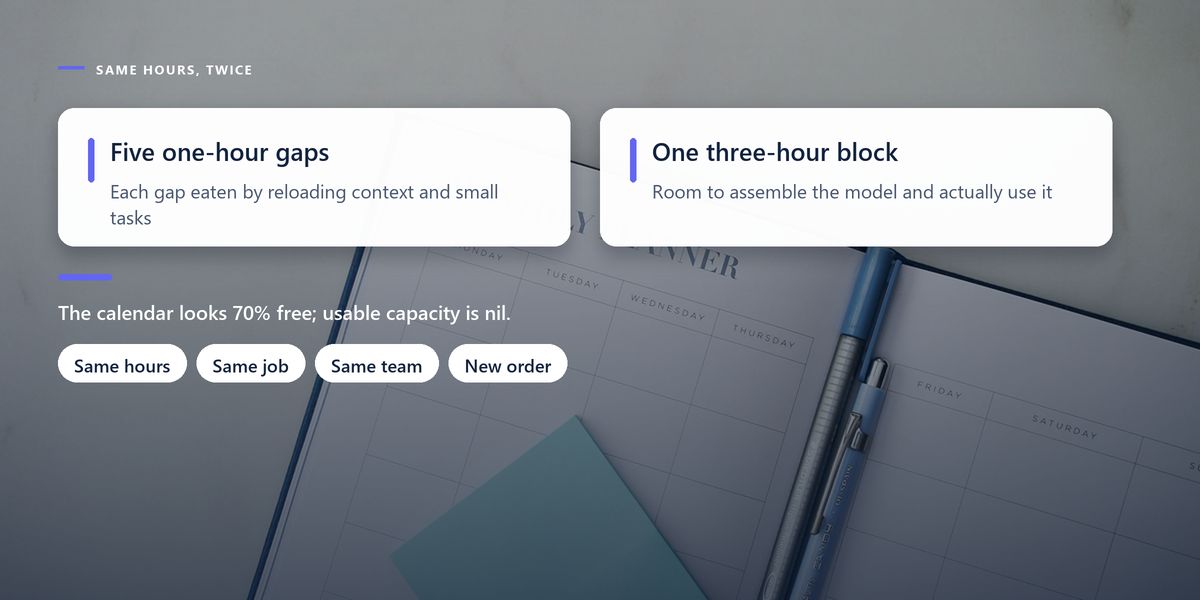
This is why developers describe a day of meetings as producing nothing even when the meetings were short. The calendar looks 70% free. The usable capacity is close to zero.
Most advice here assumes a level of control over your calendar that many people do not have. These are the tactics that work within normal constraints.
The same four meetings arranged consecutively leave a genuine four-hour block. Spread evenly across the day they leave nothing. This is usually negotiable, costs nobody anything, and is the single highest-return change available.
Time that appears free will be filled. A recurring block in your calendar, treated with the same seriousness as a meeting, survives — and it also sets an expectation with colleagues without any confrontation.
Chat applications are interruption systems by design. Most messages do not need a response within minutes, and the ones that genuinely do usually arrive by another route. Check messages between blocks rather than during them.
A status set to focus time, a shared calendar block, or an agreed team convention removes the social cost of not replying instantly. Most interruptions are not urgent; they are simply people not knowing you were mid-thought.
Stop at a place you can restart from. Leaving a failing test, a half-written function, or a two-line note about your next step means tomorrow's session starts in two minutes rather than twenty. Ending on a clean, finished note feels tidier and costs you a whole re-entry each time.
Deep work is not a productivity system that scales indefinitely. Most people manage around three to four hours of genuinely demanding cognitive work per day, and the figure does not increase with practice as much as people hope.
This is a useful constraint rather than a discouraging one. It means the goal is not an eight-hour day of pure focus, which is not achievable. It is protecting the three or four hours you do have and arranging everything else — reviews, meetings, planning, correspondence — around them.
| Time of day | Suits | Does not suit |
|---|---|---|
| First block of the day | hardest problem, new design | email and message triage |
| After lunch | implementation of a known plan | novel architectural thinking |
| Late afternoon | code review, documentation, admin | anything requiring deep context |
| Between blocks | messages, planning, short questions | starting complex work |
Working on three projects in one day is not the same as working on one project for three days. Each switch discards the model you had built and requires assembling a new one.
Where possible, batch by context: all reviews together, all meetings together, one substantial problem per block. It feels less responsive and produces considerably more. Where it is genuinely impossible — support rotations, on-call weeks — accept it explicitly and lower your expectations for deep work in that period rather than being disappointed by it.

Open-plan offices are a genuine problem, but they are frequently blamed for what is really a scheduling problem. Noise-cancelling headphones do not help with a calendar full of holes.
Working from home helps some people considerably and others not at all, depending on their domestic situation. The consistent variable across all of these is not the room. It is whether there are uninterrupted stretches of time in the day.
A team of six felt permanently behind. Their calendars showed roughly two hours of meetings a day, which seemed modest. But those meetings were scattered — one at 10, one at 11:30, one at 2, one at 4.
They agreed one rule: no meetings before 1pm, with a shared exception for genuine emergencies. Standup moved to 1pm. Everything else was booked into the afternoon.
Total meeting time did not change. Within a month, the team's own estimate of how much substantial work they completed had roughly doubled, and the complaint about being behind quietly disappeared from retrospectives. They had not worked more hours; they had assembled the same hours into usable pieces.
Protecting focus is not the same as being unavailable. A developer nobody can reach for six hours creates a different problem, particularly for junior colleagues who are genuinely blocked. Publish when you are reachable, hold to it, and make it easy for someone with an urgent issue to reach you.
Focused work is genuinely tiring, and treating rest as wasted time is how people arrive at a fourth hour that produces nothing. Short breaks between blocks, a proper lunch away from the screen, and a definite end to the working day all sustain the capacity to concentrate tomorrow.
The failure mode is not laziness. It is grinding through a long low-quality day, ending exhausted, and starting the next one already depleted — at which point the model in your head takes even longer to assemble.
You cannot make more hours in the day. You can stop cutting the ones you have into pieces too small to use.
— The whole idea, briefly
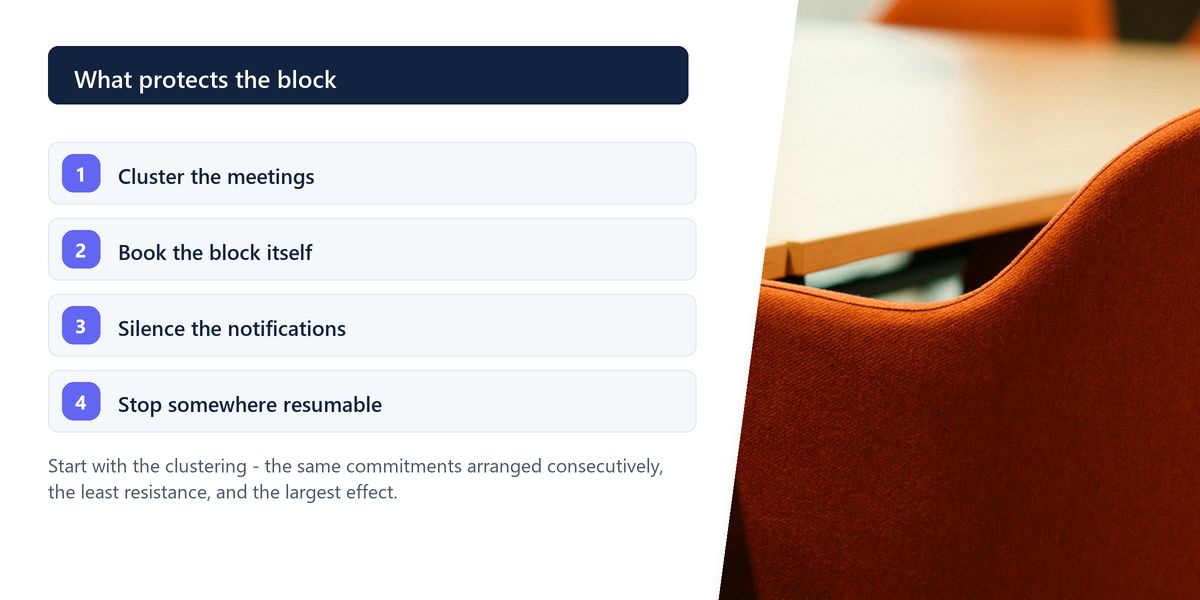
Interruptions cost far more than their duration because the mental model has to be rebuilt. Cluster meetings, book focus blocks as real appointments, silence notifications during them, and make your availability visible. Expect three to four hours of deep work a day, batch similar tasks, stop at a resumable point, and treat rest as part of the system.
None of this requires an unusual amount of discipline. It mostly requires arranging the same commitments in a different order, which is a scheduling problem rather than a character one.

Start with the meeting clustering. It is the change with the least resistance and the largest effect, and most teams find it improves their week within a fortnight.
Tap a star to share what you thought.
No ratings yet
Because programming requires holding a detailed mental model of a system, and that model collapses when attention moves elsewhere. Rebuilding it takes far longer than the interruption itself, which is why a two-minute question can cost twenty minutes of work.
Most people sustain around three to four hours of genuinely demanding cognitive work per day. The figure does not increase much with practice, so the aim is to protect those hours rather than to extend them indefinitely.
Clustering meetings into one part of the day. The same commitments arranged consecutively leave a real multi-hour block, while the same meetings spread evenly leave none. It costs nobody anything and is usually negotiable.
Publish when you are reachable and hold to it, set a visible status during blocks, and keep an escalation path for genuine urgency. Most interruptions happen because people do not know you are mid-thought, not because the matter is urgent.
It depends entirely on your domestic circumstances. The consistent factor across office and home is whether the day contains uninterrupted stretches — a quiet room with a fragmented calendar does not produce focused work.
Batch by context wherever possible: reviews together, meetings together, one substantial problem per block. Each switch discards the mental model you built, so three projects in a day costs far more than the time arithmetic suggests.
Stop somewhere you can restart from — a failing test, a half-written function, or a short note about your next step. Ending on a tidy finished point feels better and costs you a full re-entry the following morning.
Yes, because focused work depletes a real capacity. Short breaks between blocks and a definite end to the day preserve your ability to concentrate tomorrow, whereas grinding through a long low-quality day borrows against it.
Sign in to join the conversation.
Loading responses…
Have a story, idea, or something valuable to share? Join The Blog Story for free, publish your content, reach more readers, and earn a share of advertising revenue from eligible content.
Create quality content. Grow your audience. Grow your earning potential.