Planning a Good Trip on a Small Budget
Where you go and when you go decide the cost far more than how frugal you are once there.

6 min read
—Not yet rated
Where you go and when you go decide the cost far more than how frugal you are once there.
Most advice about cheap travel concerns behaviour at the destination — eat where locals eat, use public transport, skip the tourist restaurants. All true, all marginal.
The cost of a trip is mostly decided before you leave, by two choices: where you go and when. A week somewhere inexpensive in the shoulder season can cost less than a long weekend somewhere expensive in August, including the flights.
Get those two right and the rest is comfortable rather than constrained.
The most useful principle in budget travel is that you need flexibility in one dimension, not both. Either you know exactly where you want to go and are flexible about when, or you have fixed dates and are open about the destination.
Being rigid about both is what makes travel expensive, because you are then buying whatever the price happens to be. Being flexible about either lets you buy when it is cheap.
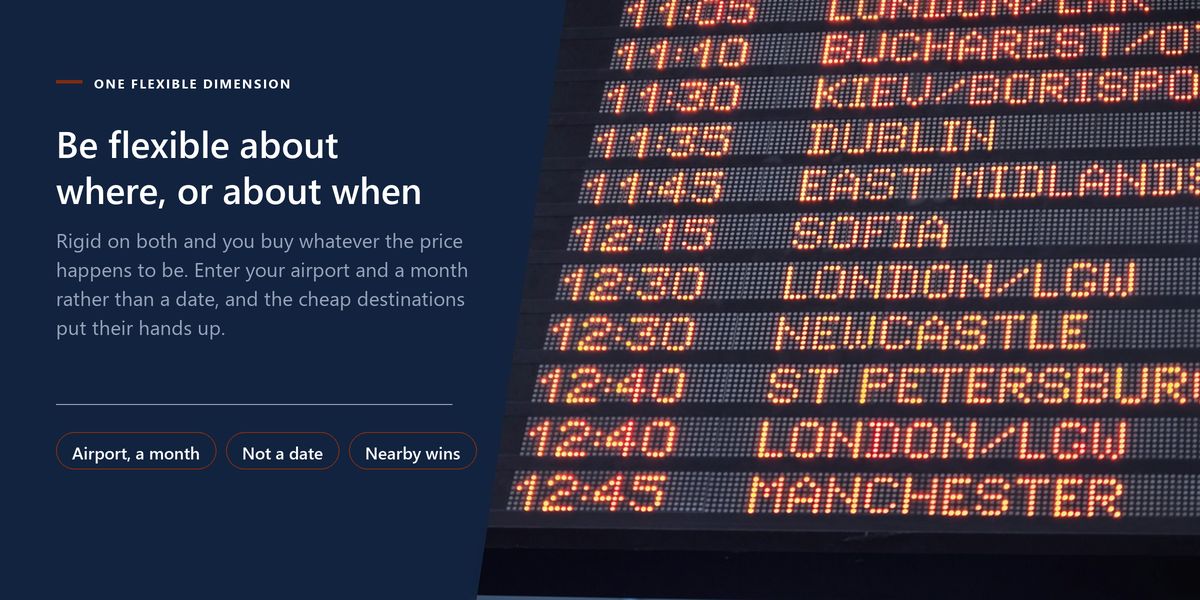
Practically: use the map or flexible-date search on any flight comparison tool. Enter your airport, a month rather than a date, and look at what is cheap. It routinely reveals destinations at a third of the price of the one you had in mind, often nearby.
The weeks either side of peak season — roughly May to early June and September to October in the northern hemisphere — are consistently the best value in travel.
Prices for flights and accommodation drop substantially, crowds thin, and the weather is frequently better than in high summer, particularly around the Mediterranean where August is uncomfortably hot as well as expensive.
Avoiding school holidays is the mechanism underneath this. If your circumstances allow travel outside them, that single constraint being lifted is worth more than every other saving on this page combined.
There is a great deal of folklore about booking flights, most of it unsupported. What holds up reasonably well:
The advice about clearing cookies or booking on a specific weekday has little evidence behind it. Prices move because of demand and inventory, not because a website recognised you.
| Type | Best for | Watch out for |
|---|---|---|
| Hostel private room | solo and couples, cities | location versus price trade-off |
| Guesthouse or pension | value with some comfort | often not on the big platforms |
| Apartment rental | families, longer stays | cleaning fees can dominate short stays |
| Budget chain hotel | predictability, one-night stops | outskirts locations add transport cost |
| Campsite | outdoors trips | gear cost if you do not own it |
Pay attention to location before price. Accommodation twenty pounds cheaper but forty minutes out of town costs you the difference in transport and, more importantly, in time and willingness to go out. Central and small beats spacious and remote on almost every short trip.
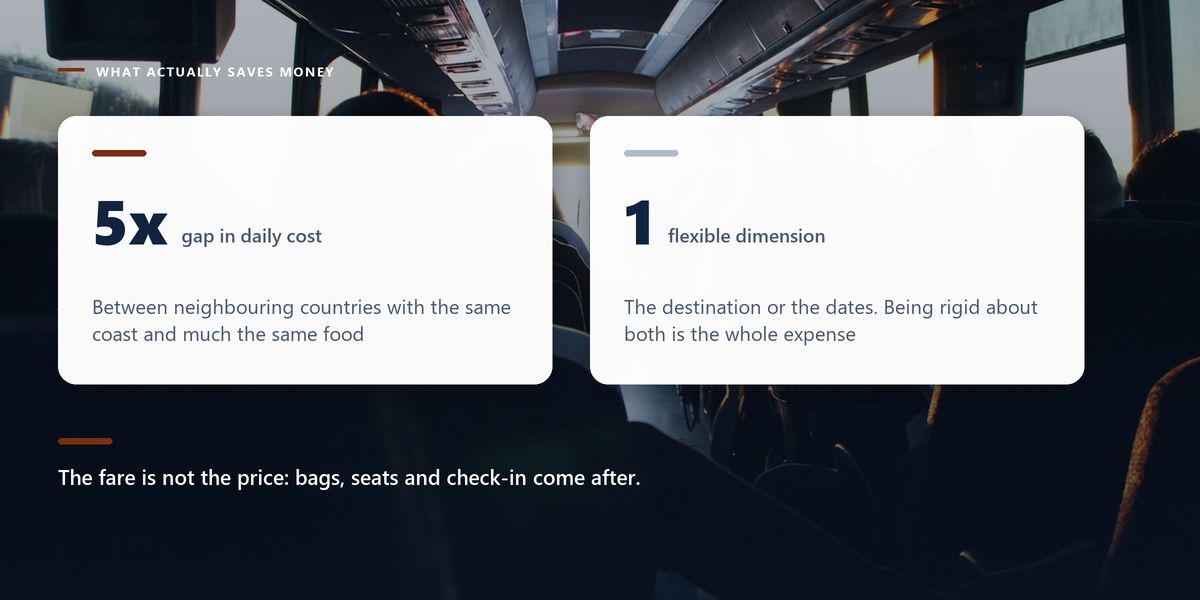
Daily costs vary by a factor of five or more between countries, which is why choosing a cheaper destination outperforms any amount of frugality in an expensive one.
A useful exercise before committing: look up the cost of a simple restaurant meal, a local transport ticket and a mid-range room for two or three candidate destinations. The gap is usually larger than expected and reframes the choice entirely.
This is also where regional alternatives come in. Neighbouring countries frequently offer similar landscapes, food and history at half the daily cost, and are considerably less crowded for the same reason.
Budget travel done badly means saying no to everything and returning with nothing much to report. Done well it means economising ruthlessly on the forgettable so you can afford the memorable.
Nobody remembers the room. Almost everyone remembers a meal, a walk, a boat, a concert or a guide who was genuinely good. Decide in advance which two or three things define the trip, budget for those properly, and cut everywhere else without guilt.
Two friends each had about eight hundred pounds and a week free in August. One booked five days in a well-known Mediterranean city, at peak prices, and spent most of the budget on flights and a small hotel room.
The other used a flexible-date search, shifted her week to late September, and flew to a smaller city in a neighbouring country for roughly a third of the airfare.
She stayed ten days rather than five, ate out most evenings, took a two-day trip to the coast and still came home with money left. The difference was two decisions made before either of them left home.
Do not economise on travel insurance, or on anything safety-related. Medical treatment abroad is one of the classic catastrophic costs, and a cancelled trip or a hospital stay without cover can dwarf the entire holiday budget. This is precisely the kind of loss insurance exists for.
Choose destination and timing first, since they decide most of the cost. Travel in shoulder season and outside school holidays if you can. Be flexible about either where or when. Compare total flight costs including extras, prioritise location in accommodation, and spend deliberately on the few things that will define the trip.
Travelling cheaply is not the same as travelling poorly, and the difference is almost entirely in the planning rather than the sacrificing.
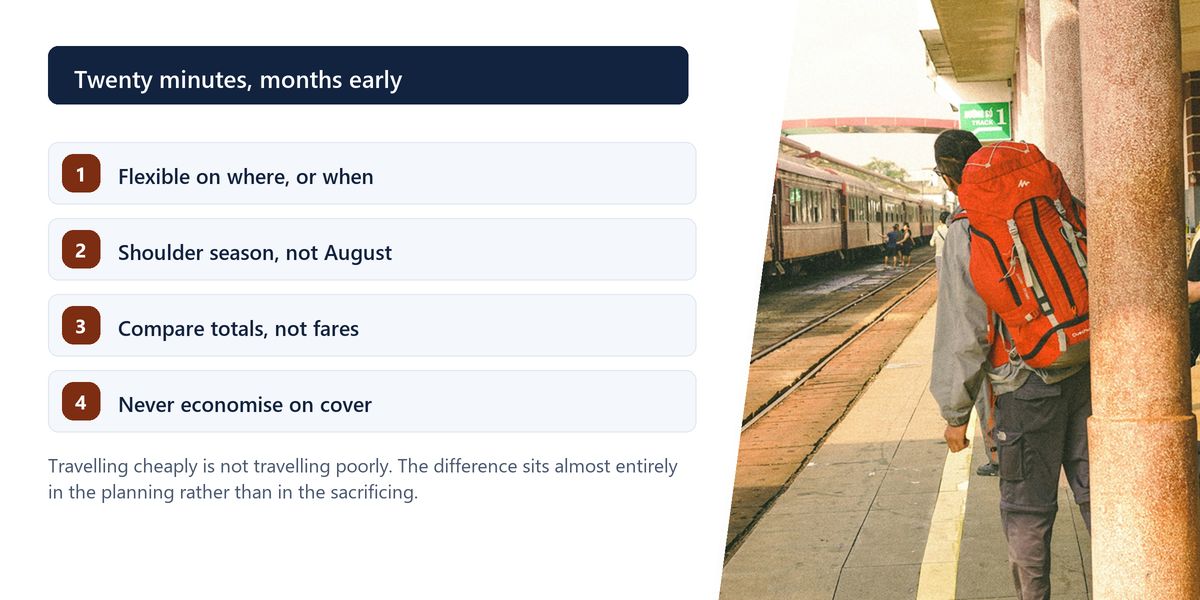
Twenty minutes with a flexible-date search, done two months before you would normally book, is worth more than a fortnight of careful spending once you arrive. If your trip involves walking somewhere remote, our guide to planning a first multi-day hike covers the rest.
Tap a star to share what you thought.
No ratings yet
Choosing the destination and the timing. Daily costs vary enormously between countries, and travelling in shoulder season outside school holidays reduces flight and accommodation prices substantially — more than any economy you can make once you arrive.
Well ahead for peak periods and moderately ahead otherwise. Genuine last-minute bargains are now rare on popular routes. Setting price alerts and using flexible-date searches is more effective than trying to book on a supposedly cheap day of the week.
There is little evidence for it. Prices change because of demand and remaining inventory, not because a site recognises a returning visitor. Time is better spent on flexible-date searches and comparing total costs including baggage.
Sometimes, and it varies by route and season. Always compare the total cost of a package against separate bookings including all extras — baggage, seat selection and resort fees frequently change which option is actually cheaper.
Decide in advance on the two or three experiences that will define the trip and budget for them properly, then economise consistently on the forgettable costs. Use a card without foreign transaction fees and always pay in the local currency.
No. Medical treatment abroad is a classic catastrophic cost, and a hospital stay or a cancelled trip without cover can exceed the entire holiday budget many times over. This is exactly the type of risk worth insuring.
Sign in to join the conversation.
Loading responses…
Have a story, idea, or something valuable to share? Join The Blog Story for free, publish your content, reach more readers, and earn a share of advertising revenue from eligible content.
Create quality content. Grow your audience. Grow your earning potential.