Planning Your First Multi-Day Hike Without Suffering Through It
Feet, weight and weather. Almost every miserable first trip comes down to one of the three.

6 min read
—Not yet rated
Feet, weight and weather. Almost every miserable first trip comes down to one of the three.
There is a particular expression on the face of someone on day two of their first long walk. It is the look of a person who has realised, with total clarity, that there are four more days of this and their heels are already raw.
Almost every miserable first multi-day hike comes down to one of three things: feet, pack weight, or weather that was not planned for. None is about fitness, and all three are entirely solvable before leaving home.
Here is how to plan a first trip that ends with you wanting to do another one.
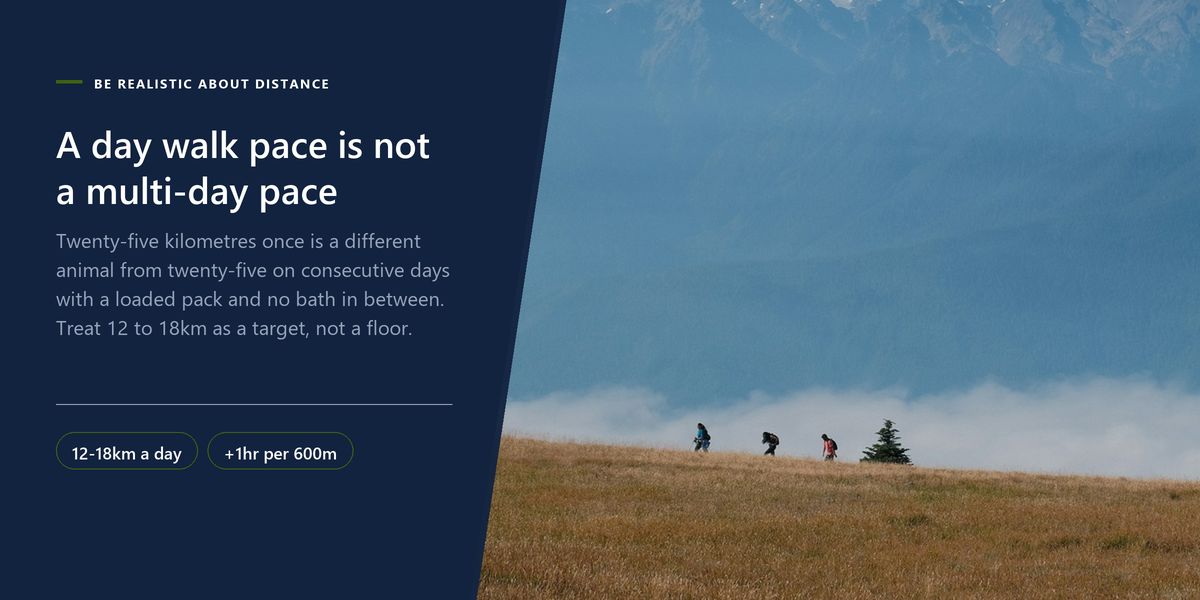
The most common planning error is treating a day walk pace as a multi-day pace. Walking 25 kilometres once is very different from doing it on consecutive days with a loaded pack and no bath in between.
For a first trip, 12 to 18 kilometres a day is sensible on reasonable terrain. Consider it a target rather than a minimum, and cut it substantially if the route involves significant ascent.
For ascent, a widely used rule adds roughly an extra hour for every 600 metres of climbing on top of the time the horizontal distance would take. A 15-kilometre day with 900 metres of ascent is a genuinely long day, not a short one.
Blisters end more trips than exhaustion, injury or weather combined, and they are almost entirely preventable.
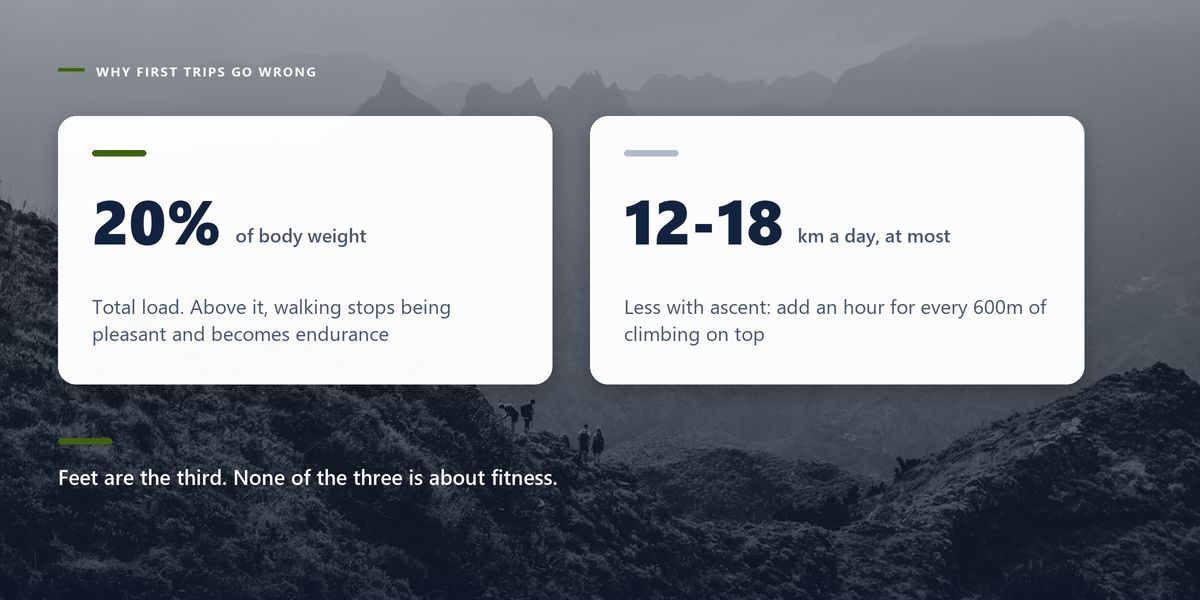
A useful target is a base weight — everything except food, water and what you are wearing — that keeps your total load under roughly 20% of your body weight. Above that, walking stops being pleasant and becomes an endurance exercise.
The heaviest items are almost always the same four: shelter, sleeping bag, sleeping mat and the pack itself. Getting those right matters far more than shaving grams off small things, which is where beginners tend to focus.
| Item | Common mistake | Better approach |
|---|---|---|
| Water | carrying days of it | carry between sources; know where they are |
| Clothing | several changes | one to walk in, one dry set for camp |
| Food | heavy tins and packaging | calorie-dense, repackaged, no tins |
| 'Just in case' items | packing for every scenario | pack for likely, plus a genuine emergency kit |
| Books, chairs, extras | comfort items | leave them; you will not use them |
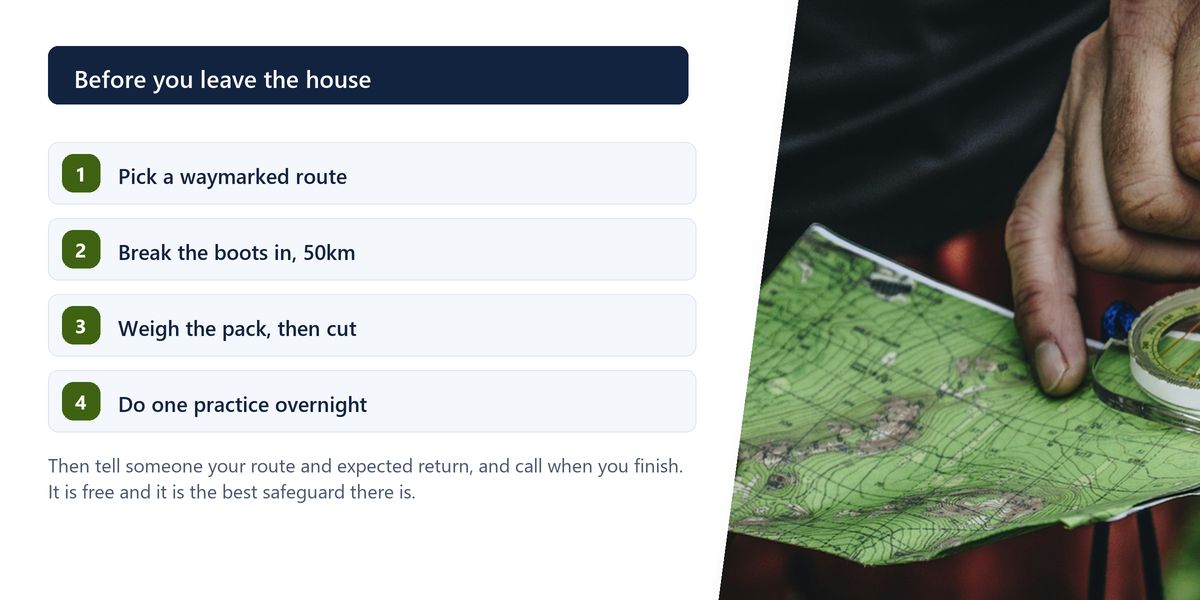
Do one full overnight practice trip close to home before the real thing, carrying everything exactly as you would. Nothing else exposes an ill-fitting pack, a leaking tent, a stove you cannot light or boots that hurt after four hours — and finding all that out an hour from your car is enormously better than finding it out on day two of six.
Mountain and upland weather changes faster and more severely than the forecast in the valley suggests, and temperature drops roughly 6 degrees Celsius for every thousand metres of ascent before wind is accounted for.
Three layers cover almost everything: a base layer that moves moisture away from your skin, an insulating mid layer, and a genuinely waterproof and windproof shell. Cotton has no place in any of them, since it holds water and stops insulating entirely when wet.
Then decide your escape routes in advance. For each day, identify where you could bail out to a road, a village or a lower path. Knowing your options before the weather turns is what turns a difficult day into an inconvenient one.
A phone with a mapping app is excellent and it is not a navigation system on its own. Batteries fail in cold, screens break, and signal is irrelevant to some apps and essential to others.
Carry a paper map and a compass, and — this is the part people skip — know how to use them before you need to. A map you cannot read in poor visibility is dead weight and false confidence.
Download offline maps, carry a power bank, and keep the phone warm in cold weather, since battery capacity falls sharply as temperature drops.
Two friends set out on a four-day route with new boots, a 19-kilogram pack each and a forecast they had checked once, three days earlier.
By mid-afternoon on day one both had hot spots on their heels, and the pack straps had rubbed one of them raw. They stopped at a village eleven kilometres in, stayed the night, and went home the next morning feeling that they had failed.
They tried again four months later after a practice overnight, with worn-in boots and packs about five kilograms lighter each. They completed the same route comfortably and extended it by a day. The difference was preparation rather than fitness or determination.
Do not push on into deteriorating weather or failing light because of a plan. Turning back or taking an escape route is a normal decision made routinely by experienced walkers, and the overwhelming majority of serious mountain incidents involve people who continued when they should have stopped.
For a first multi-day walk, choose a well-marked established trail with accommodation or campsites at regular intervals, in a region with reliable summer weather, and with public transport or roads within reach along the way.
Waymarked long-distance paths in national parks are ideal precisely because they are unadventurous — the navigation is simple, the escape routes are obvious, and there are other people around. Save the remote route for when you know how your feet, your pack and your judgement behave.
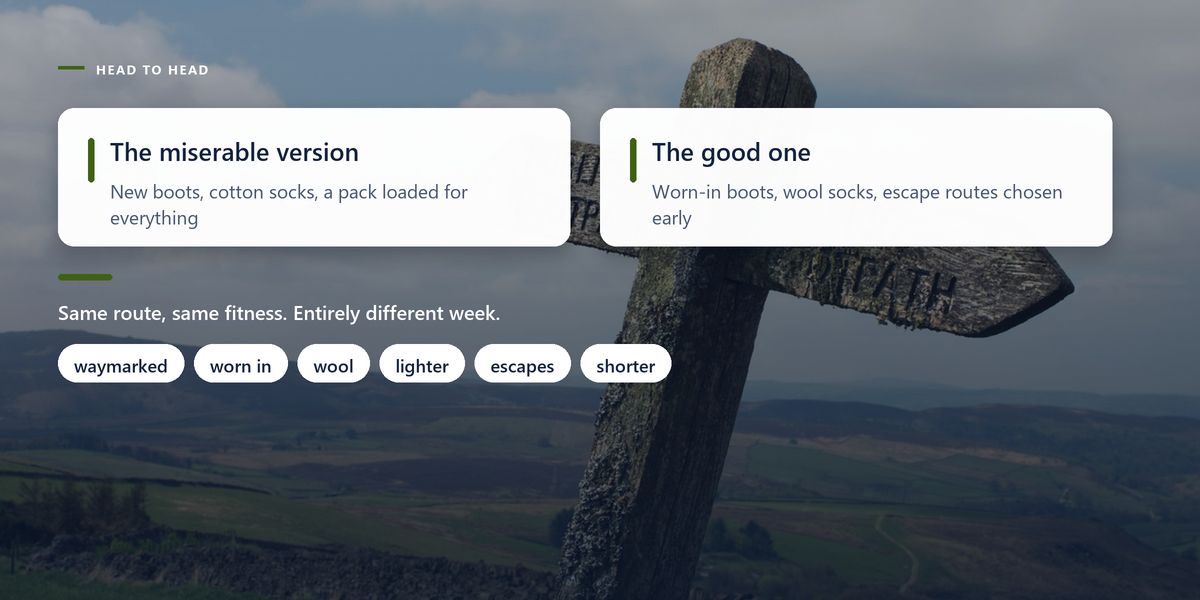
Plan 12 to 18 kilometres a day, less with ascent. Break in footwear, wear wool or synthetic socks and treat hot spots immediately. Keep total pack weight under about 20% of body weight. Layer properly and identify escape routes. Carry paper navigation and know how to use it, and tell someone your plan.
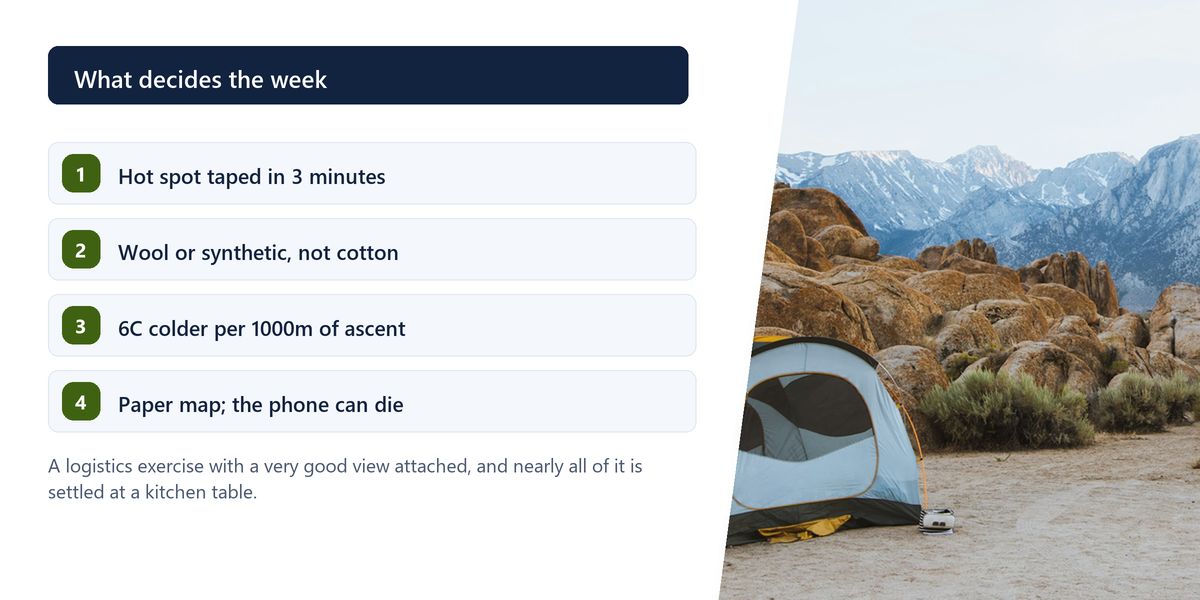
A first long walk is not a test of toughness. It is a logistics exercise with a lovely view attached, and almost everything that ruins one is decided at a kitchen table weeks before.
Do the practice overnight. It is the single highest-value thing on this list, and nobody who has done one regrets it.
Tap a star to share what you thought.
No ratings yet
Around 12 to 18 kilometres on reasonable terrain, and less where there is significant climbing. A useful rule adds roughly an hour for every 600 metres of ascent on top of the time the distance alone would take.
Break footwear in over several long walks, size boots to allow for feet swelling, wear wool or synthetic socks rather than cotton, and stop to tape any hot spot the moment you notice it. That last habit prevents most blisters entirely.
Aim for a total load, including food and water, under roughly 20% of your body weight. The heaviest items are almost always shelter, sleeping bag, sleeping mat and the pack itself, so those are where weight savings actually come from.
Yes. Phones fail in cold weather, break, and run out of battery. Carry a paper map and compass as well, and learn to use them before the trip — a map you cannot read in poor visibility offers only false confidence.
Use one of the escape routes you identified during planning, or turn back. Experienced walkers do this routinely, and continuing into deteriorating conditions because of a plan is a factor in the large majority of serious incidents.
One full overnight practice trip close to home, carrying exactly what you intend to carry. It exposes ill-fitting packs, leaking tents, unfamiliar stoves and uncomfortable boots while you are still an hour from your car.
Sign in to join the conversation.
Loading responses…
Have a story, idea, or something valuable to share? Join The Blog Story for free, publish your content, reach more readers, and earn a share of advertising revenue from eligible content.
Create quality content. Grow your audience. Grow your earning potential.