Planning a Road Trip That Is Still Fun on Day Four
Most road trip misery comes from driving too far on too many consecutive days.

6 min read

—Not yet rated
Most road trip misery comes from driving too far on too many consecutive days.
Road trips are planned in a state of optimism. Someone opens a map, notices that two places are only four hours apart, and builds an itinerary in which that is true seven days running.
What that spreadsheet does not capture is that four hours of driving is really six once you include stops, that arriving somewhere at seven in the evening means seeing almost nothing, and that packing and unpacking daily becomes genuinely wearing by day three.
The fix is not less ambition about where you go. It is a different structure for how you get there.
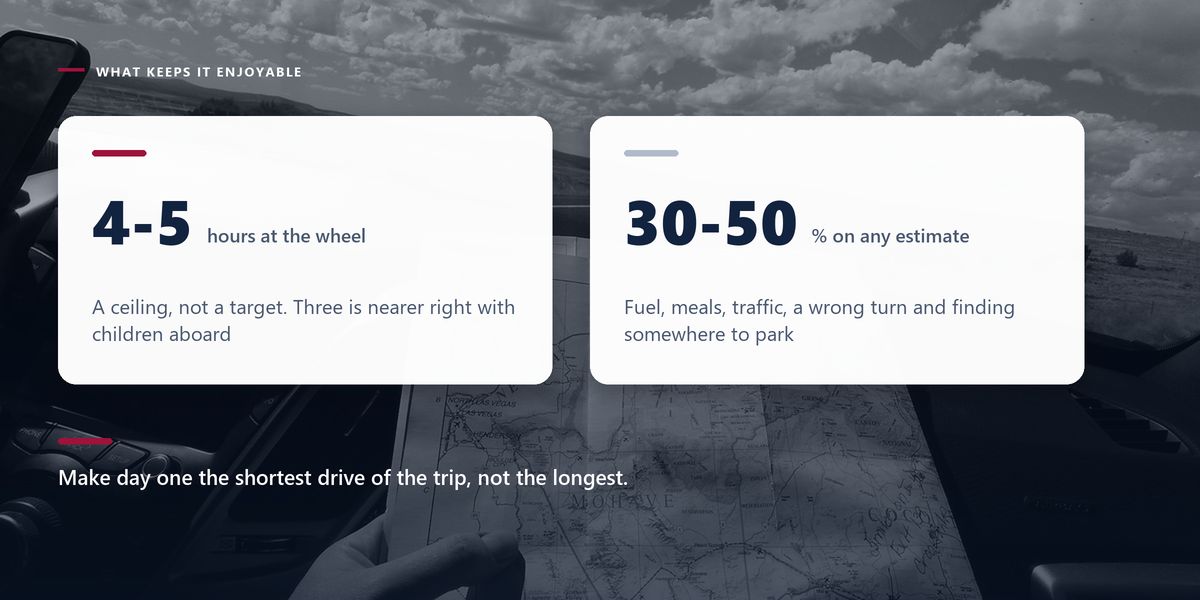
For a trip you want to enjoy rather than complete, four to five hours of actual driving per day is a sensible ceiling, and three is better with children.
The important detail is that mapping applications lie by omission. A stated four-hour route does not include fuel stops, meals, toilet breaks, traffic, a wrong turn or the twenty minutes spent finding parking on arrival. Add roughly 30 to 50% to any estimate to get the real door-to-door time.

This is why day one so often runs late and sets the tone for everything after. Plan the shortest drive of the trip on the first day, not the longest.
If you take one thing from this article, take this: never stay only one night anywhere unless you genuinely have to.
A single-night stop means you arrive, unpack, sleep, repack and leave, having seen a hotel and a car park. Two nights gives you a full day in a place without moving your luggage, and it changes the character of a trip completely.
A structure that works well is alternating: two nights somewhere, a shorter drive, two nights somewhere else. You cover less ground and see considerably more, which is usually what people actually wanted.
The tension in road trip planning is between the freedom of improvising and the anxiety of arriving somewhere at eight in the evening with nowhere to stay.
| Approach | Works when | Risk |
|---|---|---|
| Everything booked | peak season, popular routes, families | no flexibility when you love somewhere |
| First and last nights only | shoulder season, flexible travellers | occasional evening scramble |
| Nothing booked | off season, rural areas, van or camping | festivals and events fill towns overnight |
| Rolling one day ahead | most trips | requires signal and a little discipline |
The rolling approach — booking tomorrow's stop over breakfast — suits most trips. You keep the ability to stay an extra night somewhere good, and you never spend an evening driving between full hotels.
Always book the first and last nights regardless of your approach. The first because arriving tired in an unfamiliar place with nothing arranged is a bad start, and the last because you want a predictable, close-to-the-airport-or-home ending rather than a scramble.
A breakdown does not cost you a few hours; it can cost days and a substantial amount of money in an unfamiliar place. A short check beforehand is worth a great deal.
A road trip is a shared experience in a small space, and the difference between a good one and a tense one is often about the people rather than the route.
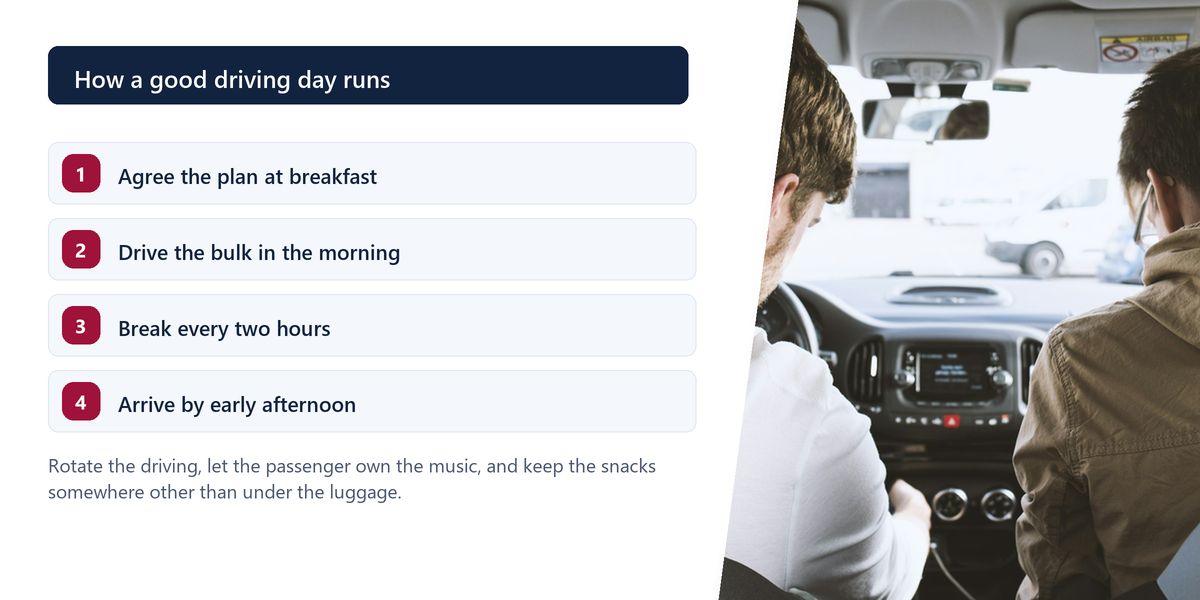
The best structure for a driving day is to leave reasonably early, do the bulk of the driving in the morning, and arrive somewhere by early afternoon.
This one change transforms a trip. Arriving at two o'clock means you have an afternoon and an evening somewhere; arriving at seven means you have dinner and a bed. The driving time is identical.
It also builds in slack. If something goes wrong — traffic, a closed road, a detour worth taking — you have hours of buffer rather than arriving in the dark.
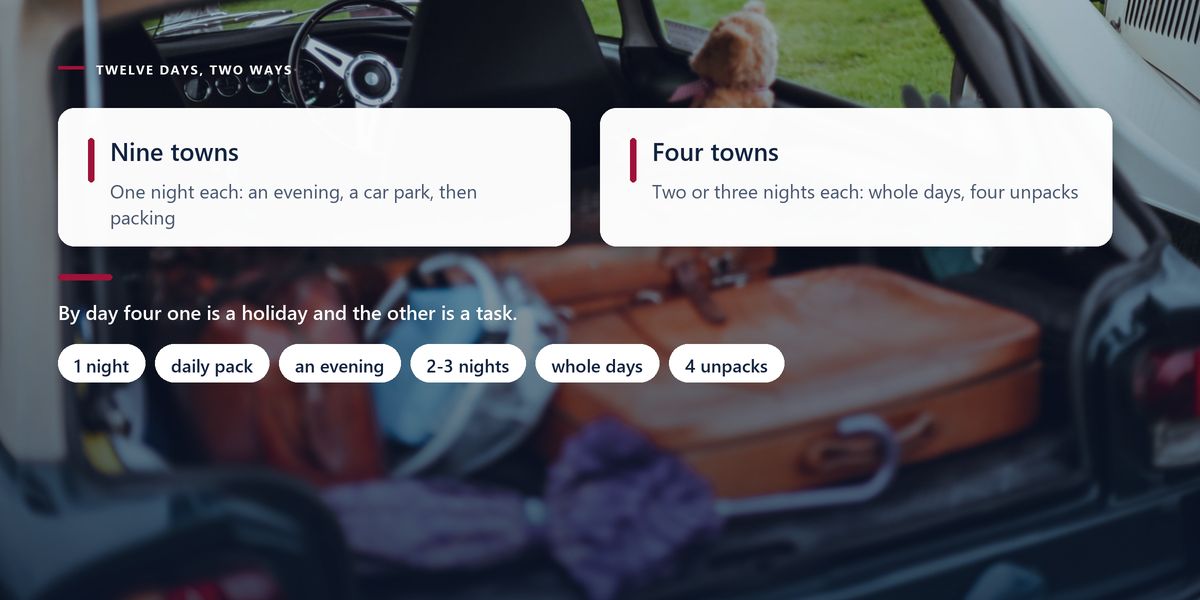
A couple planned a twelve-day trip covering nine towns, with drives of three to five hours between each and one night in most of them. It looked, on paper, like an efficient way to see a lot.
By day four they were exhausted, had eaten most meals at service stations, and had a running argument about departure times. They abandoned the plan and stayed three nights in the next town.
The remaining eight days covered four places instead of five, with two or three nights in each. Both later described the second half as the actual holiday and the first half as a driving task they had set themselves for no reason.
Tiredness at the wheel is a serious and underestimated risk, and it accumulates over consecutive days of driving. Never push on to reach a booked destination when you are struggling to concentrate — stop, swap drivers or find somewhere closer. No itinerary is worth it, and the cost of an unplanned night is trivial by comparison.
Download offline maps for the whole route before you leave, since coverage is unreliable in exactly the scenic areas you are driving through. Carry a physical charger rather than relying on one cable everyone needs.
Keep a small bag with what you need overnight separate from the main luggage, so a one-night stop does not require unloading the entire car. And check tolls, city access restrictions and parking rules in advance — low-emission zones in particular catch out a lot of visiting drivers, and the fines arrive by post weeks later.
Cap daily driving at four to five hours and add 30 to 50% to app estimates. Stay two nights minimum in each place. Book the first and last nights and roll the rest. Check the car and your breakdown cover. Drive in the mornings, arrive early, and stop more often than seems necessary.
The instinct when planning a road trip is to maximise the number of places. The thing that makes one enjoyable is almost the opposite: fewer stops, longer in each, and afternoons that belong to you rather than to the road.
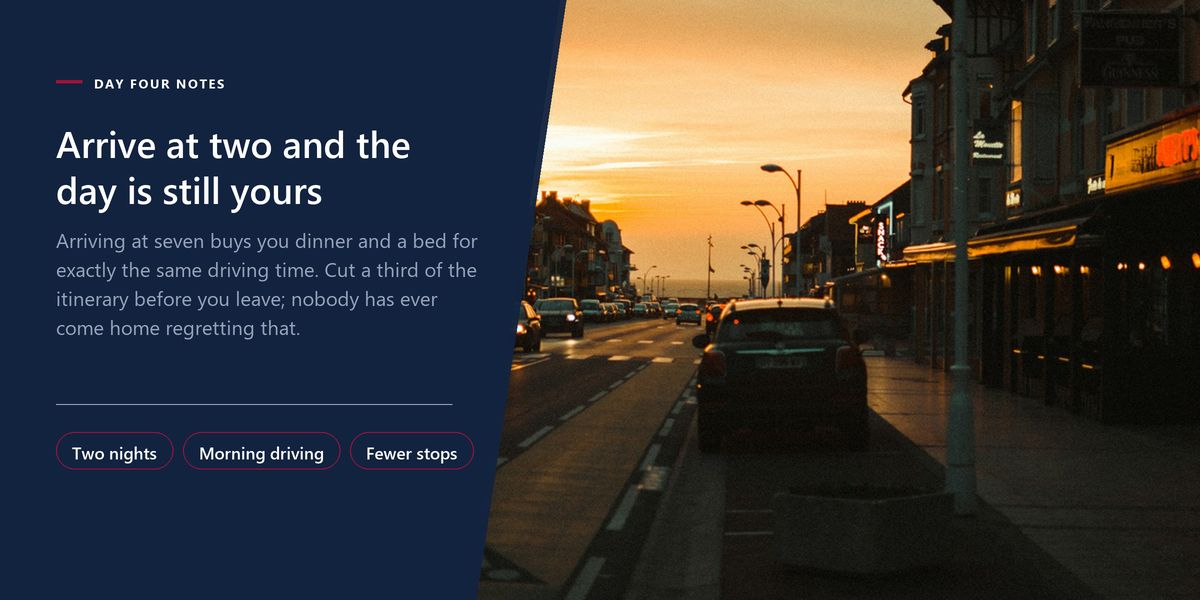
Cut a third of your itinerary before you leave. Nobody has ever regretted this. If your budget is tight, our guide to travelling on a small budget pairs well with it.
Tap a star to share what you thought.
No ratings yet
Four to five hours of actual driving is a sensible ceiling for an enjoyable trip, and around three with children. Remember that mapping estimates exclude stops, traffic and parking, so add roughly 30 to 50% for the real door-to-door time.
Book the first and last nights at minimum. Beyond that, booking a day ahead over breakfast suits most trips — it keeps the flexibility to stay somewhere longer while avoiding an evening spent driving between full hotels.
Because you spend the time arriving, unpacking, sleeping, repacking and leaving, which means seeing very little. Two nights gives you a full day somewhere without moving luggage and changes the character of the whole trip.
Tyre pressure and tread including the spare, oil and coolant levels, screenwash, brakes and lights. Also confirm your breakdown cover extends to the countries you are visiting and check any legally required equipment for those countries.
Rotate drivers, stop roughly every two hours before anyone needs to ask, keep snacks and water within reach rather than in the boot, share control of the music, and agree the day's driving distance in advance so nobody is surprised.
Do most of the driving in the morning and aim to arrive by early afternoon. The driving time is identical but you gain an afternoon and evening in each place, plus a buffer if something on the road goes wrong.
Sign in to join the conversation.
Loading responses…
Have a story, idea, or something valuable to share? Join The Blog Story for free, publish your content, reach more readers, and earn a share of advertising revenue from eligible content.
Create quality content. Grow your audience. Grow your earning potential.