Index Funds Explained: What They Are and Why They Are So Widely Recommended
Owning a small slice of everything, cheaply, and then leaving it alone.

6 min read

—Not yet rated
Owning a small slice of everything, cheaply, and then leaving it alone.
Index funds are recommended so consistently, by so many people with so little else in common, that it is worth understanding what they actually are rather than taking it on faith.
The idea is almost aggressively simple. Instead of employing someone to choose which companies will do well, an index fund buys all of them in a given market, in proportion to their size, and does nothing else.
This article explains the mechanics and the trade-offs. It is general educational information, not advice for your circumstances — investment involves risk and anyone unsure should speak to a regulated financial adviser.
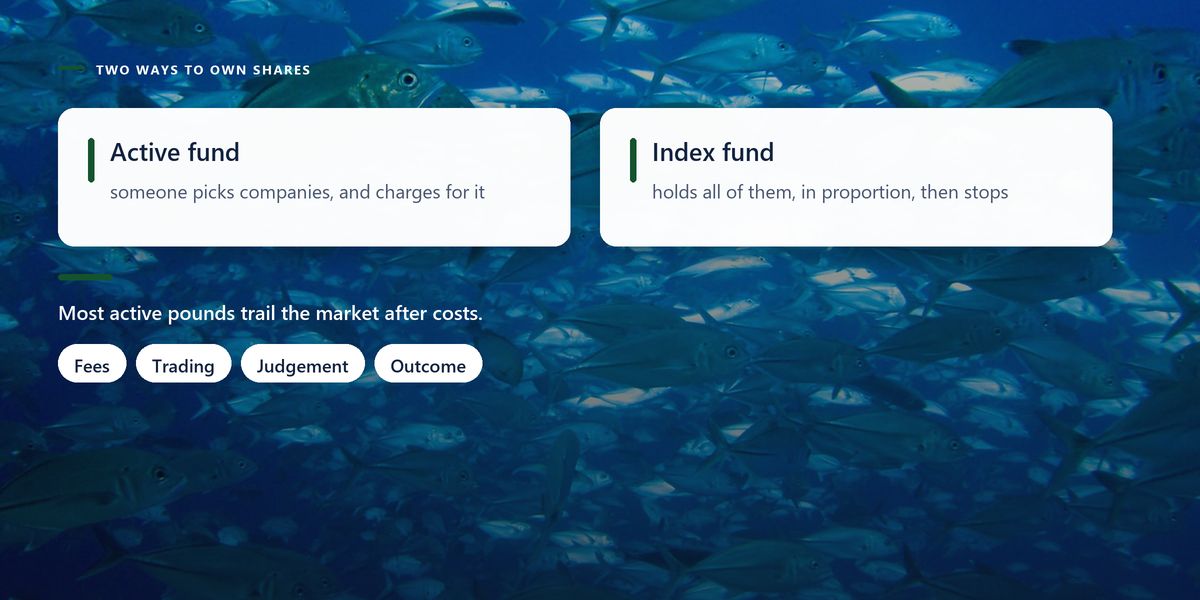
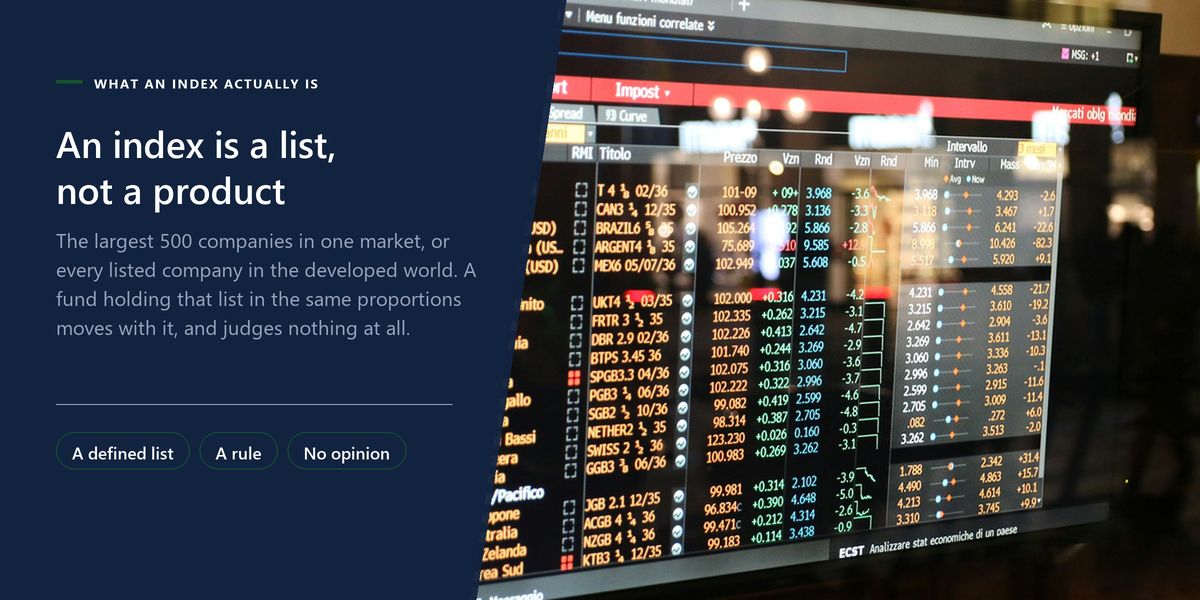
An index is just a defined list of companies with a rule for measuring them collectively — the largest 500 companies in the United States, or all listed companies in developed markets worldwide, for example. It is a measuring instrument, not a product.
An index fund is a fund that holds those companies in the same proportions, so its value moves with the index. There is no judgement involved about which companies are attractive, which is exactly the point.
The counter-intuitive part is that a strategy involving no skill outperforms most strategies that involve a great deal of it. There are two reasons, and both are structural rather than a matter of opinion.
The first is arithmetic. All investors collectively own the whole market, so their combined return before costs must equal the market return. That means for every investor beating the market, another must be behind it — and after fees, the average actively managed pound necessarily returns less than the market.
The second is cost. Active funds charge more because research, trading and fund managers are expensive. Those costs come out every year regardless of whether the fund performed well.
A fee of 1% a year sounds trivial and is not. Over decades it compounds against you in the same way returns compound for you, and the cumulative effect on a final balance can be very large — plausibly a quarter of it over an investing lifetime.
This is the single clearest argument for index funds. Typical index tracker charges are a small fraction of typical active fund charges, and that difference is certain, whereas outperformance is not.
| Typical index fund | Typical active fund | |
|---|---|---|
| Annual charge | very low | several times higher |
| What it holds | the whole index | a selection chosen by a manager |
| Trading activity | minimal | frequent, adding cost |
| Performance vs market | market return minus a small fee | varies; most trail after costs |
| Predictability | high | low |
Compare the ongoing charges figure rather than the headline fee, since it captures the fund's total annual running costs. Then check the platform or account fee separately, because a cheap fund inside an expensive platform is not a cheap arrangement.
Both can track the same index and the practical differences are small for a long-term investor.
A traditional index fund is priced once a day and you buy directly in currency amounts, which suits regular automated contributions. An exchange-traded fund trades on an exchange like a share, priced continuously, which suits people who want intraday flexibility and may involve trading commissions depending on the platform.
For someone contributing monthly and holding for decades, either is fine. Choose based on what your platform charges and how easily you can automate contributions.
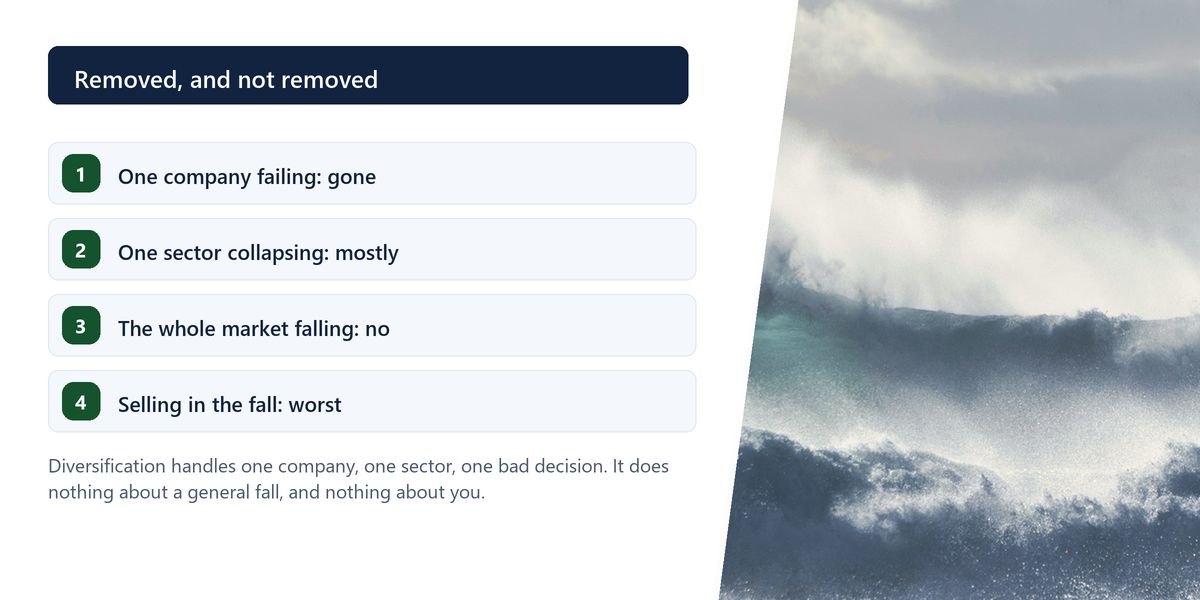
Holding hundreds or thousands of companies means no single company failing can seriously damage you. That is genuine and valuable protection, and it is the specific risk index funds remove.
What it does not remove is market risk. If the whole market falls 30%, a fund tracking the whole market falls roughly 30% too. Diversification protects against one company, one sector or one bad decision — not against a general downturn.
This matters because the most common way investors lose money is not choosing badly. It is selling during a fall, converting a temporary decline into a permanent loss.
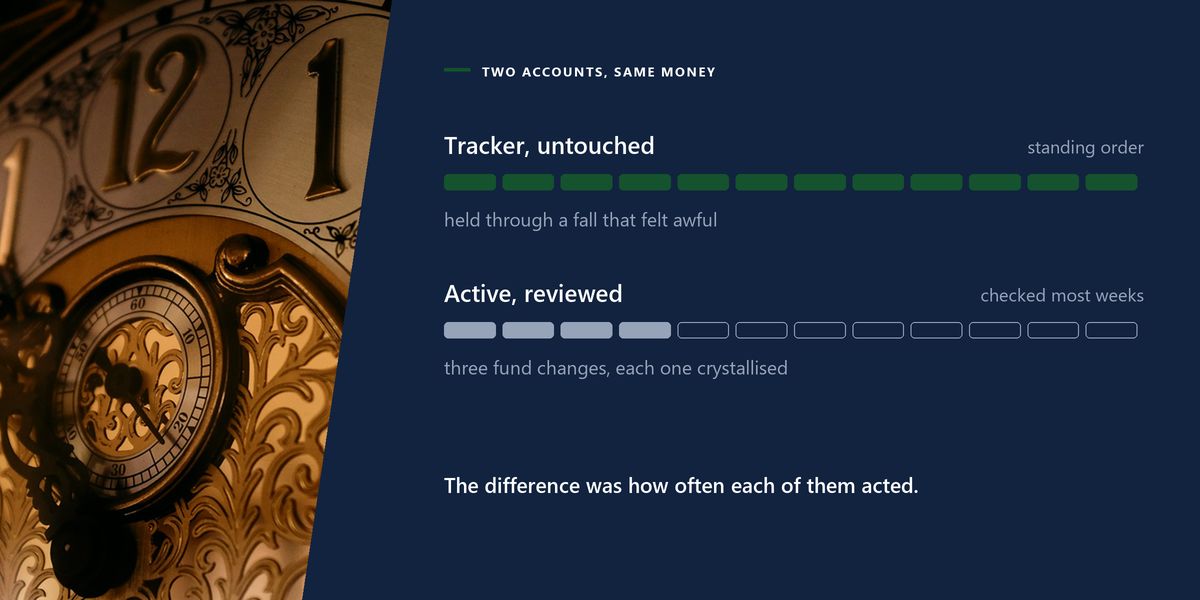
A couple began investing at the same time with the same monthly amount. One chose a low-cost global index tracker and set up a standing order. The other chose an actively managed fund recommended by a friend and reviewed his holdings most weeks.
Over the following years the active investor changed funds three times — twice after a period of poor performance, once after reading an article. Each change crystallised the underperformance and incurred costs.
The index investor did nothing at all, including through a sharp fall that made her distinctly uncomfortable. The difference in their outcomes had less to do with fund selection than with how often each of them acted.
Investments can fall as well as rise and past performance does not predict future returns. Nothing here is a recommendation for your circumstances. Tax rules, available account types and product regulation differ considerably between countries, and anyone with meaningful sums at stake should take regulated advice.
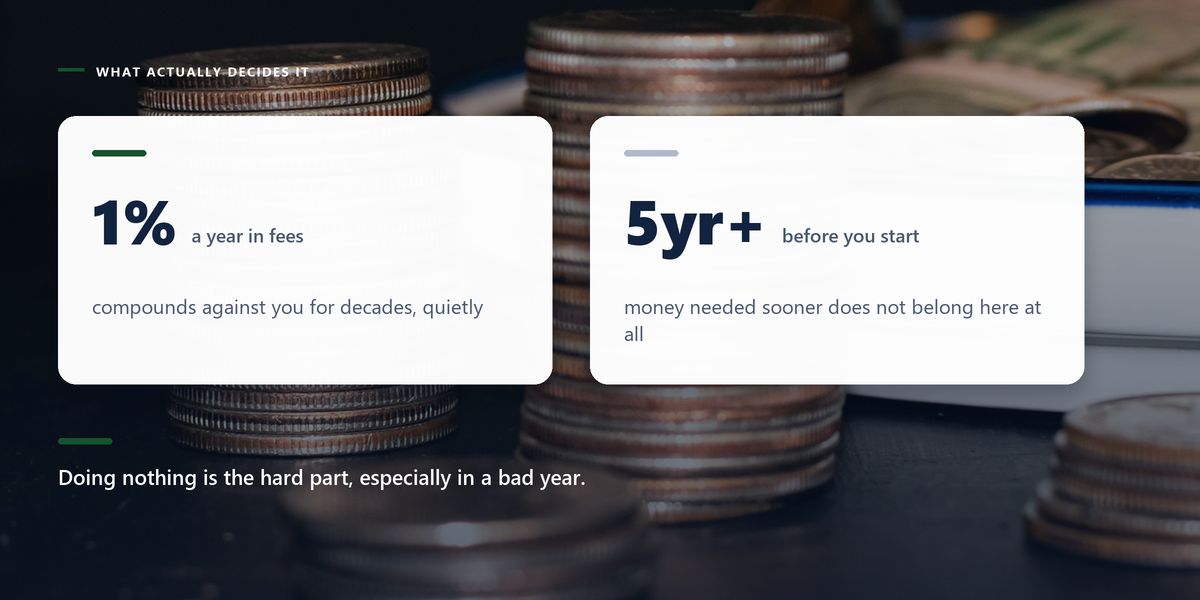
An index fund holds an entire market rather than selecting companies, at a much lower cost than active management. Low costs compound in your favour, diversification removes single-company risk, and neither protects against a general market fall. Use tax-efficient accounts, automate contributions, invest only money you will not need soon, and then leave it alone.
The appeal of index investing is not that it is clever. It is that it removes most of the ways ordinary investors damage their own returns — high fees, frequent trading, and reacting to news.
Which makes the hardest part of the strategy the doing-nothing, particularly during a bad year. Before starting, make sure the emergency fund is in place, so a difficult month never forces you to sell.
Tap a star to share what you thought.
No ratings yet
A fund that holds all the companies in a defined index, in the same proportions, rather than selecting which ones to own. Its value moves with the index, and because no research or stock picking is involved, its running costs are very low.
Because of arithmetic and cost. Investors collectively own the market, so before fees their average return equals the market return; after fees, higher-cost active management necessarily averages less. Low, predictable costs are the reliable part of the argument.
Both can track the same index. A traditional index fund is priced once daily and bought in currency amounts, which suits automated monthly contributions. An ETF trades on an exchange throughout the day and may involve trading commissions depending on your platform.
They are diversified, which is different from safe. Holding hundreds of companies removes the risk of any single one failing, but if the whole market falls sharply, a fund tracking that market falls with it.
A great deal over long periods. A one percent annual charge compounds against you in the same way returns compound for you, and over an investing lifetime the cumulative difference can amount to a substantial share of the final balance.
Waiting for a better entry point is market timing, which disappoints even professionals with far more information. Regular automated contributions spread the price you pay and remove the decision entirely.
Sign in to join the conversation.
Loading responses…
Have a story, idea, or something valuable to share? Join The Blog Story for free, publish your content, reach more readers, and earn a share of advertising revenue from eligible content.
Create quality content. Grow your audience. Grow your earning potential.