The Emergency Fund and Your First Budget: Where Money Management Actually Starts
Before investing, before optimising, before anything: a buffer between you and a bad month.

6 min read

—Not yet rated
Before investing, before optimising, before anything: a buffer between you and a bad month.
Personal finance advice tends to start with investing, because investing is interesting. It has charts, opinions and the possibility of being clever. Meanwhile the thing that determines whether most people's finances survive an ordinary year is a boring pile of cash in an instant-access account.
An emergency fund does not grow impressively and there is nothing to optimise. What it does is prevent a broken boiler, a car repair or three weeks of lost income from becoming credit card debt that takes two years to clear.
This is a general guide to building one, plus the simplest budget that works. It is educational rather than personal advice — anyone with complex circumstances should speak to a qualified adviser.
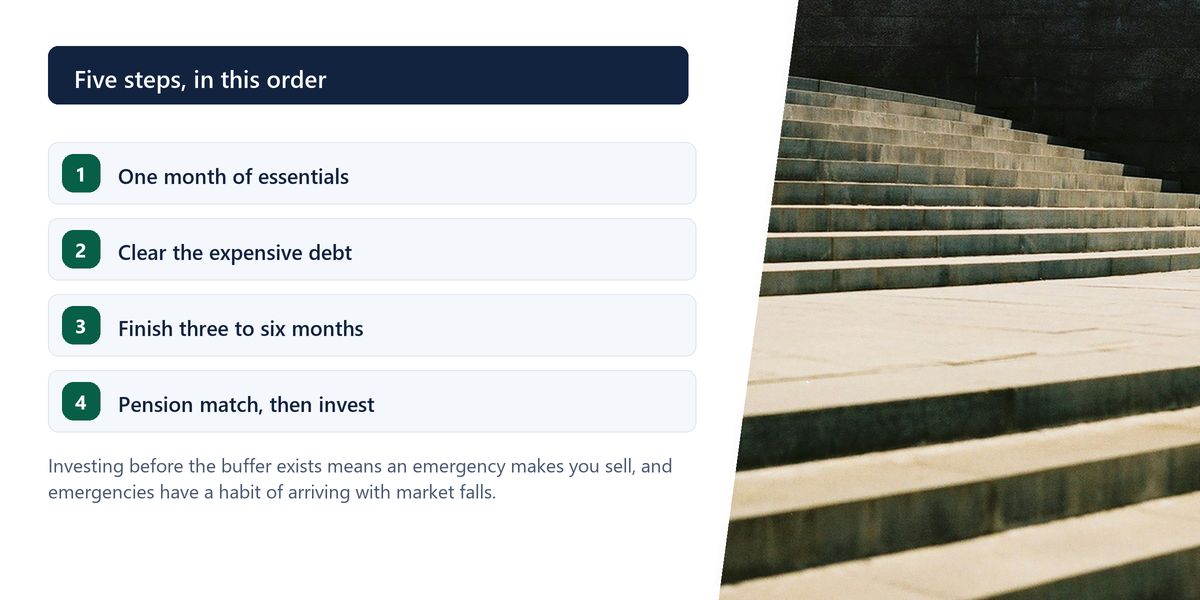
There is a broadly agreed sequence in personal finance, and its logic is about risk rather than returns.
The reason for this order is that investing before you have a buffer means an emergency forces you to sell — often at the worst possible moment, since emergencies and market falls have a habit of coinciding.
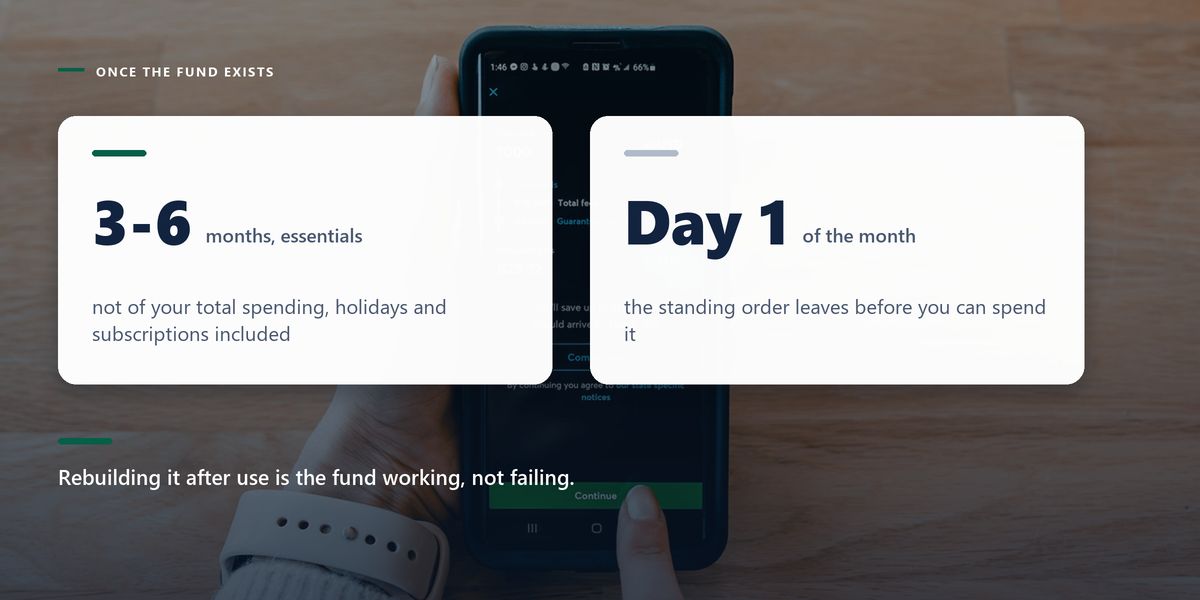
The usual guidance is three to six months of essential expenses, and it is worth understanding both halves of that. Essential expenses means rent or mortgage, utilities, food, transport, insurance and minimum debt payments — not your current total spending including holidays and subscriptions.
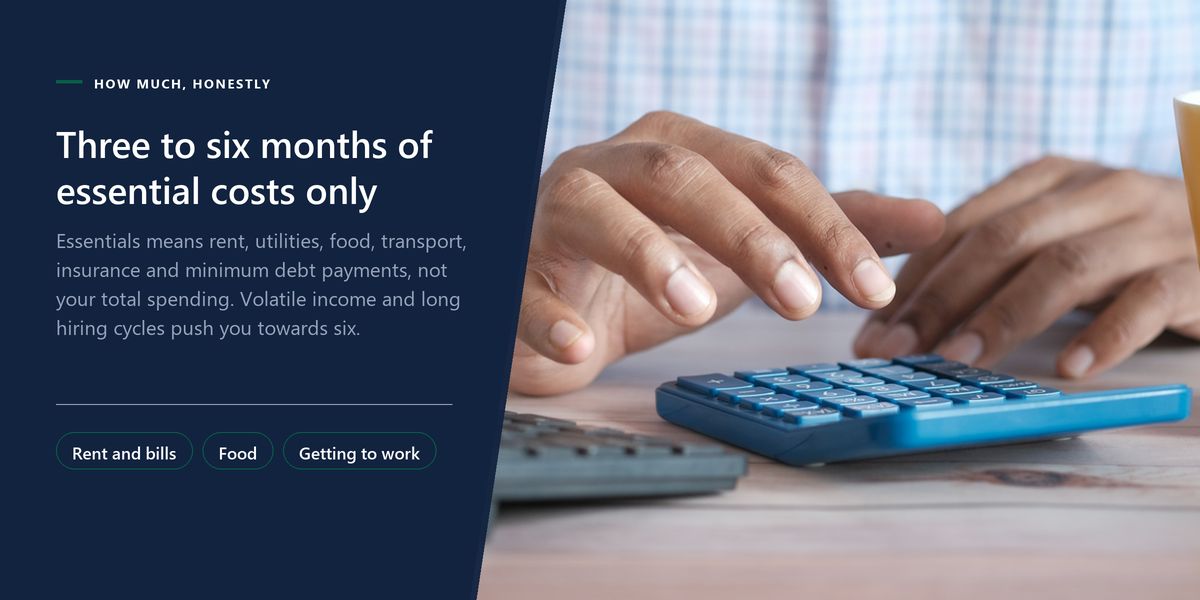
Where you fall in that range depends on how volatile your income is and how quickly you could replace it. A permanent employee in a stable sector with a partner also earning is nearer three months. A freelancer, a sole earner, or anyone in a sector with long hiring cycles is nearer six, and sometimes beyond.
Three requirements, in order: you can access it within a day or two, its value does not fall, and it is not so accessible that it gets spent.
| Location | Suitable? | Why |
|---|---|---|
| Instant-access savings account | yes | accessible, protected, earns some interest |
| Your current account | no | it will be spent without you deciding to |
| Fixed-term savings bond | no | locked exactly when you need it |
| Stocks and shares | no | may be down 30% on the day you need it |
| Cash at home | small amount only | no protection, no interest, easily lost |
| A separate bank entirely | often best | friction stops casual spending |
Hold the fund at a different bank from your current account. The extra day it takes to move money is exactly enough friction to stop it being used for a sale, and not nearly enough to matter in a real emergency.
Elaborate budgets fail for the same reason elaborate diets do. The one that works is the one still being used in April.
A widely used starting structure splits take-home pay into three: around 50% for needs, 30% for wants, and 20% for saving and debt repayment. The percentages are a starting point rather than a rule — high housing costs make 50% impossible in many cities, and the value is in the structure rather than the exact numbers.
The important part is that saving happens first. Standing order on payday, into the separate account, before the money is available to spend. Saving what remains at the end of the month reliably produces very little, because spending expands to fill whatever is there.
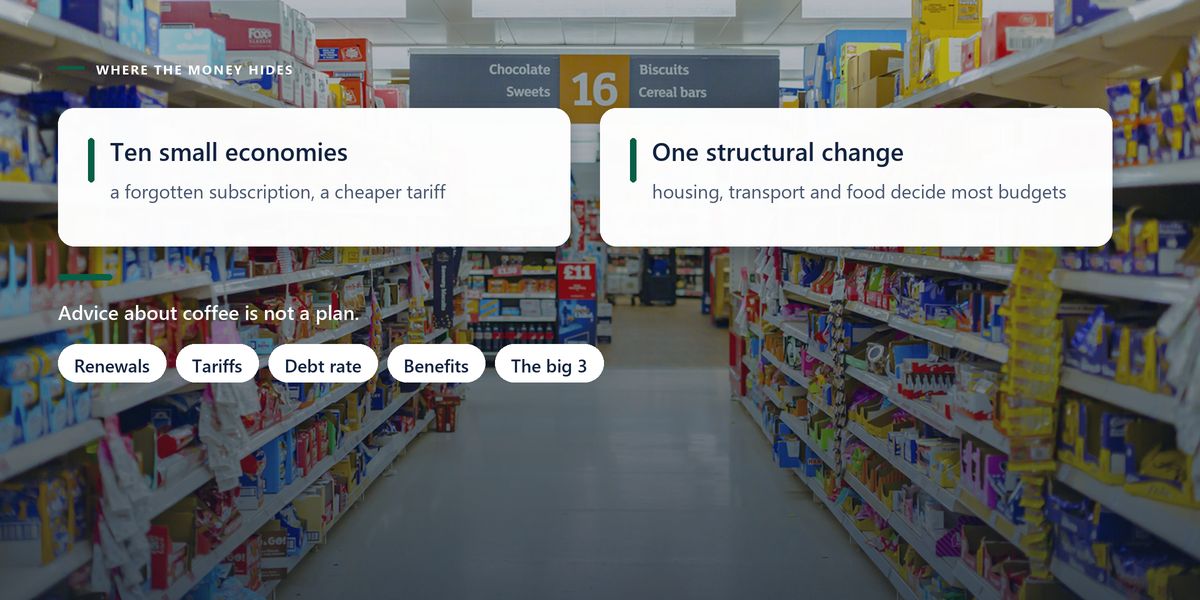
For anyone whose budget genuinely does not balance, the standard advice about coffee is insulting and useless. The larger levers are worth checking first, because they are where real money hides.
A fund that is spent on non-emergencies is not a fund. The useful test is three questions: is it unexpected, is it necessary, and is it urgent? All three must be true.
A boiler failing in January passes. A car repair you need in order to work passes. Losing your income passes. A holiday, an upgrade, a sale, and Christmas all fail — Christmas in particular is not unexpected, and budgeting for it separately is what stops it raiding the fund every year.
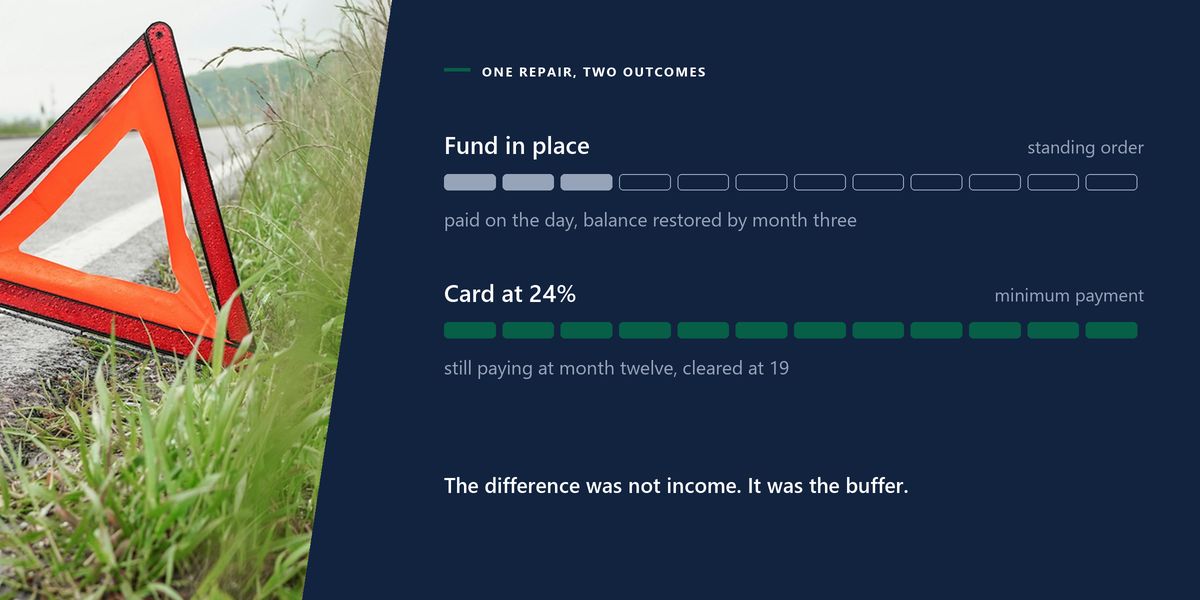
Two colleagues on similar salaries both had their cars fail in the same month, with repairs of around eight hundred pounds each.
One had four months of expenses saved. She paid, felt mildly annoyed, and spent the following three months restoring the balance through her usual standing order.
The other put it on a credit card at 24% and paid the minimum. Between the interest and two subsequent months where the payment squeezed everything else, the same eight-hundred-pound repair took nineteen months to clear and cost close to a thousand.
The difference in outcome was not income or discipline. It was whether a buffer existed on the day the car stopped.
This is general information rather than advice for your situation. Debt priorities, tax treatment and available savings products vary considerably by country and by circumstance, and anyone with problem debt should contact a free debt advice service rather than acting on a general article.
Two things happen after the fund is complete, and both are worth expecting. The first is that you will use it, probably sooner than you would like. That is not a failure — it is precisely what it exists for. Rebuild it and carry on.
The second is more subtle. People consistently report that the largest benefit of an emergency fund is not financial but psychological: the low background hum of anxiety about money going wrong quietens. That effect starts well before the fund is complete.
Build one month of essential costs, clear expensive debt, then extend the fund to three to six months. Keep it in an instant-access account at a different bank. Automate saving on payday rather than saving what remains. Check subscriptions, insurance and the big three costs. Spend it only on things that are unexpected, necessary and urgent.
Nobody enjoys building an emergency fund. It produces no story, no return worth discussing and no sense of cleverness.
What it produces is the ability to have a bad month without it becoming a bad two years — which is, by a considerable margin, the most valuable thing personal finance can do for most people. Once it is done, our explainer on how index funds work covers what usually comes next.
Tap a star to share what you thought.
No ratings yet
Commonly three to six months of essential expenses — housing, utilities, food, transport, insurance and minimum debt payments, not your total spending. Lean toward six months or more if your income is variable or you are the sole earner.
Usually build a small one-month buffer first, then clear high-interest debt such as credit cards, then complete the full fund. Clearing debt charging 20% or more is effectively a guaranteed return that no savings account can match.
In an instant-access savings account, ideally at a bank other than your everyday one. It needs to be reachable within a day or two, protected from falling in value, and just inconvenient enough that it does not get spent casually.
It is generally a poor idea. Investments can fall sharply at exactly the moment you need the money, and emergencies often coincide with wider economic stress. The fund's job is certainty, not return.
Splitting take-home pay roughly into needs, wants and saving — a commonly cited starting split is 50/30/20 — and automating the saving portion on payday. The exact percentages matter far less than saving before spending rather than after.
Something unexpected, necessary and urgent — all three. A boiler failure, an essential car repair or lost income qualify. Christmas, holidays and sales do not, because they are predictable and should be budgeted for separately.
Sign in to join the conversation.
Loading responses…
Have a story, idea, or something valuable to share? Join The Blog Story for free, publish your content, reach more readers, and earn a share of advertising revenue from eligible content.
Create quality content. Grow your audience. Grow your earning potential.