How to Actually Learn a Language as an Adult
Consistency, comprehensible input and the willingness to be bad in public.

6 min read

—Not yet rated
Consistency, comprehensible input and the willingness to be bad in public.
There is a familiar profile: someone has used a language app daily for two years, has an impressive streak, and cannot hold a two-minute conversation.
This is not a failure of effort, and it is not evidence that adults cannot learn languages — the claim that they cannot is considerably weaker than popularly believed. It is a mismatch between what was practised and what was wanted.
Recognising a word in a multiple-choice exercise and producing it under time pressure while someone waits are different skills. Here is what closes the gap.
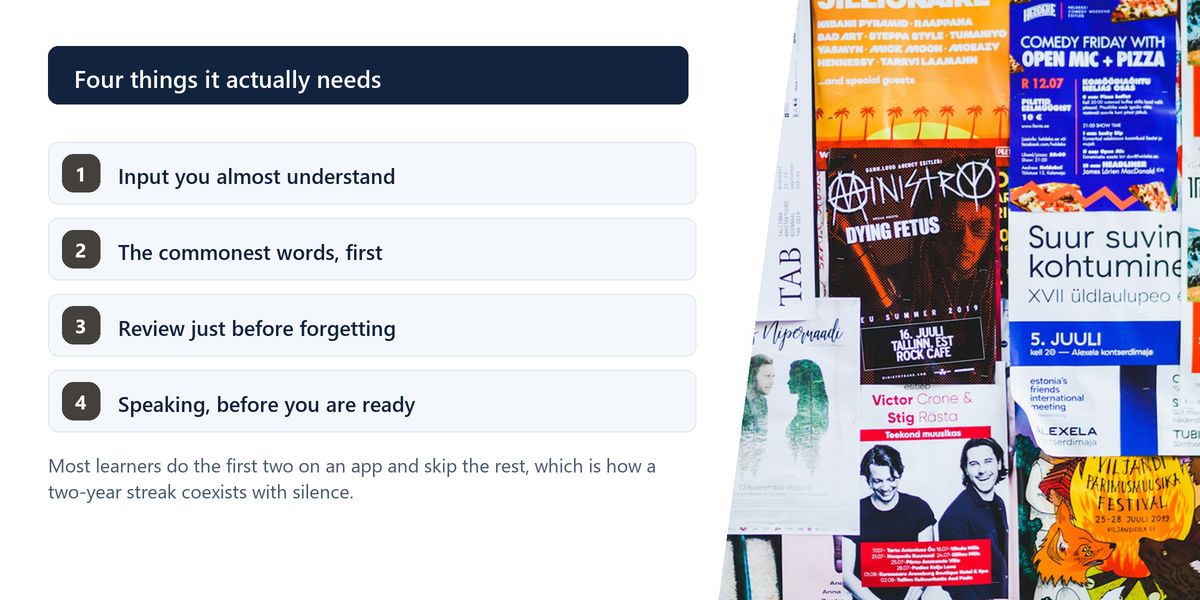
The most robustly supported idea in language acquisition is that you learn primarily by understanding messages slightly above your current level — challenging enough to stretch you, easy enough to follow.
This is why children immersed in a language acquire it and why adults who consume a great deal of content improve rapidly. It is also why studying grammar tables in isolation produces knowledge about a language rather than the ability to use one.
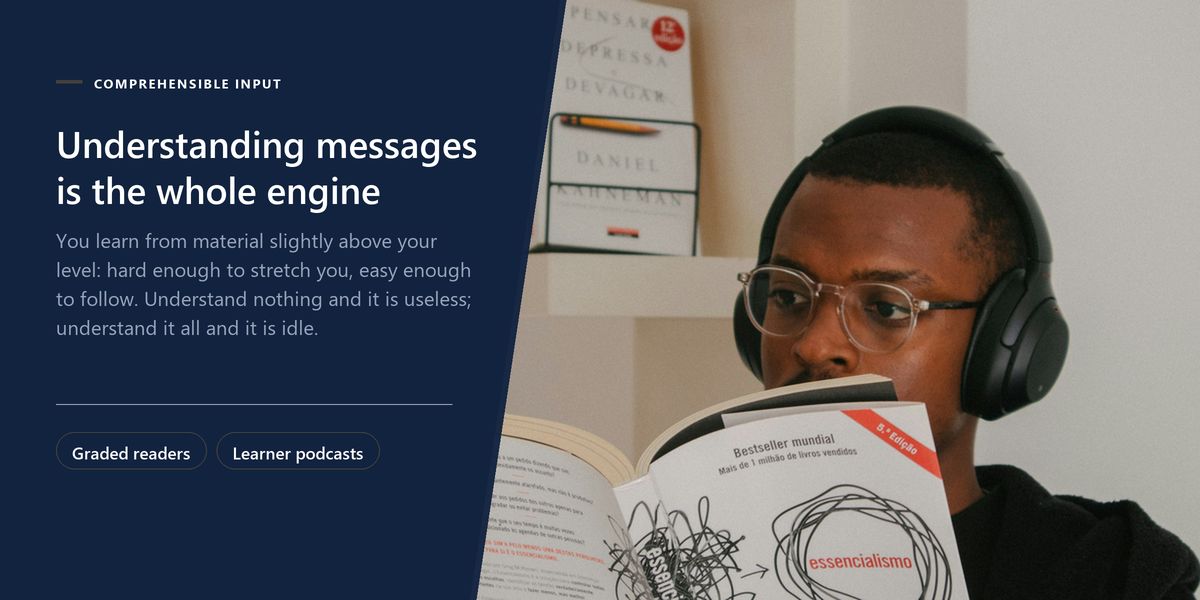
Practically, that means a great deal of listening and reading at roughly the right level: graded readers, learner podcasts, children's programmes, then gradually real material. If you understand almost nothing, it is too hard to be useful. If you understand everything effortlessly, it is too easy to be productive.
Word frequency in languages is extremely uneven. A relatively small number of words accounts for a very large proportion of everyday speech, and the returns fall off sharply after that.
The practical consequence is that learning the most common thousand or two thousand words gives disproportionate access to ordinary conversation. Meanwhile a learner who has studied several tenses but lacks common nouns and verbs cannot say anything at all.
Learn vocabulary in context rather than as isolated word lists — whole phrases and sentences, since that also teaches how words combine, which is where a great deal of the difficulty in a new language actually lives.
Memory research is unusually clear on this: material reviewed at increasing intervals, just as you are about to forget it, is retained far better than material re-read repeatedly in a block.
Spaced repetition software automates the scheduling. The important part is not which application you use but that you make your own cards from material you encountered in context rather than downloading a large pre-made deck, which is a common route to abandoning the habit.
Keep cards short and specific. A card containing a full paragraph is not a memory item; it is a reading exercise you will start skipping.
This is the step most adults avoid, and it is the one that separates people who become conversational from people who study indefinitely.
The reluctance is understandable. Speaking badly in front of another person is uncomfortable, particularly for adults accustomed to being competent. But production is a distinct skill from comprehension and does not develop passively — you can understand a great deal and still be unable to produce a sentence in real time.
| Practice | Develops | What it does not develop |
|---|---|---|
| Listening to podcasts | comprehension, ear for rhythm | production under pressure |
| App exercises | recognition, some vocabulary | spontaneous speech |
| Reading | vocabulary, grammar patterns | pronunciation, listening |
| Speaking with a person | production, recovery, fluency | little — this is the broadest |
| Writing | accuracy, considered production | speed |
Book a regular conversation session with a tutor or exchange partner from an early stage — well before you feel ready. The scheduled commitment forces production, and half an hour a week of speaking usually advances fluency more than several hours of solo study.
Twenty to thirty minutes daily is substantially more effective than a long weekend session, because memory consolidates through repeated exposure over time rather than through duration in one sitting.
It also keeps the language present. A week without contact means the first part of each session is spent recovering rather than progressing, which is why irregular study produces the sense of running to stay still.
Attach it to an existing routine — commute, coffee, the walk to work — and it stops requiring a decision, which is where most study plans quietly fail.
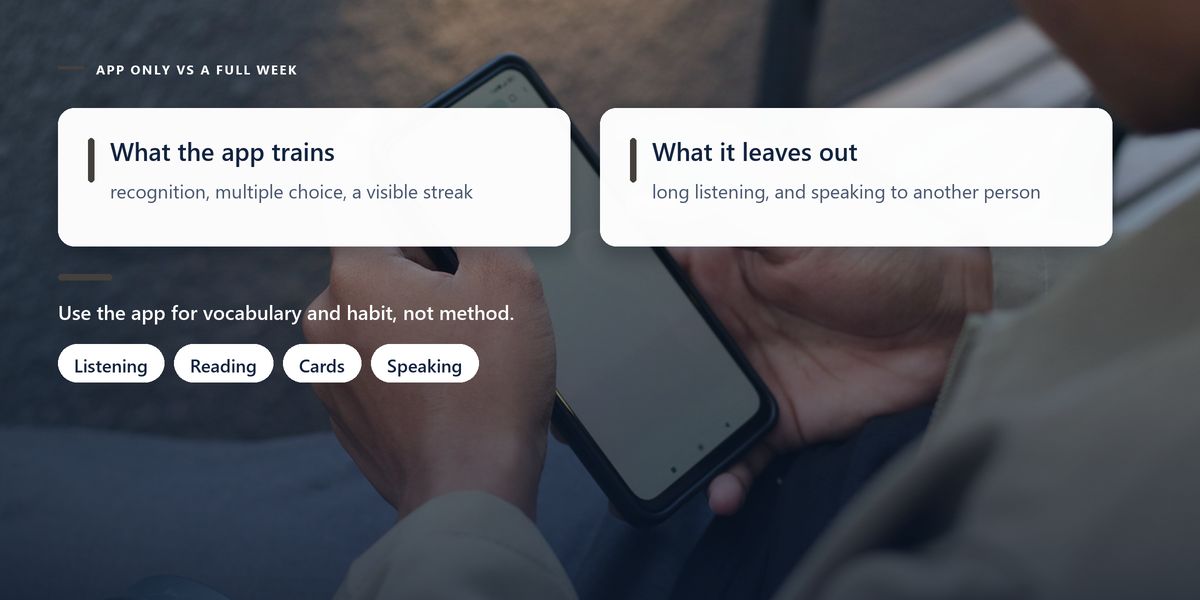
Language apps are genuinely useful for early vocabulary, for building a daily habit and for keeping motivation up through visible progress. That is a real contribution and it is not the whole thing.
Their limitation is that they mostly train recognition through multiple choice and short prompts, which is why a long streak can coexist with an inability to speak. They also rarely provide extended listening or real conversation, the two things that produce fluency.
Use them as one component — ideally the vocabulary and habit component — and add input and speaking alongside. Treating an app as the entire method is the single most common reason adults plateau.
Pronunciation is worth attention at the start, because habits formed early are difficult to correct and errors that fossilise can persist for years.
Listen closely, imitate deliberately, and record yourself occasionally — most learners are surprised by the gap between what they think they sound like and what they do.
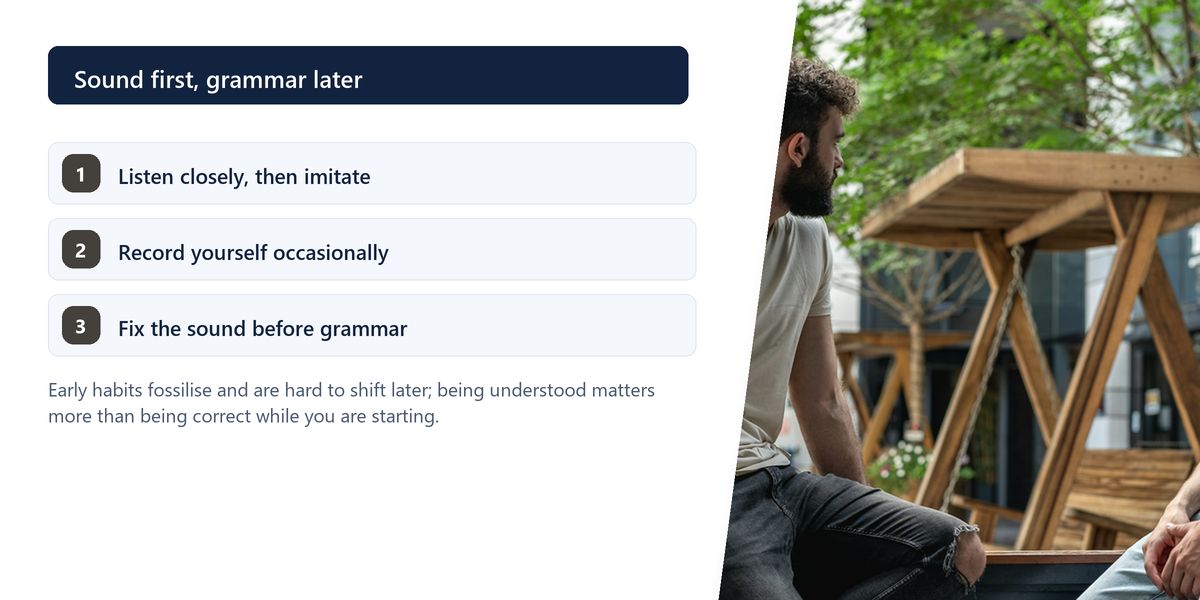
Grammatical accuracy, conversely, can wait. Being understood matters more than being correct in the early stages, and accuracy improves through exposure and correction once you are producing enough language to correct.
A software tester spent two years on a language app, reaching a streak he was proud of and a vocabulary he could recognise reasonably well. On a holiday to the country in question, he found he could not order food without switching to English.
He changed approach: two half-hour conversation sessions a week with a tutor, a learner podcast on his commute, and spaced repetition cards built from words he encountered in those conversations.
Within three months he was managing extended conversations, awkwardly but successfully. The two years had not been wasted — the vocabulary was there — but it had never been converted into production, because nothing he had been doing required it.
Beware measuring progress by streaks, points or lesson counts. These measure engagement with an application rather than language ability, and they can substitute for progress convincingly for a long time. Better measures are concrete: can you follow a podcast episode, read a news article, or hold a five-minute conversation?
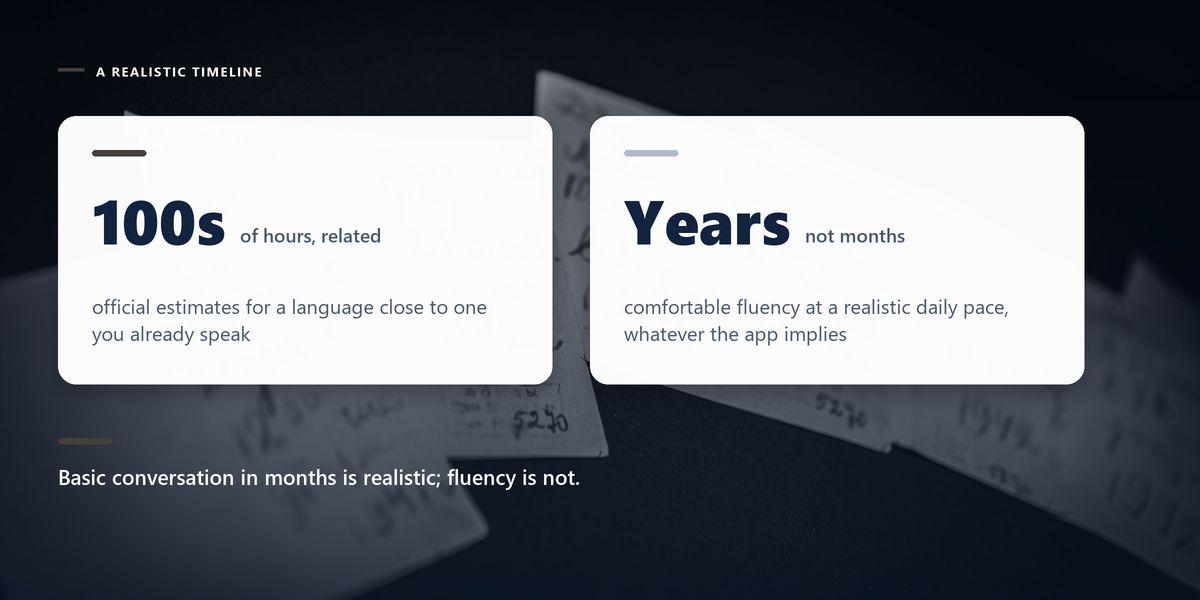
Time to competence varies substantially by language, by how much it resembles languages you already speak, and by how much contact you get. Government language institutes publish rough estimates for their own training, and those run into hundreds of hours for closely related languages and considerably more for distant ones.
That means basic conversational ability in a few months of consistent daily work is realistic for a related language, and comfortable fluency takes years rather than months. Expecting less produces disappointment; expecting more produces the sense of failing at something that was going fine.
Get large amounts of comprehensible input slightly above your level. Learn high-frequency vocabulary in context, reviewed with spaced repetition. Speak with people early and badly. Study daily in short sessions rather than in long weekend blocks. Use apps for vocabulary and habit, not as the whole method, and attend to pronunciation early.
Adults learn languages perfectly well. What they often do is study in ways that produce the feeling of learning without the ability to speak, and then conclude something is wrong with them.
Add the two uncomfortable things — a lot of input you only partly understand, and conversation before you are ready — and progress usually arrives faster than expected. If study technique is your bottleneck, the same principles appear in our piece on building a reading habit.
Tap a star to share what you thought.
No ratings yet
Adults learn differently rather than worse. They acquire vocabulary and grammar rules faster than children, while pronunciation and effortless intuition tend to come less easily. The bigger obstacles are usually available time and reluctance to speak badly, not age itself.
Because comprehension and production are distinct skills, and most study methods train only the first. Recognising a word in a multiple-choice prompt is very different from retrieving it under time pressure while someone waits for you.
They are useful for early vocabulary and for building a daily habit, and they mostly train recognition rather than production. Adding extended listening and regular conversation is what converts app progress into the ability to speak.
Material you can mostly understand but which contains some unfamiliar language — slightly above your current level. It is the most strongly supported mechanism in language acquisition, which is why volume of listening and reading matters so much.
The most common one to two thousand words account for a very large share of everyday speech, so learning those first gives disproportionate access to ordinary conversation. Learn them in phrases and sentences rather than as isolated word lists.
It depends heavily on the language's distance from ones you already speak and on how much contact you get. Basic conversational ability within a few months of consistent daily work is realistic for a closely related language; comfortable fluency takes years.
Sign in to join the conversation.
Loading responses…
Have a story, idea, or something valuable to share? Join The Blog Story for free, publish your content, reach more readers, and earn a share of advertising revenue from eligible content.
Create quality content. Grow your audience. Grow your earning potential.