How to Read More Books Without Turning It Into a Chore
Most people who want to read more do not need discipline. They need permission to abandon books.

6 min read

—Not yet rated
Most people who want to read more do not need discipline. They need permission to abandon books.
Ask people why they do not read more and they will say time. Then observe how the same people spend their evenings, and the explanation becomes less convincing.
The real obstacle is usually far more specific: a single book they are not enjoying, sitting on a bedside table, generating guilt and quietly blocking everything they might otherwise have read.
Reading more is rarely about discipline. It is about removing the things that make it feel like an obligation.
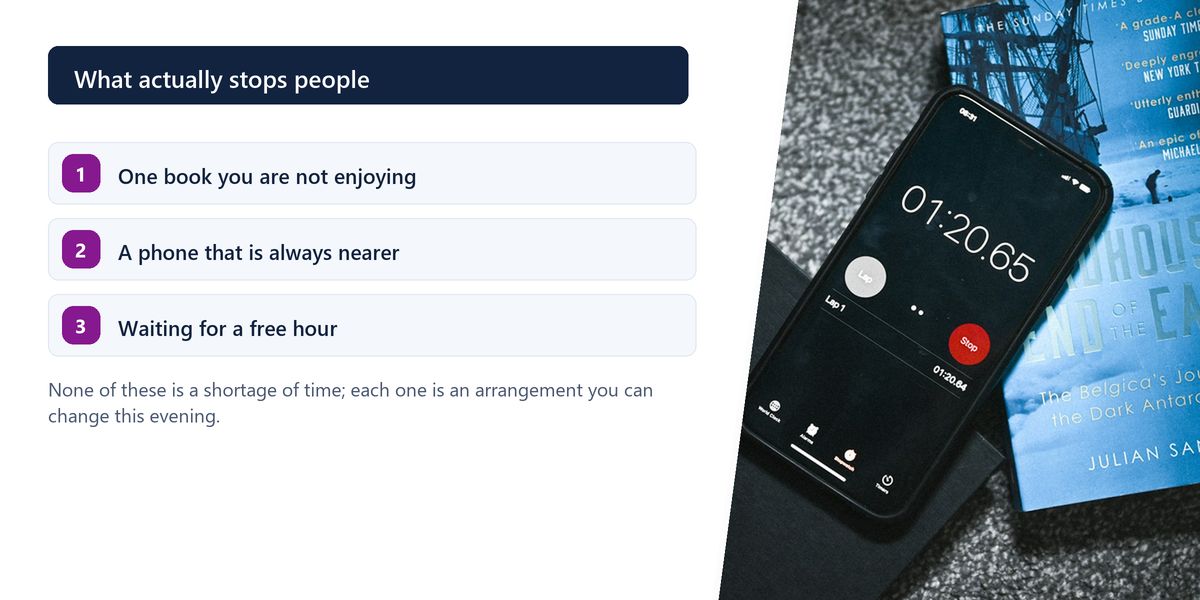
This is the single most effective change, and most people find it uncomfortable — a legacy of school, where finishing was compulsory and books were assigned.
There is no obligation to finish a book you are not enjoying. Nobody is checking, and the author will not know. What abandonment protects is the habit itself: one unenjoyable book kept out of duty can stop someone reading for months.
A useful convention is fifty pages. If a book has not earned your attention by then, put it down without ceremony and start another. You can always return to it, and quite often a book that fails at one moment lands perfectly two years later.
Reading competes with things engineered to be effortless. A phone requires no decision and no reaching; a book on a shelf in another room requires both.

Many people wait for a proper stretch of time — an hour, a quiet house, a free afternoon — which arrives rarely and unpredictably. Meanwhile, twenty minutes a day is roughly twenty books a year for an average reader.
The best places to find those minutes are the gaps already in your day: a commute, a wait, the time before sleep, a lunch break. None of them feel like reading time, and together they exceed what most people manage in deliberate sessions.
Pairing reading with an existing routine works better than scheduling it separately. Ten pages before sleep, or a chapter with morning coffee, requires no willpower after the first fortnight because it stops being a decision.
There is an unhelpful hierarchy in which audiobooks are considered cheating. Research on comprehension generally finds listening and reading produce broadly comparable understanding for most narrative and general non-fiction material.
Where print retains an advantage is dense, technical or reference material, where re-reading a paragraph and moving at your own pace matters. For a novel, a memoir or most popular non-fiction, listening is genuinely reading the book.
Practically, audiobooks unlock time that was never available for print — walking, driving, cooking, exercising — which for many people is where the majority of their reading now happens.
| Situation | Best format | Why |
|---|---|---|
| Commuting or walking | audiobook | hands and eyes occupied |
| Before sleep | physical book or e-reader | no bright screen, easy to stop |
| Dense non-fiction | print or e-reader | re-reading and note-taking |
| Travelling light | e-reader or phone | many books, no weight |
| Cooking or chores | audiobook | otherwise unusable time |
Keep a running list of books you want to read, added to whenever something is recommended. The moment after finishing a book is when reading habits most often stall — not because of time, but because choosing the next one requires energy that is not available at eleven at night.
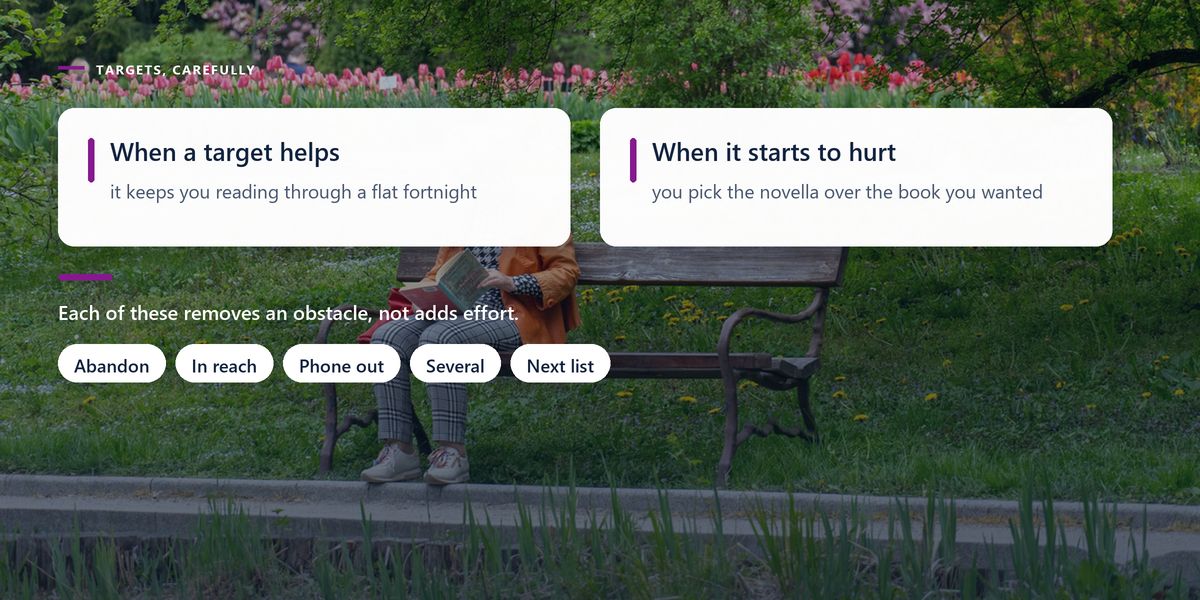
Annual reading challenges motivate some people considerably and distort behaviour in others. The failure mode is well documented: choosing short books over ones you actually want to read, skimming to finish, and treating a demanding book as an obstacle to the number rather than the point of the exercise.
If a target helps you, use one. If you notice yourself picking a novella over a long book you have wanted to read for years, the target has started working against you and is worth dropping.
Volume is not the only goal, and reading more attentively is worth some effort for books that deserve it.
For non-fiction, some form of engagement helps retention considerably — underlining, notes in the margin, or a few sentences written down after finishing about what was actually useful. Reading passively and forgetting almost everything is extremely common and largely avoidable.
For fiction, none of that is necessary. Getting absorbed is the entire point, and treating a novel as a study exercise is a good way to stop enjoying novels.
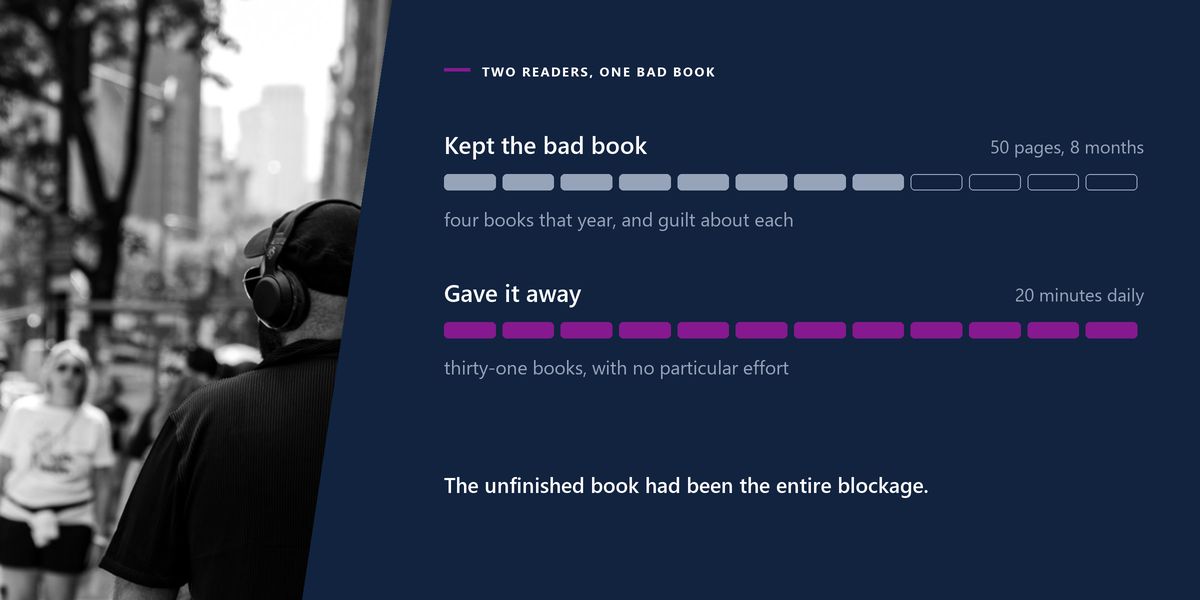
A project manager read perhaps four books a year and felt guilty about it. He had a book on his bedside table that he had been fifty pages into for eight months, and he could not bring himself to start another while it sat there.
He gave that book away, put a novel he actually wanted to read in its place, moved his phone charger to the hallway, and started listening to audiobooks on a forty-minute commute.
He finished thirty-one books the following year, mostly without feeling he was making any particular effort. The unfinished book had been the entire blockage.
Beware turning reading into a performance metric. Tracking, ranking and public challenges suit some people and turn a pleasure into an obligation for others. If reading has started to feel like a task you are behind on, stop counting for a few months and read whatever you actually want.
The most reliable source is a person whose taste you know, rather than a bestseller list or an algorithm. Ask specific people what they loved recently — the answers are usually much better targeted than a general recommendation.
Libraries are also underused, and they solve the abandonment problem elegantly. Borrowing removes the sunk-cost feeling of having paid for something you are not enjoying, which makes putting it down considerably easier.
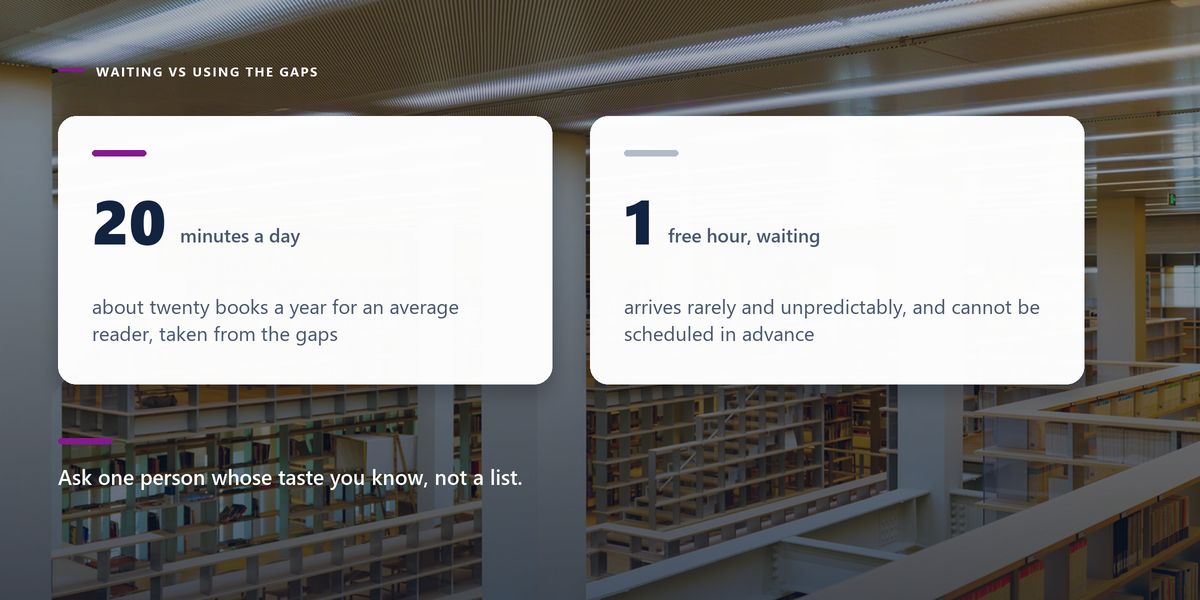
Abandon books you are not enjoying, ideally by around fifty pages. Keep books within reach and the phone elsewhere. Read several at once and match them to your energy. Use audiobooks for otherwise unusable time. Read in twenty-minute gaps rather than waiting for an hour, and keep a list of what is next.
People who read a great deal are not more disciplined than people who do not. They have simply arranged their lives so that reading is the easiest available option in the gaps, and they gave up finishing books they dislike a long time ago.
Start there. Give away the book on your bedside table that you have not touched in two months, and see what happens.
Tap a star to share what you thought.
No ratings yet
Use the gaps rather than waiting for a long stretch. Twenty minutes a day — commuting, waiting, before sleep — amounts to roughly twenty books a year for an average reader, and none of it requires finding an uninterrupted hour.
Entirely. Finishing is a habit left over from school, and one unenjoyable book kept out of obligation can stop someone reading for months. A common convention is to give a book around fifty pages, then put it down without ceremony.
For most narrative and general non-fiction, yes — research on comprehension finds listening and reading produce broadly comparable understanding. Print retains an advantage for dense technical material where re-reading and note-taking matter.
Several at once suits most people better, because it lets you match the book to your energy — something demanding when alert, something lighter when tired. Being stuck with a single unsuitable book is a common reason reading stalls.
For some people. The known failure mode is choosing shorter books to hit a number and treating a demanding book as an obstacle rather than the point. If you notice that happening, drop the target.
For non-fiction, engage actively — underline, annotate, or write a few sentences afterwards about what was genuinely useful. For fiction, none of that is necessary; absorption is the point and treating a novel as study tends to spoil it.
Sign in to join the conversation.
Loading responses…
Have a story, idea, or something valuable to share? Join The Blog Story for free, publish your content, reach more readers, and earn a share of advertising revenue from eligible content.
Create quality content. Grow your audience. Grow your earning potential.