Family Activities That Cost Nothing and Children Actually Remember
Ask an adult about childhood and they rarely describe an expensive day out.

5 min read
—Not yet rated
Ask an adult about childhood and they rarely describe an expensive day out.
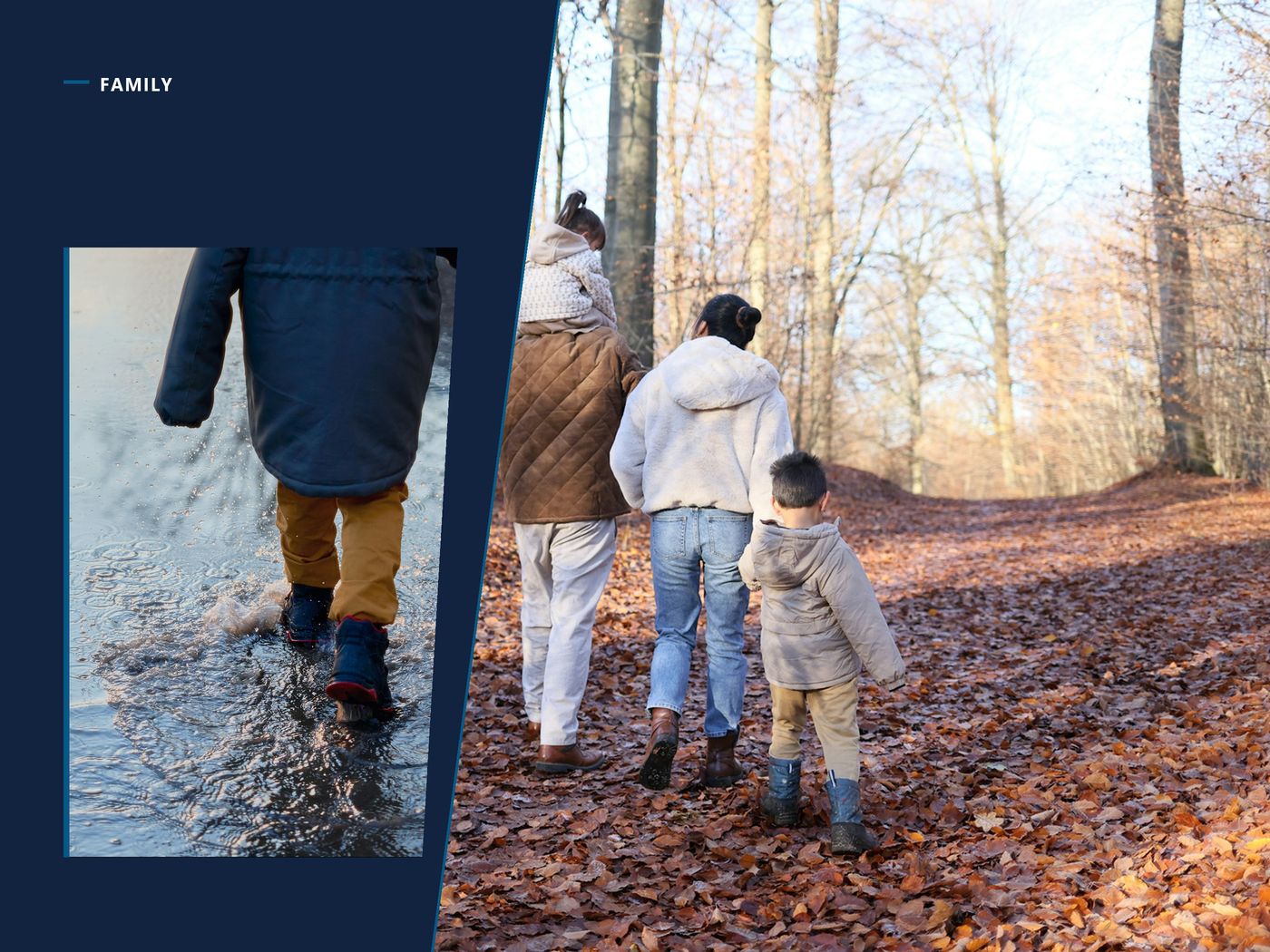
There is a familiar disappointment in family life. You spend a considerable amount on a day out, everyone is tired and overstimulated by two o'clock, and three weeks later the thing your child talks about is the puddle in the car park.
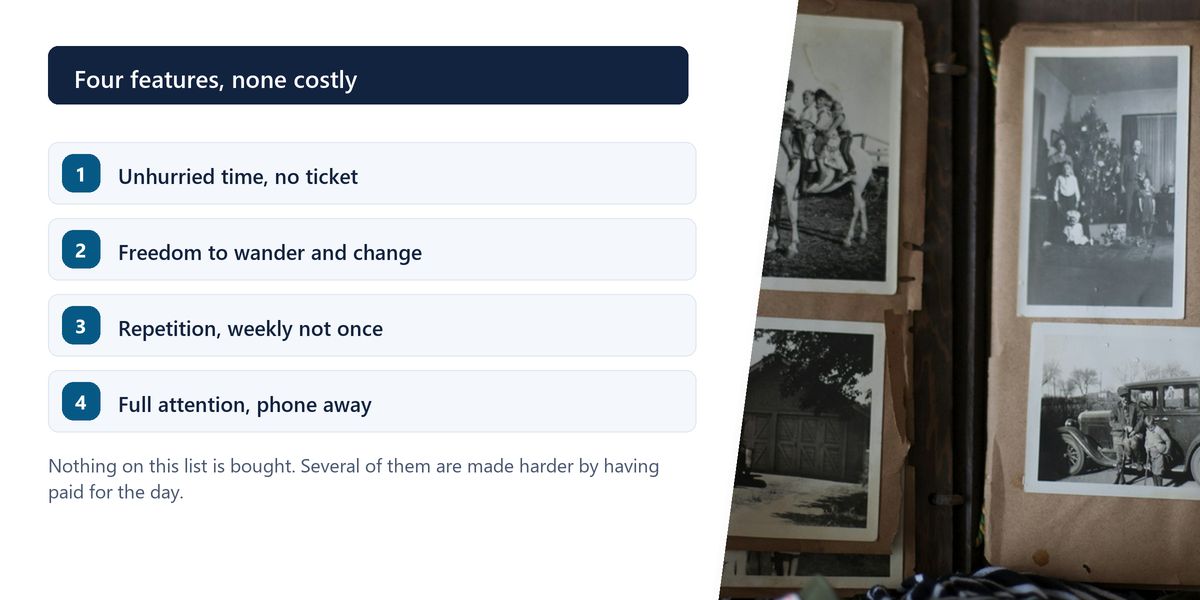
This is not a coincidence and it is not ingratitude. Memorable childhood experiences tend to share features that expensive outings actively work against: unhurried time, a degree of freedom, repetition, and the full attention of a parent.
None of those cost anything. Here is what tends to work, organised by the situation you are actually in.
Big outings usually involve travel, crowds, queues and a schedule, all of which are the conditions under which small children cope worst. Add the parental pressure of having paid for it, and everyone is monitoring whether enjoyment is occurring.
There is also a well-documented pattern in how people remember experiences: the emotional peak and the ending dominate, rather than the duration or cost. A short, calm, happy afternoon frequently outperforms a long expensive one that finished with a meltdown at the exit.

This is genuinely liberating. It means the ordinary Saturday morning has as much potential as the day you booked three weeks in advance.
Cooking with children is slower and messier than doing it alone, and it is one of the highest-value activities available. It involves them in something real rather than something arranged for them, which children detect and respond to.
Pizza dough, biscuits, pancakes and soup are all forgiving enough to survive enthusiastic help. Give a specific job — kneading, stirring, weighing, decorating — rather than vague assistance, and accept that the outcome will be irregular.
Give children a real job rather than a pretend one. Setting a table, carrying something breakable, being trusted with a timer or holding the map produces far more engagement than an activity obviously designed to occupy them. Being useful is more interesting than being entertained.
| Activity | Ages it suits | What you need |
|---|---|---|
| Blanket fort | 3 to 10 | furniture, blankets, clips |
| Making a newspaper or comic | 6 to 12 | paper and pens |
| Indoor obstacle course | 2 to 8 | cushions, tape, imagination |
| Baking something simple | 3 upward | flour, patience |
| Family quiz or card games | 6 upward | nothing |
| Looking through old photos | any | a phone or an album |
| Torch shadow puppets | 2 to 7 | a torch and a wall |
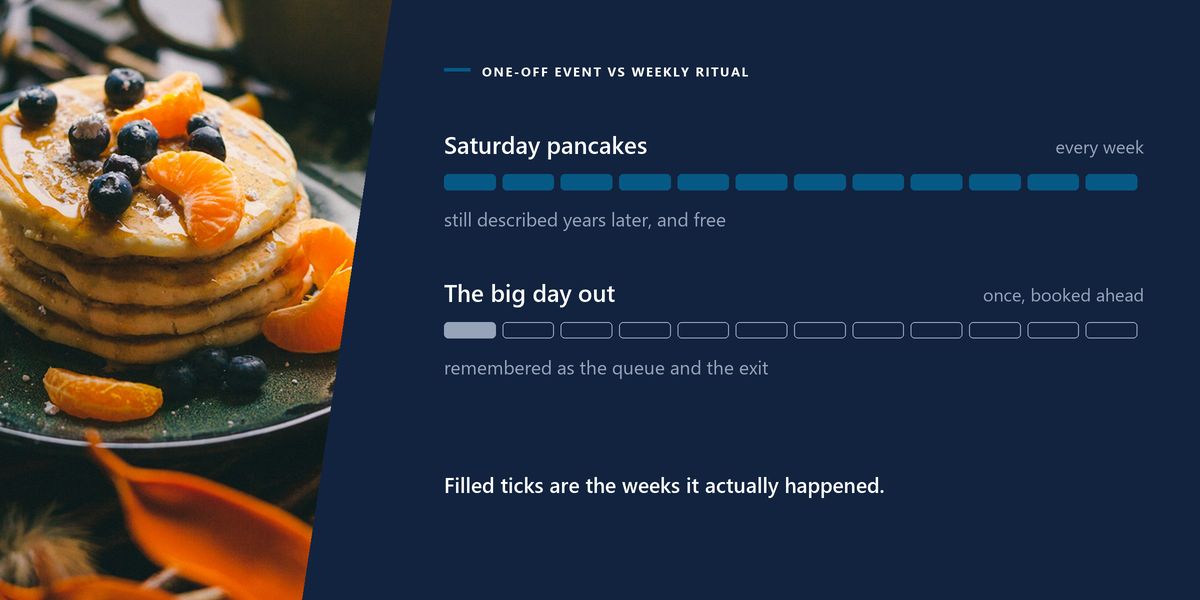
The single most underrated category is the small thing that happens every week. Pancakes on Saturday morning. A walk to the same bench. Friday night films with the same blanket. One song at bedtime.
Rituals work because repetition builds anticipation and identity — this is a thing our family does — and because they require no planning once established. A one-off trip to a theme park is an event; the Saturday pancake is a childhood.
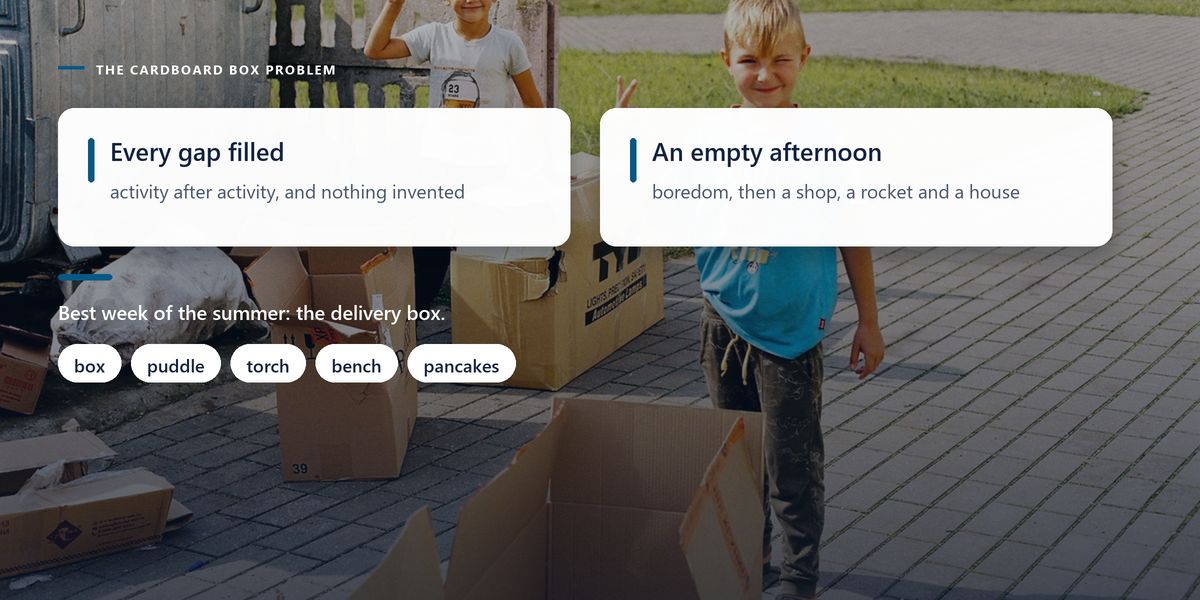
There is a strong modern instinct to fill every gap in a child's day, and it is worth resisting. Unstructured, unsupervised time is where self-directed play develops, and self-directed play is where a great deal of creativity and problem-solving comes from.
A child who says they are bored is not making a complaint requiring action. It is frequently the last thing they say before inventing something. The most useful parental response is usually sympathy and no solution.
A family spent a considerable sum on a week away with a packed itinerary — aquarium, theme park, boat trip, the lot. Everyone enjoyed it and everyone was exhausted.
Two months later the parents asked their six-year-old what the best part of the summer had been. She said the week the washing machine was delivered, because they had the box in the garden for four days and it was, in turn, a shop, a rocket and a house.
The parents found this mildly deflating and then genuinely useful. The following year they booked less and left more afternoons empty, and the holiday was reported by everyone as better.
Beware turning free activities into a performance. The scavenger hunt with a laminated checklist, the baking that must photograph well, the walk with a learning objective — children detect when an activity is being run rather than shared, and the pleasure drains out of it quickly.
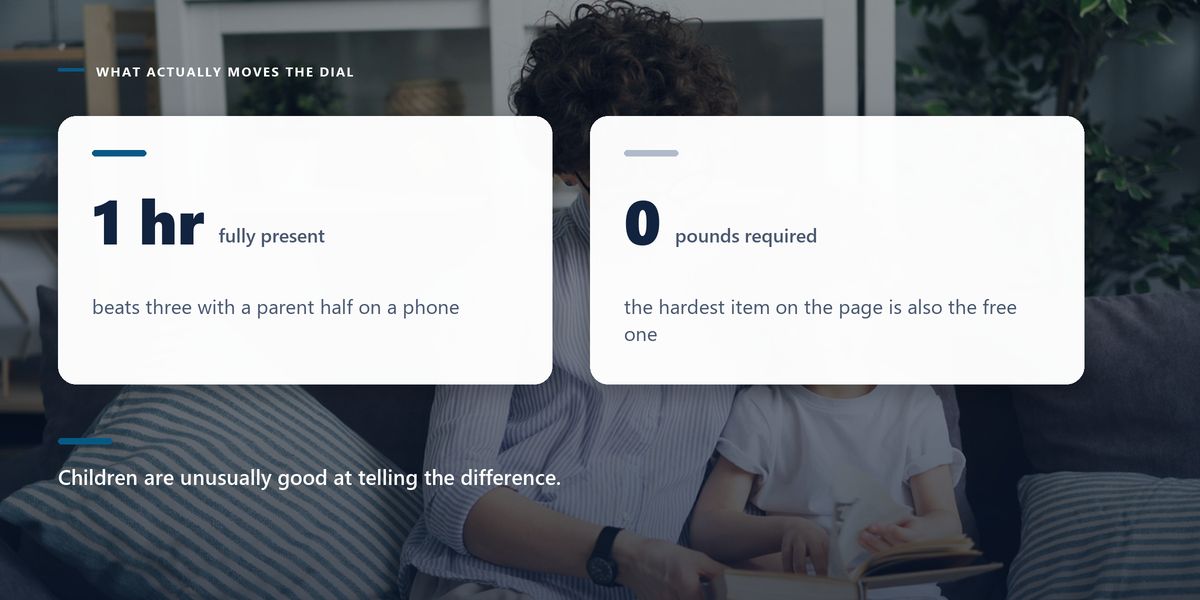
Across all of this, the variable with the largest effect is attention. An hour with a parent who is genuinely present is worth several with one who is half on a phone, and children are extremely good at telling the difference.
That is also the hardest thing on this page. Leaving the phone in another room for one hour is more difficult than driving to an attraction, and it makes considerably more difference.
Choose unhurried, repeatable and slightly unstructured over expensive and scheduled. Get outside in any weather with a simple game attached. Involve children in real jobs rather than arranged entertainment. Build small weekly rituals, allow boredom, and give full attention for a defined stretch.
Children are not, in general, keeping score of what things cost. They are keeping score of who was paying attention and whether it was fun.
That is an unusually achievable standard, and it is available on a wet Tuesday with no notice and no budget.
Tap a star to share what you thought.
No ratings yet
Memory favours emotional peaks and endings over duration or cost, and the conditions that make experiences memorable — unhurried time, freedom, attention — are often undermined by the crowds, queues and schedules of a big day out.
Anything tactile and repeatable: puddles and streams, a blanket fort, an indoor obstacle course from cushions, baking something simple, or torch shadow puppets. Toddlers particularly enjoy being given a real job within an adult activity.
Build something — a fort, an obstacle course, a comic or newspaper. Bake. Play cards. Look through old photographs together. The common feature is that the child is making or doing something rather than receiving it.
Both, with more boredom than most modern schedules allow. Unstructured time is where self-directed play develops, and 'I'm bored' is frequently the sentence immediately before a child invents something.
Undivided attention for a defined stretch. Children distinguish very reliably between a parent who is present and one who is nearby with a phone, and an hour of the former outweighs several hours of the latter.
They tend to be remembered far more strongly than one-off events, because repetition builds anticipation and a sense of family identity. A weekly pancake breakfast or a Friday film night costs nothing and requires no planning once established.
Sign in to join the conversation.
Loading responses…
Have a story, idea, or something valuable to share? Join The Blog Story for free, publish your content, reach more readers, and earn a share of advertising revenue from eligible content.
Create quality content. Grow your audience. Grow your earning potential.