Dog Training Fundamentals: What Actually Changes Behaviour
Dogs repeat what works for them. Almost all training is arranging for the right things to work.

6 min read
—Not yet rated
Dogs repeat what works for them. Almost all training is arranging for the right things to work.
Ask people why their dog does something unwanted and you will usually hear a story about personality. He is stubborn. She knows she is not supposed to. He does it to wind me up.
Dogs are considerably simpler than that, which is good news. They do what has worked for them before, and they stop doing what stops working. Almost all training is a matter of arranging which is which, clearly and consistently.
This is a practical guide to the fundamentals, and to why the things that look like defiance usually are not.
Modern professional guidance is fairly unified on this: reward-based methods are both more effective and less likely to cause problems than punishment-based ones.
The practical reason is instructive. Punishment can suppress a behaviour without teaching an alternative, so the dog knows something is unsafe but not what to do instead. It also tends to associate the unpleasant experience with whatever is nearby — often the owner, or the situation — which can produce anxiety and, in some cases, aggression.
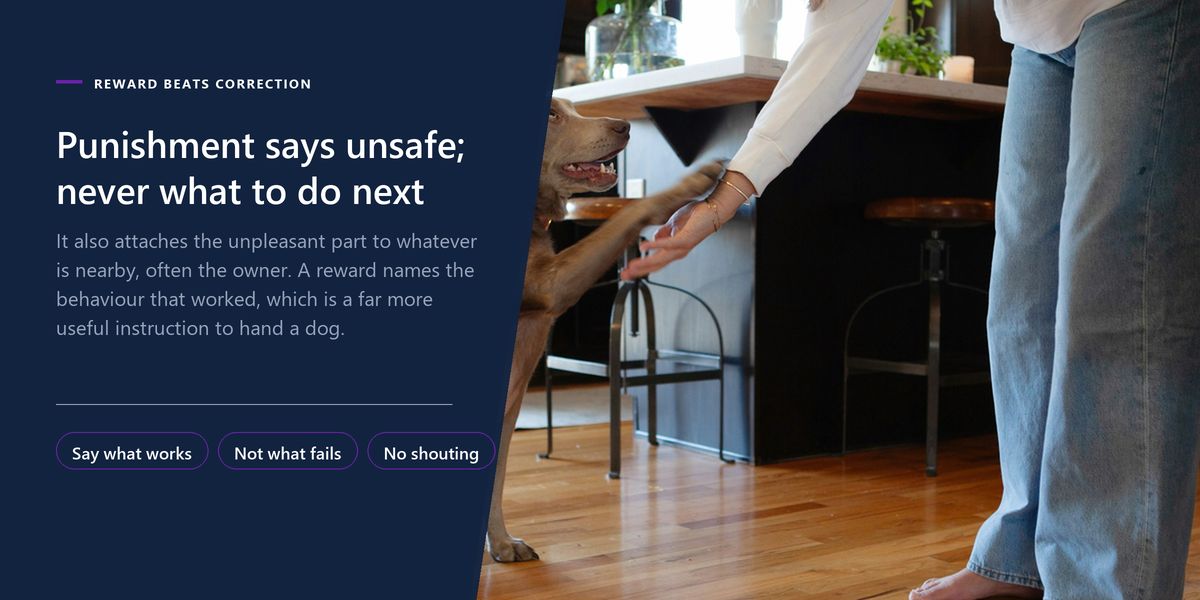
Reward-based training does the opposite. It tells the dog exactly what earns a good outcome, which is a much more useful instruction than learning what makes the human unpredictable.
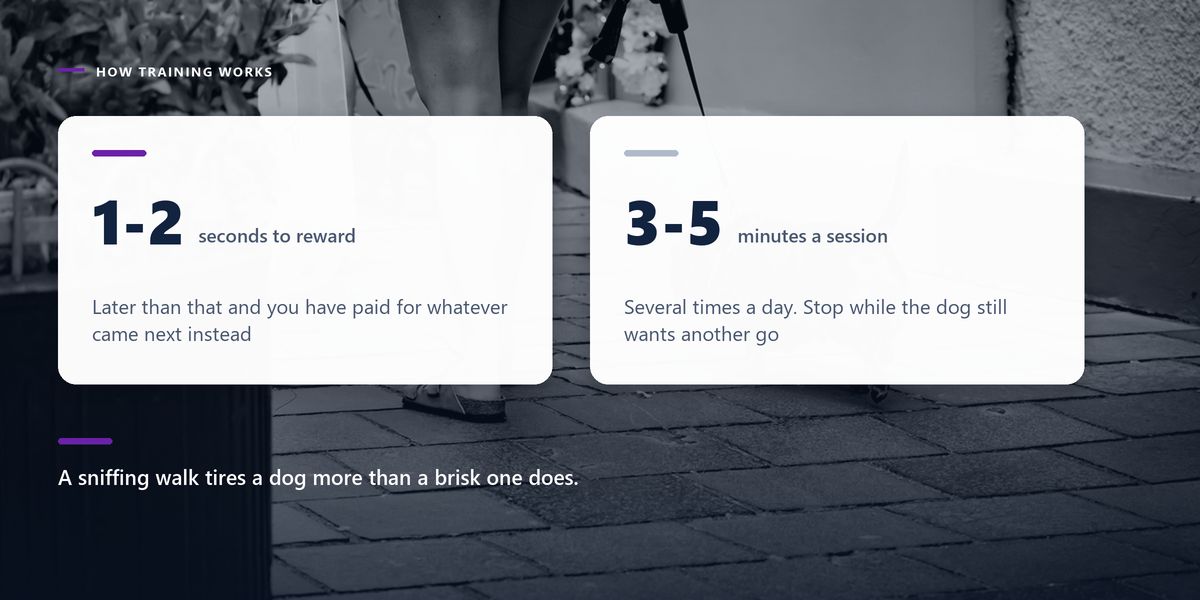
Dogs connect a consequence with a behaviour only when the two are very close together — a second or two at most. Rewarding thirty seconds later reinforces whatever the dog was doing thirty seconds later, which is usually something else entirely.
This is why marker training works so well. A consistent sound — a clicker, or a short word like yes — delivered at the exact instant the dog does the right thing tells them precisely what earned the reward, even if the treat arrives a few seconds afterwards.
The most common reason training does not stick has nothing to do with method. It is that different people in the house apply different rules, or the same person applies them differently depending on mood and circumstances.
If jumping up is rewarded with attention half the time, the dog learns that jumping up sometimes works — and intermittent rewards produce the most persistent behaviour of all. It is the same mechanism that makes gambling compelling.
Agree the rules as a household before working on any individual behaviour. Which furniture is allowed, what happens at the door, whether food from the table ever happens. One person quietly making exceptions undoes everyone else's work.
A large share of unwanted behaviour is a symptom rather than a training failure. A dog that is under-exercised, under-stimulated or under-slept will chew, bark, dig and pace, and no amount of training will resolve that while the cause remains.
| Need | What it looks like when unmet | What helps |
|---|---|---|
| Physical exercise | restlessness, destructiveness | daily walks matched to breed and age |
| Mental stimulation | boredom behaviours, attention-seeking | sniffing walks, puzzle feeders, training games |
| Sleep | over-excitement, poor impulse control | adult dogs need a great deal; puppies far more |
| Social contact | anxiety, vocalising when alone | gradual alone-time training, company |
| Chewing outlet | furniture and shoes | appropriate chews, especially for puppies |
Sniffing deserves particular mention. A twenty-minute walk where a dog is allowed to sniff extensively is more tiring and more satisfying than a brisk hour where they are marched along. Scent is their primary sense and using it is genuine mental work.
Train in short sessions — three to five minutes, several times a day — rather than one long one. Dogs, and particularly puppies, have limited concentration, and ending while they are still enthusiastic makes them keen to start again. Long sessions produce frustration on both sides.
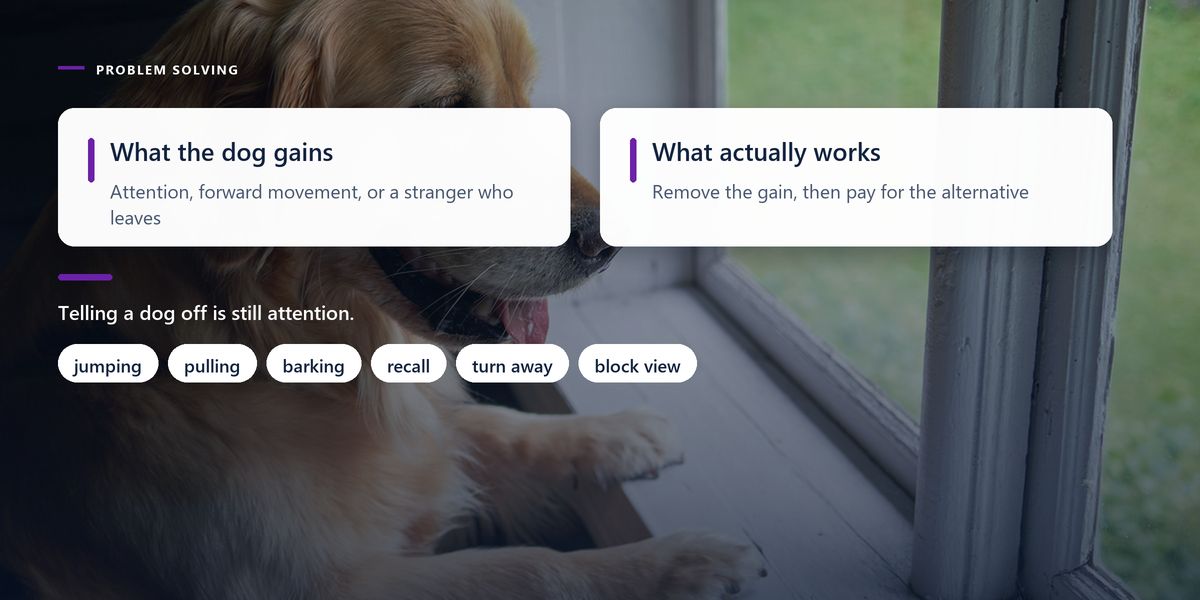
The general principle for unwanted behaviour is to work out what the dog is getting from it, remove that, and teach an alternative that achieves something similar.
Jumping up gets attention, so any attention — including pushing away and telling them off — rewards it. Turning away entirely and rewarding four paws on the floor works far better. Pulling on the lead gets the dog where they want to go, so stopping when the lead tightens and moving when it slackens teaches the actual lesson.
Barking at the window is often self-rewarding because the thing outside always leaves eventually, which the dog experiences as success. Managing the environment — blocking the view — is frequently more effective than training in that specific case.
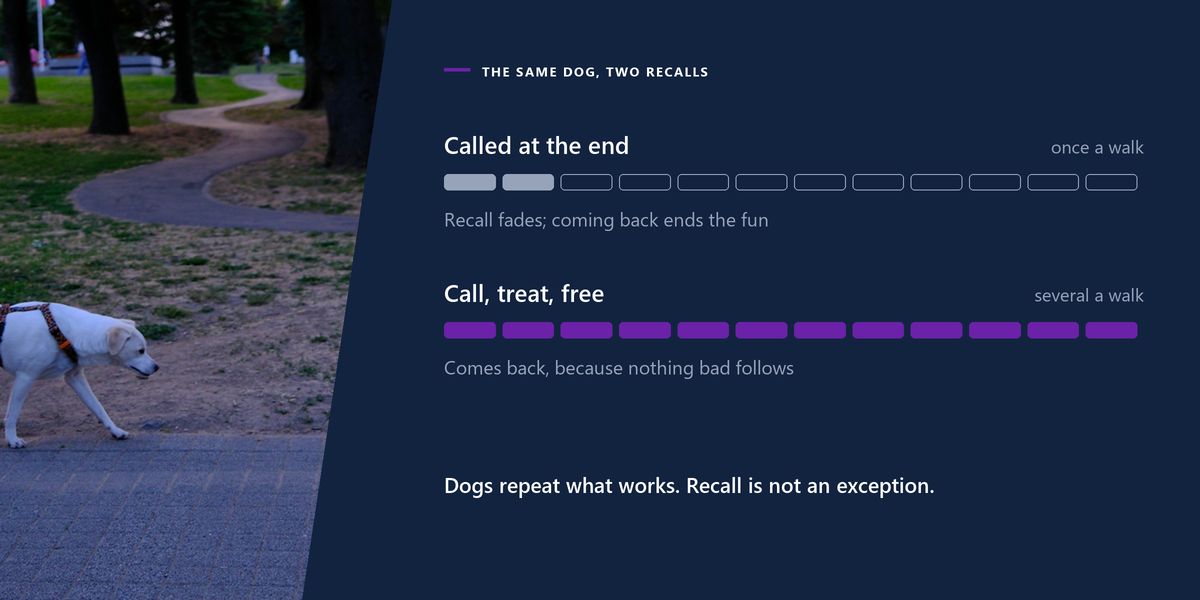
A rescue dog had a recall that worked at home and failed completely in the park. His owner had begun shouting, which made it worse, and had concluded the dog was being deliberately difficult.
The pattern was clearer than that. The only time the dog was called in the park was at the end, to have the lead clipped on and go home. Coming back reliably predicted the end of the fun.
They changed one thing: throughout every walk he was called, rewarded generously and released again immediately. Within a few weeks the recall was reliable, because coming back had stopped meaning the walk was over.
Sudden behaviour changes — new aggression, house soiling in a trained dog, unusual clinginess or withdrawal — frequently have a medical cause. Pain in particular presents as irritability and reluctance. See a vet before treating a sudden change as a training problem, and consult a qualified behaviourist for any aggression rather than working from online advice.
Straightforward manners can be taught by most owners with patience. Some situations warrant a professional: any aggression, severe separation anxiety, fear responses, and resource guarding that has escalated beyond mild.
Look for someone who uses reward-based methods and holds an accredited qualification, and be cautious of anyone promising rapid results through dominance, corrections or aversive equipment. The evidence base does not support those approaches and the potential for harm is real.
Use reward-based methods with precise timing, ideally with a marker word. Agree consistent rules across the household. Meet exercise, mental stimulation and sleep needs before treating behaviour as a training problem. Train in short frequent sessions, teach recall carefully, and get qualified help for aggression or severe anxiety.
The most useful reframe in dog training is to stop asking why the dog is being difficult and start asking what the behaviour is getting them. There is almost always an answer, and it is almost always something you can change.
Dogs are not trying to win. They are trying to work out what works. If you are considering a dog, our guide to adopting a rescue pet covers the decision before this one.
Tap a star to share what you thought.
No ratings yet
Reward-based training, which professional bodies now broadly agree is both more effective and less risky than punishment-based approaches. It teaches the dog what to do rather than only what to avoid, and it does not risk creating anxiety or aggression.
Within a second or two, or the dog associates the reward with whatever they were doing at that moment instead. A marker — a clicker or a short word like 'yes' — bridges the gap by pinpointing the exact instant that earned the treat.
Almost always inconsistency. If one household member allows jumping up or feeds from the table, the dog learns that the behaviour sometimes works. Intermittent rewards produce the most persistent behaviour of all.
It varies enormously by breed, age and individual, but mental stimulation matters as much as distance. A twenty-minute walk with plenty of sniffing is often more satisfying and tiring than a brisk hour with none.
Remove the reward. Pulling works because it moves the dog forward, so stop whenever the lead tightens and move again only when it slackens. It is slow and repetitive, and it teaches the actual lesson.
For any aggression, severe separation anxiety, strong fear responses, or escalating resource guarding. Choose someone with an accredited qualification who uses reward-based methods, and be wary of anyone promising fast results through corrections or dominance.
Sign in to join the conversation.
Loading responses…
Have a story, idea, or something valuable to share? Join The Blog Story for free, publish your content, reach more readers, and earn a share of advertising revenue from eligible content.
Create quality content. Grow your audience. Grow your earning potential.