Adopting a Rescue Pet: What to Expect in the First Three Months
The animal you meet in week one is not the animal you will live with.

6 min read

—Not yet rated
The animal you meet in week one is not the animal you will live with.
Two things regularly surprise people who adopt a rescue animal. The first is how quiet and well-behaved the animal is for the first week or two. The second is what happens after that.
Neither is a problem. Rescue animals settle in a fairly predictable pattern, and the confident, occasionally challenging creature that emerges in week three is closer to who they actually are than the subdued one who arrived.
Knowing that pattern in advance prevents a great deal of anxiety, and it prevents a proportion of the returns that happen in the first month.
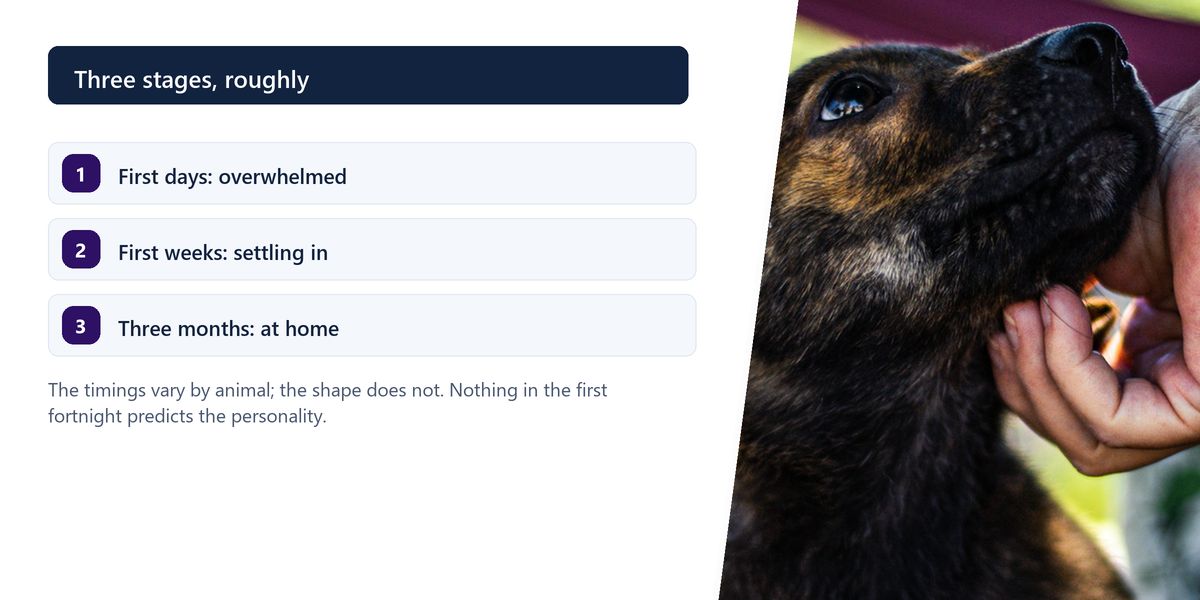
Rescue organisations frequently describe settling in three stages. The specific timings vary considerably by animal, but the shape is consistent enough to be useful.
The animal is decompressing from an enormous change. Expect hiding, reluctance to eat, sleeping a great deal, and either total shutdown or nervous over-activity. Nothing about this period predicts their personality.

They begin to learn the routine and test boundaries. This is when the real character starts appearing, and often when the first behaviour problems surface — because the animal is now comfortable enough to express themselves rather than because anything has gone wrong.
Routine is established, trust has developed and the relationship starts to feel settled. Many owners describe a specific moment somewhere in month two or three when the animal visibly relaxes into the household.
The most common mistake is doing too much. New owners are excited, want to introduce the animal to everyone, and give them the run of the house immediately.
Keep the first two weeks deliberately boring. No visitors, no trips, no new experiences beyond what is necessary. Decompression is the work being done during that period, even though it looks like nothing is happening, and rushing it is the most common cause of setbacks later.
The most important decision happens before the adoption, and it is frequently made emotionally in a corridor at a rehoming centre.
| Your situation | Often works | Often difficult |
|---|---|---|
| First-time owner, full-time work | an adult cat, or a settled older dog | a puppy, or a working breed |
| Active, outdoors, home a lot | a young energetic dog | a cat who wants quiet |
| Small flat, no garden | a cat, or a small low-energy dog | high-energy or large breeds |
| Young children | a dog with a known history around children | an unknown history, or a nervous animal |
| Other pets at home | an animal assessed as sociable with them | unknown compatibility |
Be honest with the rehoming centre about your circumstances, including how long the animal would be alone and how much exercise you realistically provide. Good centres are matching rather than selling, and an accurate picture makes a successful adoption far more likely.
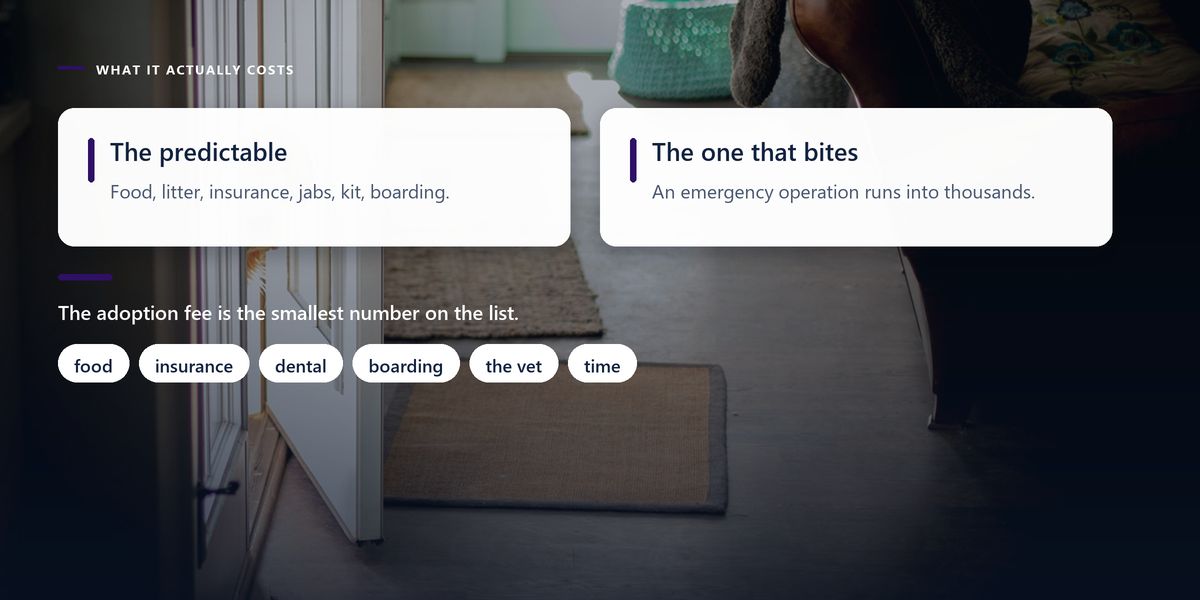
The adoption fee is the smallest part of it, and underestimating the rest is a common cause of difficulty later.
Almost every adoption includes a wobble somewhere in the first two months, and knowing they are normal makes them much easier to handle.
Behaviour that appears in week three — testing boundaries, guarding a toy, barking, being less biddable — usually indicates increasing confidence rather than a deterioration. Address it calmly with consistent rules, as you would with any animal.
Regression after progress is also common, particularly after a change: a house guest, a holiday, a new routine. It is rarely permanent, and the response is to return briefly to more structure rather than to conclude the adoption is failing.
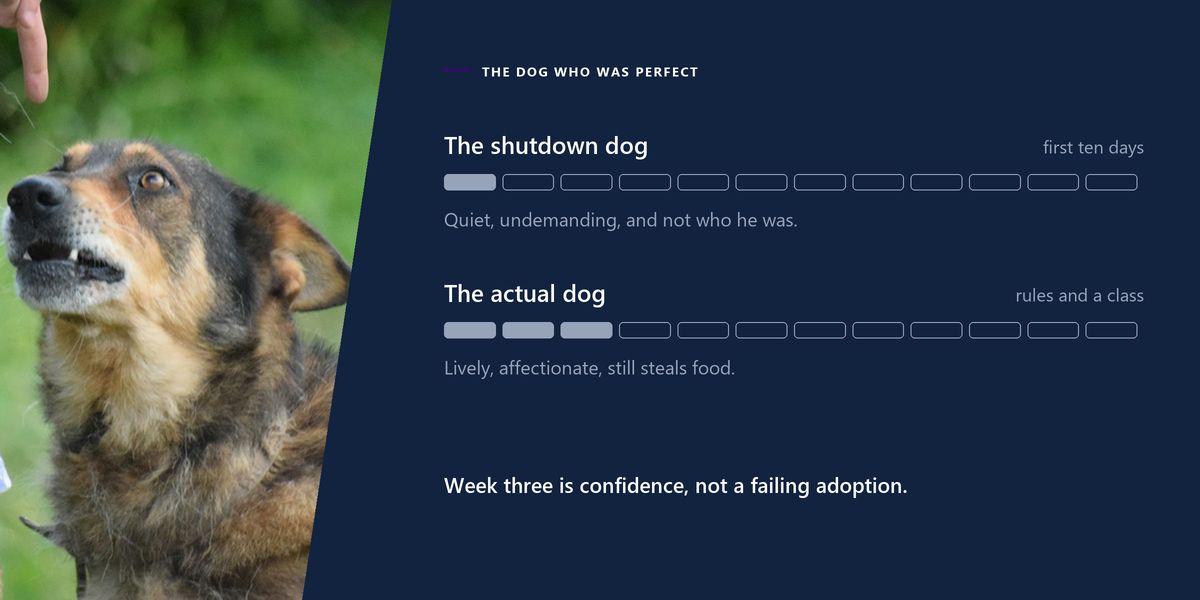
A family adopted a four-year-old dog described as calm and gentle. For ten days he was exactly that — quiet, undemanding, sleeping most of the day.
In week two he started barking at the door, pulling hard on walks and stealing food from worktops. The family were shaken and briefly wondered whether they had been misled.
Their rehoming centre recognised it immediately as a dog decompressing and becoming himself. With consistent rules, a training class and about two months, he settled into a lively, affectionate dog who still steals the occasional sandwich. Nobody had been misled; they had simply met the shutdown version first.
Never make an adoption decision under time pressure or purely from emotion at a rehoming centre. The mismatch between an animal's needs and an owner's life is the leading cause of animals being returned, which is significantly harder on the animal than not being adopted that day. Take a night to think, and be honest about your circumstances.
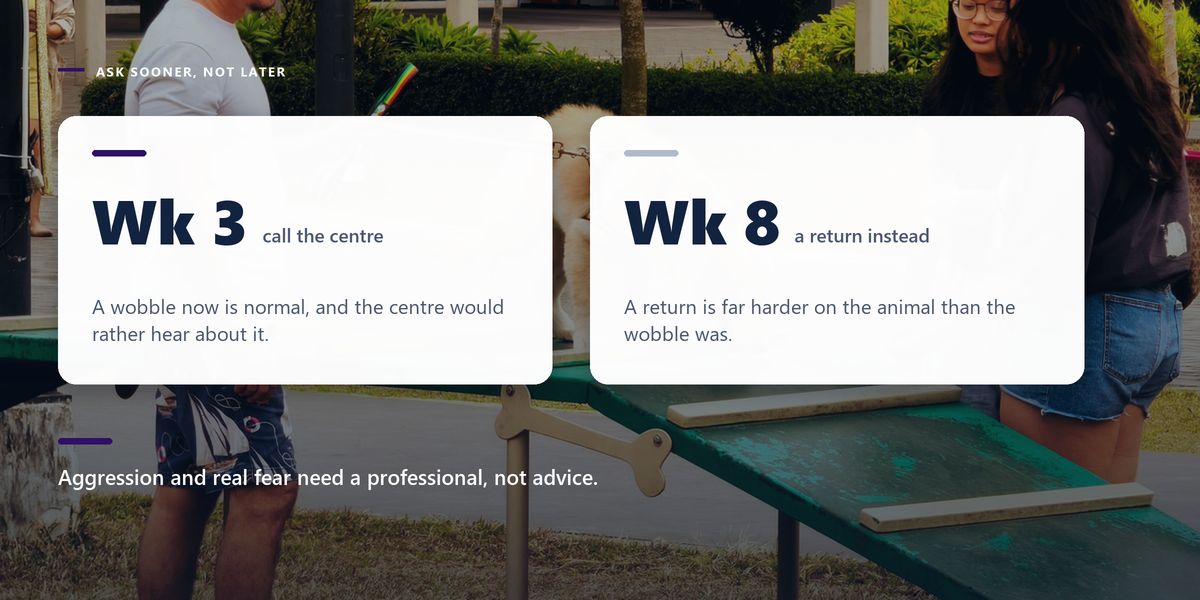
Reputable rehoming organisations offer post-adoption support and genuinely want to be contacted — a call in week three is far better for everyone than a return in week eight.
Get professional help for aggression, severe separation distress or intense fear rather than working from general advice. And see a vet early for anything physical, since undiagnosed pain presents as behaviour problems remarkably often in newly adopted animals.
Expect three stages: overwhelmed, settling, then at home. Restrict space and visitors initially and establish a routine immediately. Choose an animal that matches your actual life, budget for lifetime and emergency costs, and treat week-three challenges as growing confidence rather than as failure.
Adopting a rescue animal is not a rescue in the sense of a single act. It is a fairly long process of an animal learning that this arrangement is permanent, which they have limited reason to assume at the start.
Give it three months before drawing any conclusions. Most people find the animal they end up with is considerably more interesting than the one they thought they had adopted. For what comes next with a dog, see our guide to training fundamentals.
Tap a star to share what you thought.
No ratings yet
Commonly described as three days to decompress, three weeks to learn the routine and start showing real personality, and around three months to feel genuinely at home. Timings vary by animal, but the pattern is consistent enough to plan around.
Usually because they feel safe enough to express themselves. The subdued animal of week one was shut down rather than calm. Consistent rules and routine from that point onward is the response, not concern that something has gone wrong.
Keep things deliberately boring. Restrict them to one quiet room, avoid visitors for at least a week, establish feeding and walking routines immediately, and let the animal approach you rather than the reverse.
Match the animal to your actual life rather than your ideal one — how long they would be alone, how much exercise you genuinely provide, your living space and any other pets. Be candid with the centre, since good ones are matching rather than selling.
Far more than the adoption fee: food, preventive treatments, insurance, routine and dental veterinary care, boarding when you travel, and potentially thousands for an emergency. Insurance is the mechanism most owners use to make that last category survivable.
Early and without embarrassment. Reputable organisations offer post-adoption support and would far rather field a question in week three than take an animal back in week eight. For aggression or severe anxiety, ask them to refer you to a qualified behaviourist.
Sign in to join the conversation.
Loading responses…
Have a story, idea, or something valuable to share? Join The Blog Story for free, publish your content, reach more readers, and earn a share of advertising revenue from eligible content.
Create quality content. Grow your audience. Grow your earning potential.