Cutting Your Home Energy Use: What Actually Makes a Difference
Heat, hot water and insulation dominate. Standby mode does not.

5 min read

—Not yet rated
Heat, hot water and insulation dominate. Standby mode does not.
Household energy advice has a scale problem. The same list will suggest unplugging phone chargers and insulating a loft as though these are comparable actions, when one saves a rounding error and the other can change a bill noticeably.
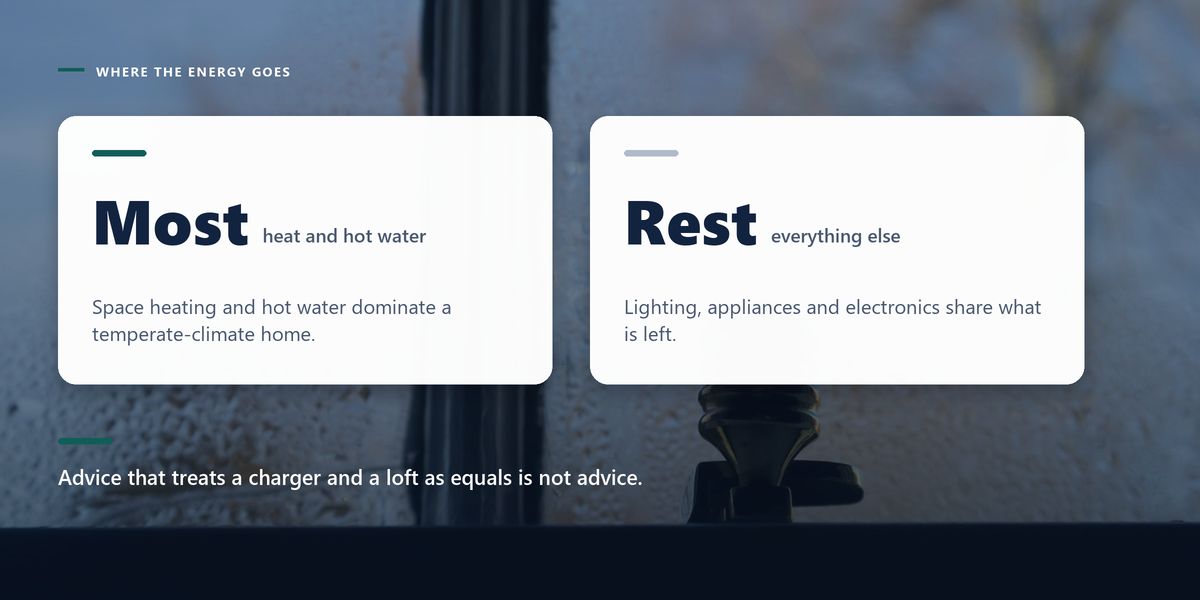
In most temperate-climate homes, space heating and hot water together account for the large majority of energy use. Everything else — lighting, appliances, electronics — shares what is left.
So the useful question is not what could be switched off. It is where the heat is going and what it costs to keep making it.
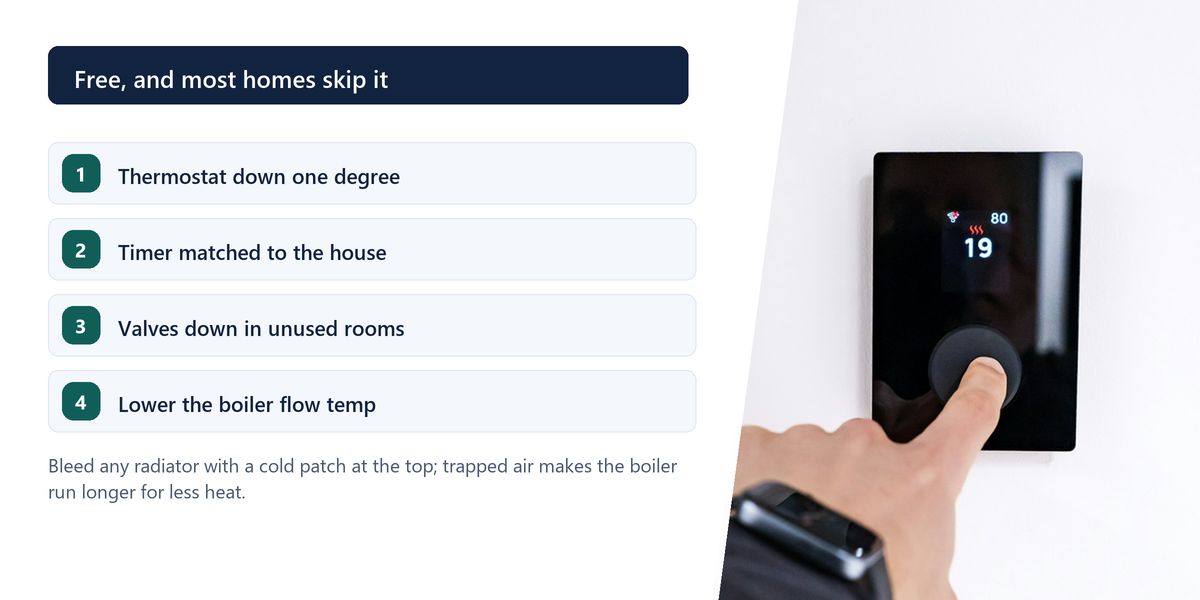
The cheapest meaningful saving is using the heating system you already have properly, and a surprising number of homes are not.
After controls, the biggest structural factor is how quickly the heat you have paid for leaves the building.
Loft insulation is usually the highest-return improvement available in an older house, because heat rises and an uninsulated loft is effectively an open lid. Cavity wall insulation, where the construction allows it, is similarly significant.
Draught-proofing is the cheapest of all and consistently underrated. Gaps around doors, windows, letterboxes, floorboards and unused chimneys let warm air out continuously. A weekend and a modest amount of material addresses most of it, and the effect on how a room feels is immediate.
Hot water is typically the second largest use, and most of it goes on showers, baths and washing.
The effective changes are shorter showers, a lower hot water cylinder thermostat where you have one — around 60 degrees is generally recommended for safety reasons as well as efficiency — and insulating the cylinder and accessible hot pipes, which is cheap and pays back quickly.
Washing clothes at 30 degrees rather than 40 or 60 reduces energy use substantially, and modern detergents are formulated to work at low temperatures. Reserve hot washes for genuinely soiled items and occasional maintenance cycles.
| Appliance | Energy use | What helps |
|---|---|---|
| Tumble dryer | very high | air dry when possible; a heat pump model if replacing |
| Electric shower | very high while running | shorter showers, low-flow head |
| Oven | high | batch cook; use a microwave or air fryer for small items |
| Kettle | high but brief | boil only what you need |
| Fridge and freezer | moderate but constant | correct temperature, clean coils, defrost |
| Standby electronics | very low | worth doing, not worth prioritising |
If you are replacing a major appliance, the efficiency rating matters more than any behavioural change you can make with the old one. Appliances last a decade or more, so the difference compounds — particularly for fridges and freezers, which run continuously, and for tumble dryers, where heat pump models use dramatically less than conventional ones.
It is worth being explicit about this, because effort spent here is effort not spent on the things that work.
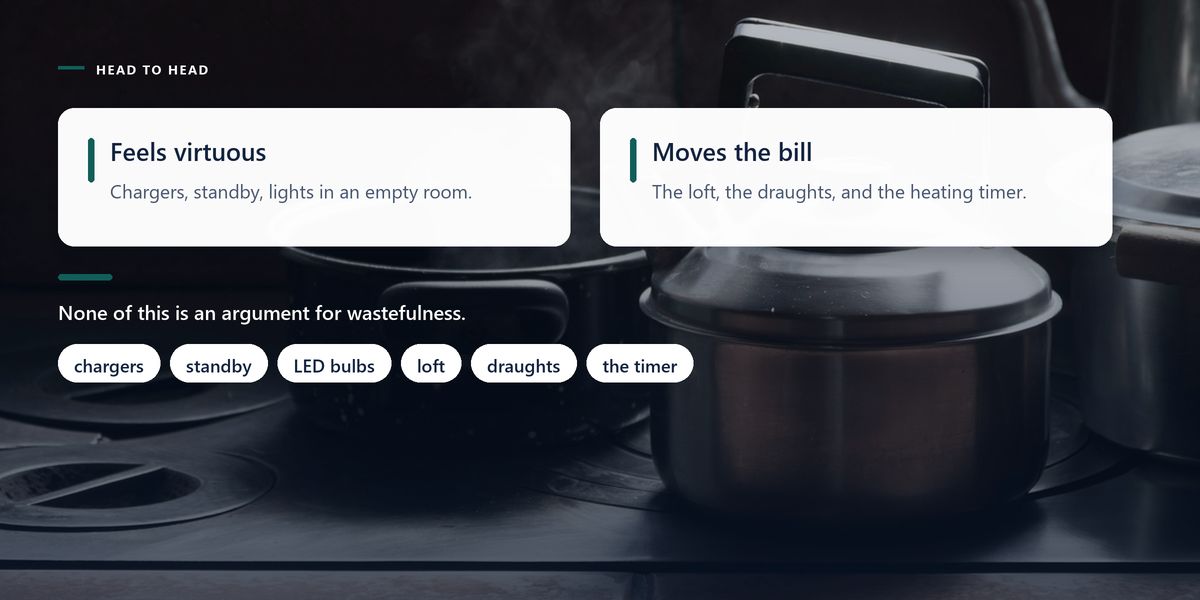
Unplugging phone chargers saves a trivial amount, since modern chargers draw almost nothing when idle. Standby power on modern appliances is a small fraction of what it was a decade ago. Turning lights off in an empty room is sensible and, with LED bulbs, no longer a significant lever.
None of this is an argument for wastefulness. It is an argument against believing you have addressed household energy because you switched a television off at the wall.
A family in a 1930s semi-detached house believed they were already careful — lights off, appliances unplugged, everyone reminded regularly.
A survey found the loft insulation was roughly a third of the currently recommended depth, the heating ran on a timer that no longer matched anyone's schedule, and there were substantial draughts around the original front door and an unused chimney.
They topped up the loft insulation, spent a weekend draught-proofing, corrected the heating schedule and turned down radiators in two unused rooms. Their energy use fell by roughly a third over the following year. Nobody unplugged anything.
Do not seal a house so thoroughly that ventilation suffers. Homes need air movement to control moisture, and over-sealing without adequate ventilation causes condensation and mould, which is both a health problem and expensive to remedy. Draught-proof deliberate gaps; keep trickle vents and extractor fans working.
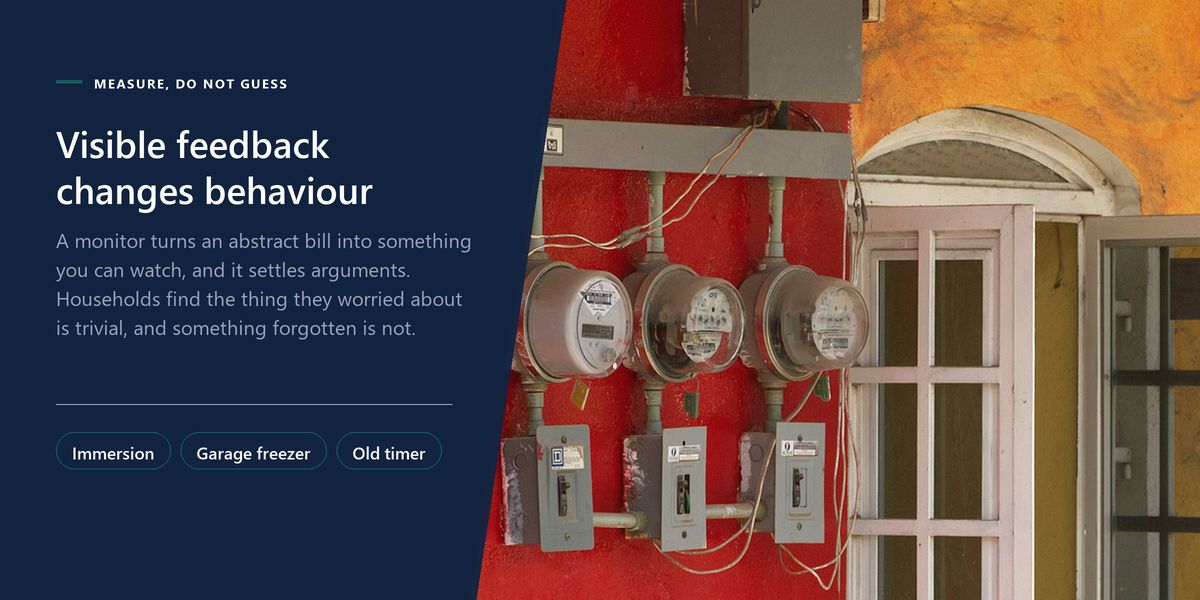
A smart meter or a simple energy monitor turns an abstract bill into visible feedback, and that visibility alone tends to change behaviour.
It also settles arguments. Households routinely discover that something they worried about is insignificant and that something they had never considered — an immersion heater running on a forgotten schedule, an old freezer in a garage — accounts for a substantial share of their usage.
Address heating first: schedule, thermostat, radiator valves and boiler settings. Then draught-proof and insulate, starting with the loft. Reduce hot water use and wash at lower temperatures. Focus appliance effort on the dryer, shower and oven. Ignore standby power as a strategy, and measure your actual usage.
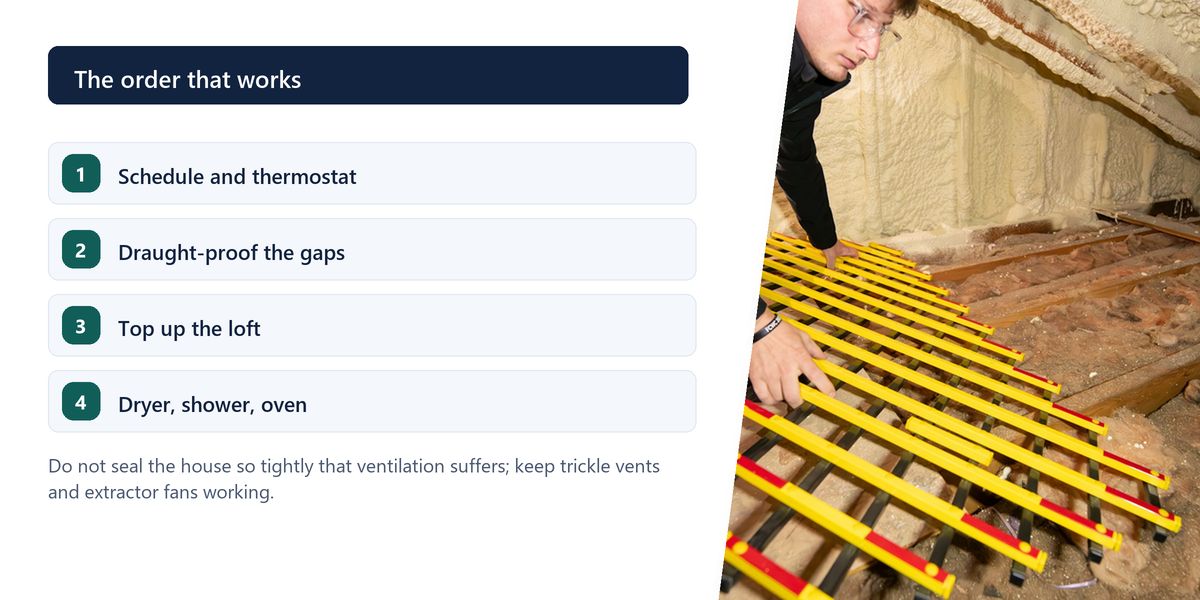
The most effective energy saving is unglamorous and largely invisible: heat that stays in the building, and a heating system that only runs when someone is there to feel it.
Do those two things properly and you will have achieved more than a decade of switching things off at the wall. For the waste side of the same question, see our piece on recycling myths.
Tap a star to share what you thought.
No ratings yet
In most temperate-climate homes, space heating accounts for the largest share and hot water for the second largest, together making up the majority of use. Lighting, appliances and electronics share what remains, which is why heating is where effort belongs.
Yes. Reducing the temperature by a degree produces a meaningful percentage saving on heating energy, and a one-degree change made gradually is barely noticeable. Combined with an accurate heating schedule, it is the largest free saving available.
It saves very little on modern equipment, where standby draw is a small fraction of what it once was. It is not harmful advice, but treating it as an energy strategy displaces attention from heating, insulation and hot water, which matter far more.
In older homes, loft insulation and draught-proofing usually offer the best return relative to cost. Draught-proofing in particular is inexpensive, achievable in a weekend, and produces an immediate difference in how rooms feel.
Tumble dryers, electric showers and ovens are the heaviest users in most homes, along with fridges and freezers because they run constantly. Focusing on those has far more effect than managing small electronics.
Yes. Homes need ventilation to control moisture, and over-sealing without adequate airflow causes condensation and mould. Draught-proof unintended gaps while keeping trickle vents and extractor fans functioning.
Sign in to join the conversation.
Loading responses…
Have a story, idea, or something valuable to share? Join The Blog Story for free, publish your content, reach more readers, and earn a share of advertising revenue from eligible content.
Create quality content. Grow your audience. Grow your earning potential.