Buying Your First Electric Car: The Questions That Actually Matter
Where you charge matters far more than how far it goes.

6 min read
—Not yet rated
Where you charge matters far more than how far it goes.
Almost every conversation about electric cars starts with range, and range is rarely what determines whether one works for a household.
The genuinely decisive question is simpler and much less discussed: where will you charge it? A modest-range car with a driveway and a home charger is straightforward to live with. A long-range car with no off-street parking and unreliable public charging near home is a daily inconvenience.
Here is what to work out before looking at any specific model.

The experience of owning an electric car divides sharply along one line: whether you can charge where you park overnight.
With home charging, the car is full every morning and you visit a public charger only on long journeys — perhaps a handful of times a year. Home electricity is also considerably cheaper than public rapid charging, particularly on an overnight tariff, which is where most of the running cost advantage actually comes from.

Without it, you depend on public infrastructure for everything. That can work well where charging is dense and reliable, and it is a meaningfully different proposition — more planning, higher cost per mile, and occasional frustration when a charger is occupied or broken.
Workplace charging sits usefully in between and is worth investigating before ruling an EV out.
Official range figures are produced under standardised test conditions and are optimistic in ordinary use. A realistic planning assumption is meaningfully below the quoted number, and further below it in specific circumstances.
| Cost | Electric | Petrol or diesel |
|---|---|---|
| Purchase price | typically higher new | typically lower |
| Fuel or electricity | much lower at home; similar or higher on rapid chargers | consistent |
| Servicing | fewer moving parts, generally lower | higher |
| Depreciation | historically steeper, though stabilising | better established |
| Tyres | often faster wear from weight and torque | standard |
| Taxes and incentives | varies widely by country and changes often | varies |
The honest summary is that an EV's total cost of ownership depends heavily on how you charge and where you live. Home charging plus high annual mileage is where the economics are strongest. Low mileage with public charging only is where they are weakest, and it is worth doing the arithmetic with your own numbers rather than accepting a general claim in either direction.
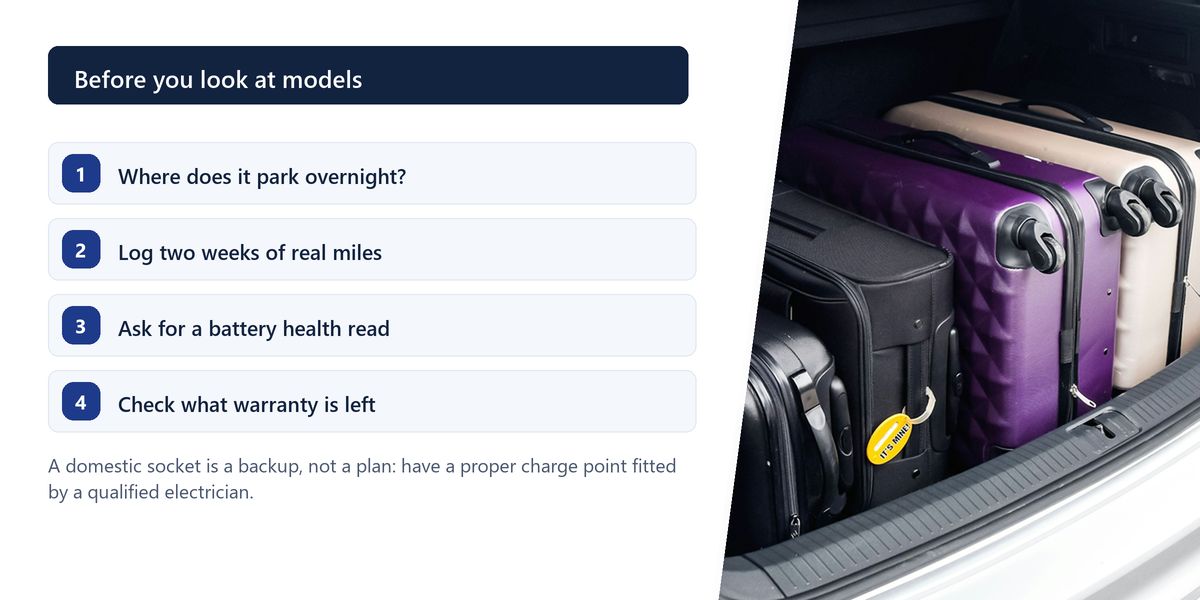
Before buying, log two weeks of your actual driving — every journey and its distance. Most people substantially overestimate their typical daily mileage while underestimating how often they make long trips. That log tells you what range you genuinely need far better than any instinct about it.
The battery is by a wide margin the most valuable component in a used electric car, and its condition matters more than mileage or age in isolation.
Batteries degrade gradually, with the rate depending on chemistry, thermal management, charging habits and climate. Modern packs generally hold up better than early ones, and most manufacturers provide a battery warranty running to a stated number of years or a mileage figure, typically guaranteeing a minimum remaining capacity.
Ask for a state of health reading, which many cars display or which a specialist can extract. Ask about charging history too — a car rapid-charged almost exclusively will typically show more degradation than one charged mostly at home. And check what remains of the battery warranty, since that transfers with the car in most cases and is worth a great deal.
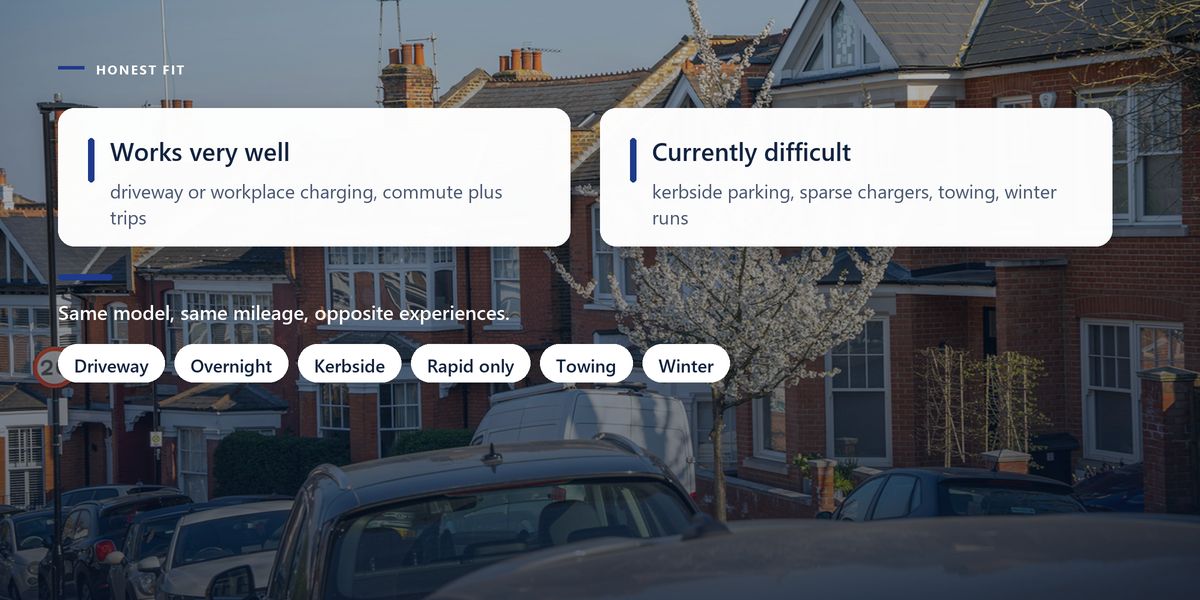
It is worth being direct about this rather than treating any hesitation as scepticism.
If you have no home or workplace charging and local public infrastructure is sparse or unreliable, ownership will be materially more inconvenient. If you regularly tow heavy loads over long distances, current options are limited and range penalties are severe. If you frequently drive long distances in very cold conditions with tight schedules, the winter range reduction is a real planning constraint.
None of these is permanent — infrastructure and technology are both moving quickly — but buying on the basis of how things may be in five years is how people end up frustrated for the next two.
A commuter drove about 40 miles a day, had a driveway and installed a home charger. His car charges overnight on a cheap tariff and he uses a public rapid charger perhaps four times a year. His running costs fell substantially and he describes public charging as almost irrelevant to his ownership.
A neighbour with terraced-house parking bought a similar car on the same reasoning. She charges on the street when a bay is free, pays rapid-charging rates most of the time, and has twice rearranged an evening around finding a working charger.
Same model, same mileage, entirely different experiences. The variable was never the car.
Do not rely on charging a car regularly from a standard domestic socket. It is very slow and, on older or unsuitable wiring, drawing high current for many hours is a genuine fire risk. Have a proper charge point installed by a qualified electrician if you intend to charge at home routinely.
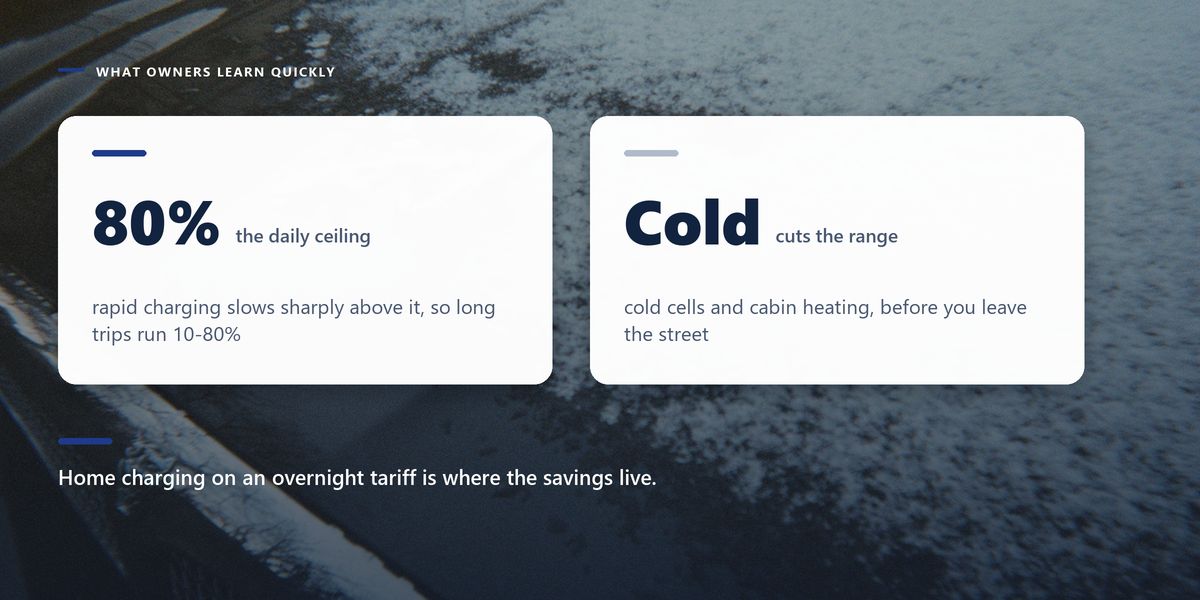
Work out where you will charge before considering any model. Assume real-world range below the official figure, especially in winter and at motorway speeds. Plan long trips as 10 to 80% charging stops. Compare total running costs using your own mileage and charging situation, and check battery state of health on anything used.
Electric cars suit a great many households extremely well and a minority quite badly, and which group you are in has almost nothing to do with the car.
Answer the charging question honestly first. Everything else — model, range, brand — is a comparatively easy decision once that one is settled. Whatever you drive, our guide to basic car maintenance still applies.
Tap a star to share what you thought.
No ratings yet
Where you will charge it overnight. Home or workplace charging makes ownership straightforward and much cheaper, while relying entirely on public rapid charging means more planning and a considerably higher cost per mile.
Optimistic for ordinary use. Plan on meaningfully less, and expect a further reduction in cold weather and at sustained motorway speeds, where aerodynamic drag dominates and cabin heating draws real power.
Charging speed is highest at low states of charge and tapers considerably as the battery fills, to protect the cells. This is why long-journey planning generally uses 10 to 80% stops rather than waiting for a full charge.
Usually, and it depends heavily on how you charge. Home charging on an overnight tariff produces the largest savings, along with lower servicing costs. Public rapid charging narrows or eliminates the advantage, and tyres often wear faster due to weight.
The battery state of health above all, since it is the most valuable component. Ask for a reading, enquire about charging history, and check how much of the manufacturer's battery warranty remains, as it usually transfers with the car.
Only occasionally and slowly. Drawing high current for many hours from a standard domestic socket is very slow and can be a fire risk on older or unsuitable wiring. Have a dedicated charge point fitted by a qualified electrician for routine charging.
Sign in to join the conversation.
Loading responses…
Have a story, idea, or something valuable to share? Join The Blog Story for free, publish your content, reach more readers, and earn a share of advertising revenue from eligible content.
Create quality content. Grow your audience. Grow your earning potential.