Watching Films More Closely: What to Notice Beyond the Plot
Every shot is a decision somebody made. Noticing them changes what a film feels like.

6 min read
—Not yet rated
Every shot is a decision somebody made. Noticing them changes what a film feels like.
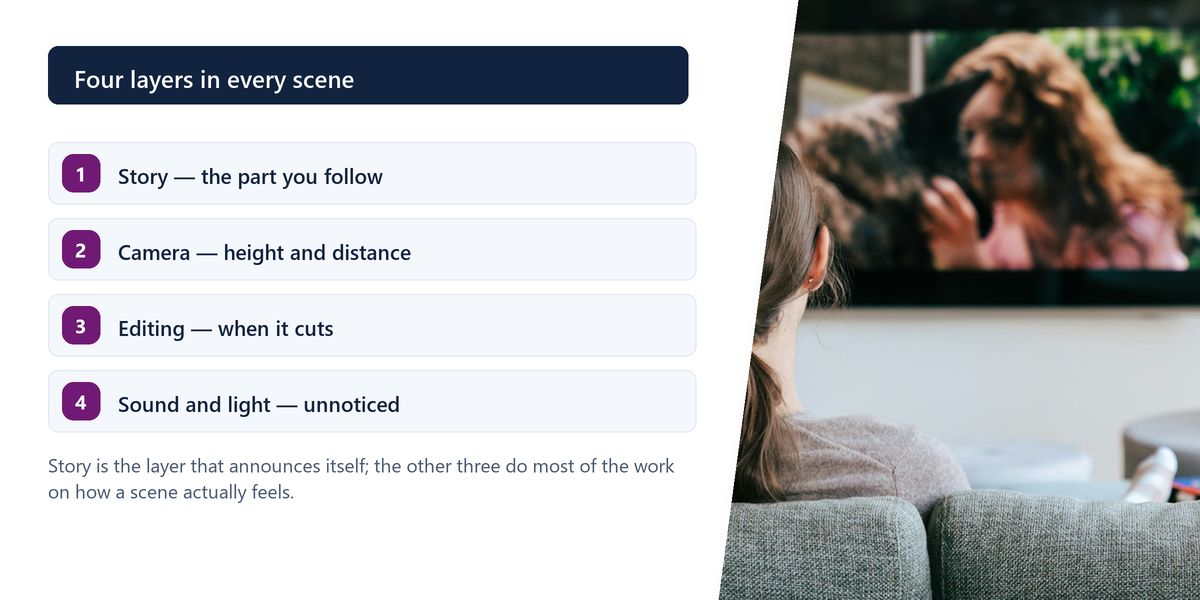
Most film conversation is about story and performance, because those are the parts that announce themselves. Meanwhile the camera has been placed somewhere specific, a cut happened at a particular moment, and a sound arrived slightly before the image it belonged to.
None of that is accidental. Every element was chosen, argued over and paid for, and most of it is designed to work on you without being noticed.
Learning to see it does not spoil films. It tends to have the opposite effect — ordinary films become more interesting and good ones become genuinely remarkable.
The most fundamental decision in any shot is where to put the camera, and it carries meaning whether or not the audience registers it.
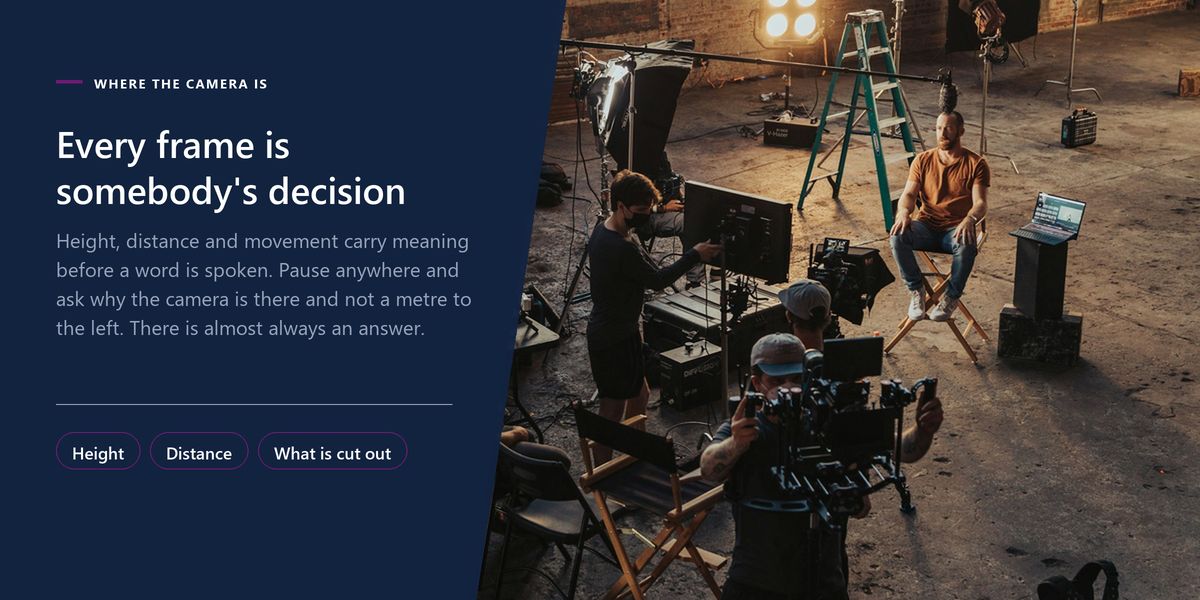
A useful exercise: pause a film at any moment and ask why the camera is exactly there rather than a metre to the left. There is almost always an answer.
Editing determines what you know and when, and it controls the pace of your attention more directly than anything else.
Notice how long shots are held. Rapid cutting creates energy and disorientation, and it can conceal weak choreography in an action scene. Long unbroken takes create tension precisely because they deny relief — you cannot look away and the film will not cut away for you.
Also notice when a film cuts. Cutting away just before a reaction withholds it; holding on a face after a line has landed forces you to sit with it. The moment of the cut is where a great deal of a film's emotional control lives.
Sound is the most underestimated element in film, largely because it works best when unnoticed. It is frequently doing more emotional work than the image.
Listen for what is absent. Silence used deliberately is one of the most powerful tools available, and a scene that drops all ambient sound immediately signals that something has changed. Horror in particular relies on the manipulation of expectation through sound far more than through what is shown.
Also listen for sound that precedes its image — a noise heard before you see its source pulls you forward into the next scene, and it is used constantly in transitions without anyone noticing.
Then there is the score, which tells you how to feel and is worth catching yourself responding to. A neutral scene with tense music is tense; the same scene silent is ambiguous.
| Choice | Common use | Effect |
|---|---|---|
| Warm palette | nostalgia, safety, memory | comfort, intimacy |
| Cool palette | isolation, clinical spaces, night | distance, unease |
| High contrast, hard shadow | noir, threat, moral ambiguity | tension, concealment |
| Soft, even light | comedy, romance | openness, clarity |
| Desaturation | grimness, realism, war | weight, seriousness |
| A single saturated colour | isolating an object or person | immediate attention |
Colour is almost never accidental in a finished film. It is decided in production design, costume, lighting and then adjusted again in grading. When a film's palette shifts partway through, that shift is telling you something.
Watch a favourite film a second time with the sole intention of noticing craft rather than following the story. Because you already know what happens, attention is freed for framing, cutting and sound — and most people are startled by how much they missed the first time.
Where characters stand relative to each other and to the camera carries information continuously. Physical distance in a frame reads as emotional distance. A character positioned higher in the frame usually holds more power in the scene. A character who moves toward or away from another during a conversation is telling you what the dialogue may be concealing.
Watch also for who is in focus. When focus shifts from one character to another during a shot, your attention has been redirected deliberately, and it usually marks the moment the scene's power has changed hands.
Much of a film's effect depends on expectations built by everything you have watched before. Genres establish patterns — how a horror scene builds, when a romantic comedy will reunite its leads, how an action sequence resolves — and films exploit that knowledge constantly.
Subverted expectation is only meaningful because the expectation existed. Noticing when a film is deliberately withholding a convention, or delivering one early, is a large part of understanding why it affects you as it does.
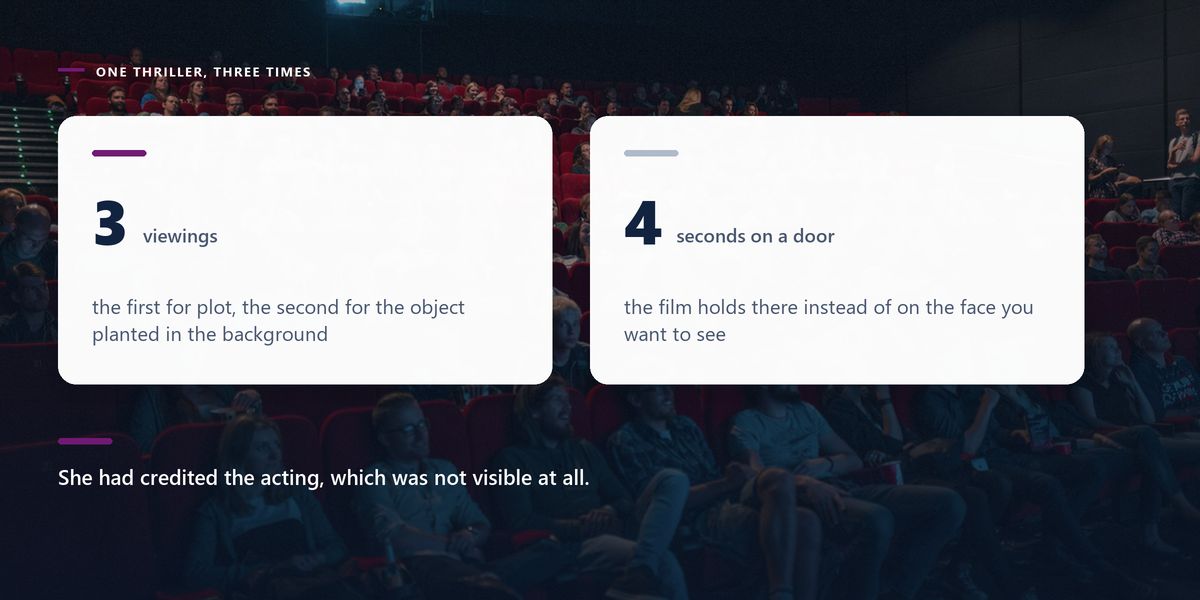
A film student watched a well-known thriller three times. On the first viewing she followed the plot. On the second she noticed the film had shown her a crucial object several scenes before it mattered, in the background, unremarked.
On the third she noticed something else. In the pivotal confrontation, the film cuts away from the protagonist's face at the exact moment a viewer most wants to see the reaction, and holds instead on a closed door for four seconds.
The withholding is why the scene works. She had felt it powerfully the first time and had attributed it entirely to the acting, which was in fact not visible at that moment at all.
There is a difference between noticing craft and treating everything as a hidden puzzle. Not every colour is symbolic and not every object is a clue. Over-reading is as much a failure of attention as under-reading, and the most reliable check is whether an interpretation is supported by the whole film or only by one convenient frame.
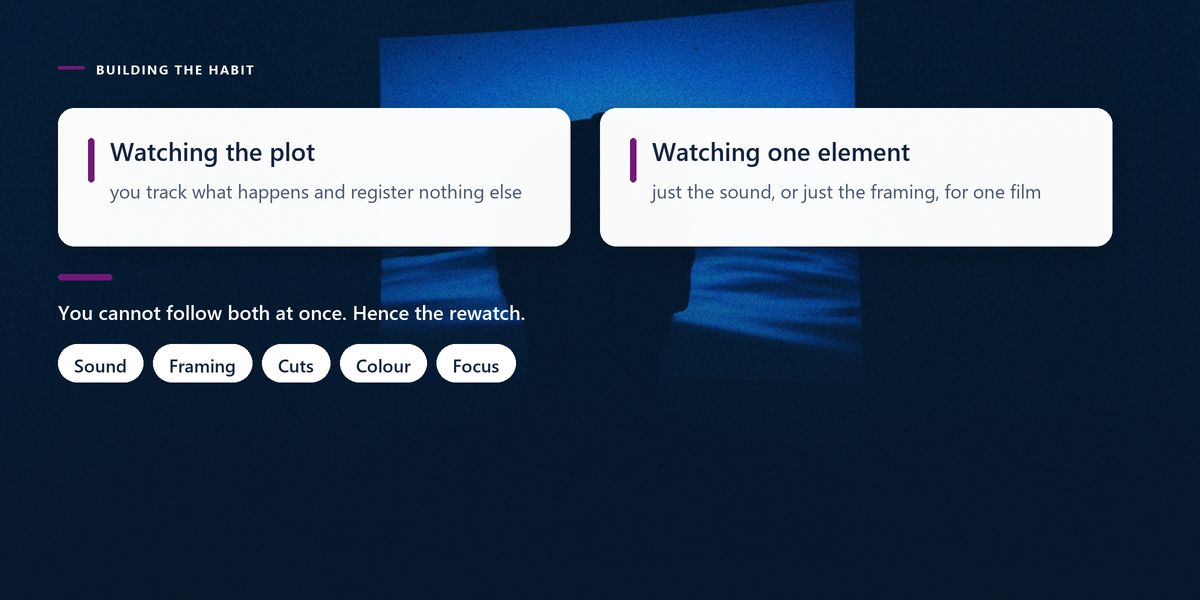
Notice where the camera is and what it excludes. Watch when a film cuts and how long it holds. Listen for silence, for sound arriving early, and for how the score is directing you. Read colour and lighting as decisions. Watch blocking and focus, and rewatch films to see craft rather than plot.
The common fear is that analysing films will spoil them, and in practice the reverse happens. Knowing how a magic trick works rarely diminishes a good magician; it makes you appreciate exactly how difficult the trick was.
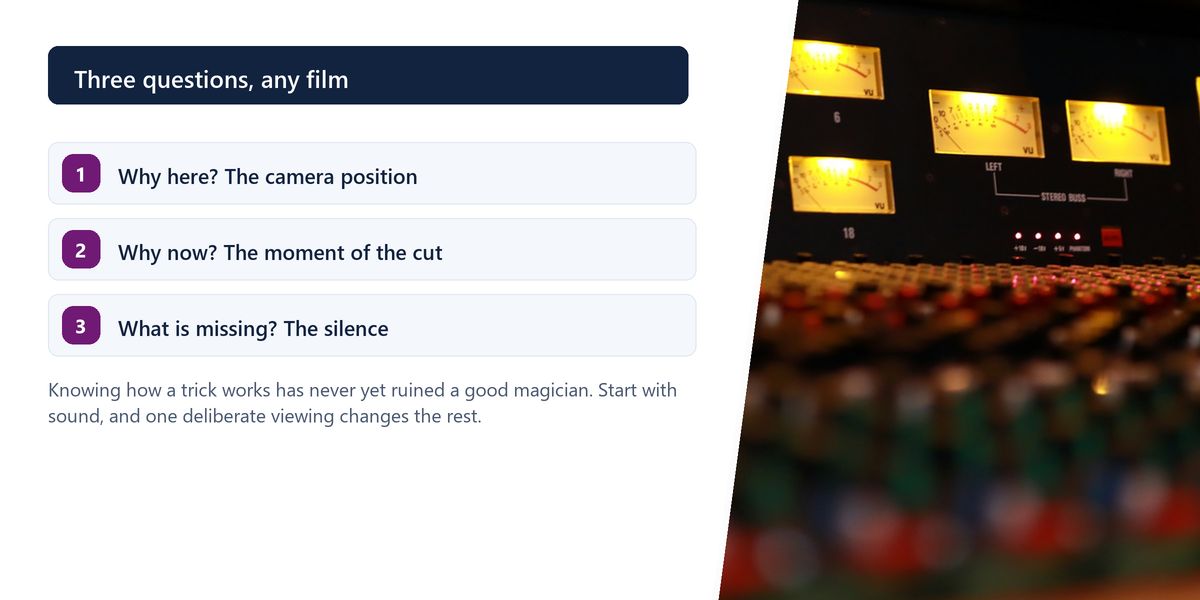
Start with sound. It is the layer most people have never consciously attended to, and one deliberate viewing will change how you watch everything afterwards.
Tap a star to share what you thought.
No ratings yet
For most people it does the opposite. Understanding how an effect is achieved tends to increase appreciation rather than diminish it, in the same way that knowing how a difficult piece of music is played makes the performance more impressive.
Sound, because it is the layer most viewers have never consciously attended to and it is doing a great deal of the emotional work. Listen particularly for deliberate silence and for sounds that arrive before the image they belong to.
Filming from below a character generally conveys power or dominance, while filming from above tends to diminish them. Eye level reads as neutral, which is itself a deliberate choice rather than a default.
Because an unbroken take denies the audience relief. You cannot look away and the film will not cut away for you, which builds tension in a way that rapid cutting cannot. Rapid cutting instead creates energy and disorientation.
In a finished film, almost always. Palette is shaped through production design, costume, lighting and then adjusted again in grading. A noticeable shift in a film's colour scheme partway through is usually communicating something deliberate.
Rewatch films you already know, since knowing the plot frees your attention. Watch one element at a time, pause and ask why the camera is where it is, and watch across different eras and countries where the conventions differ.
Sign in to join the conversation.
Loading responses…
Have a story, idea, or something valuable to share? Join The Blog Story for free, publish your content, reach more readers, and earn a share of advertising revenue from eligible content.
Create quality content. Grow your audience. Grow your earning potential.