Understanding Cat Behaviour: What They Are Actually Telling You
Cats are not aloof. They are communicating constantly, in a language most owners never learned.

6 min read
—Not yet rated
Cats are not aloof. They are communicating constantly, in a language most owners never learned.
Cats have a reputation for being unknowable, which is a little unfair. They communicate constantly and fairly precisely; it is simply that almost nobody is taught the vocabulary, whereas most people can read a wagging tail on a dog by the age of five.
The signals are not subtle once you know them. Tail position, ear angle, pupil size, blink rate and where a cat chooses to sit all carry specific information.
Here is the vocabulary, plus what is really behind the behaviours owners most often find baffling.
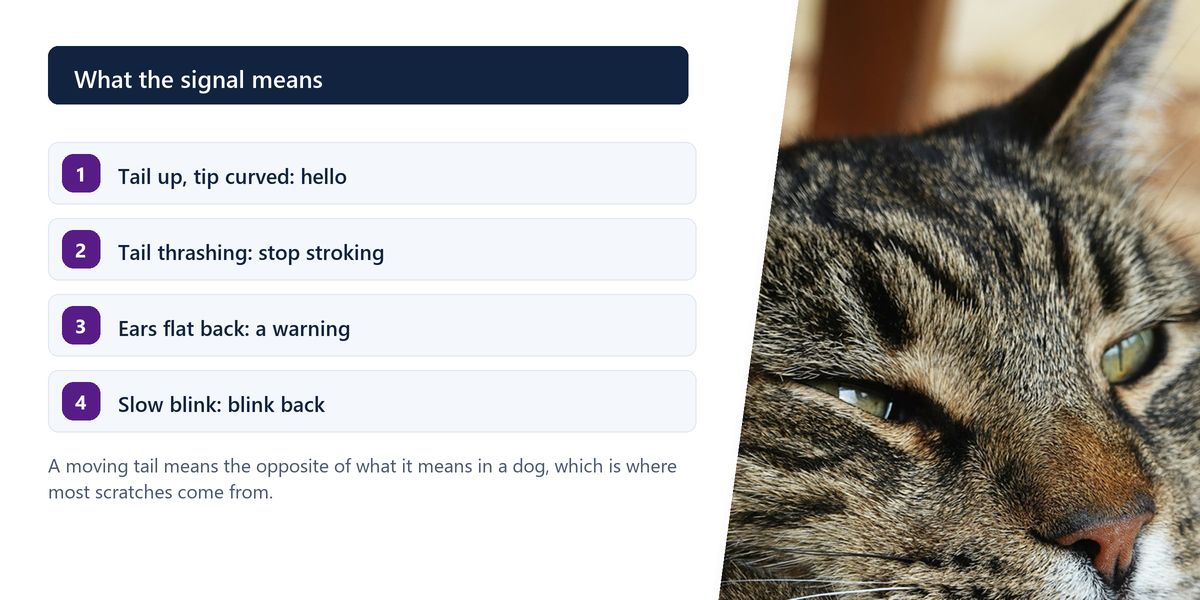
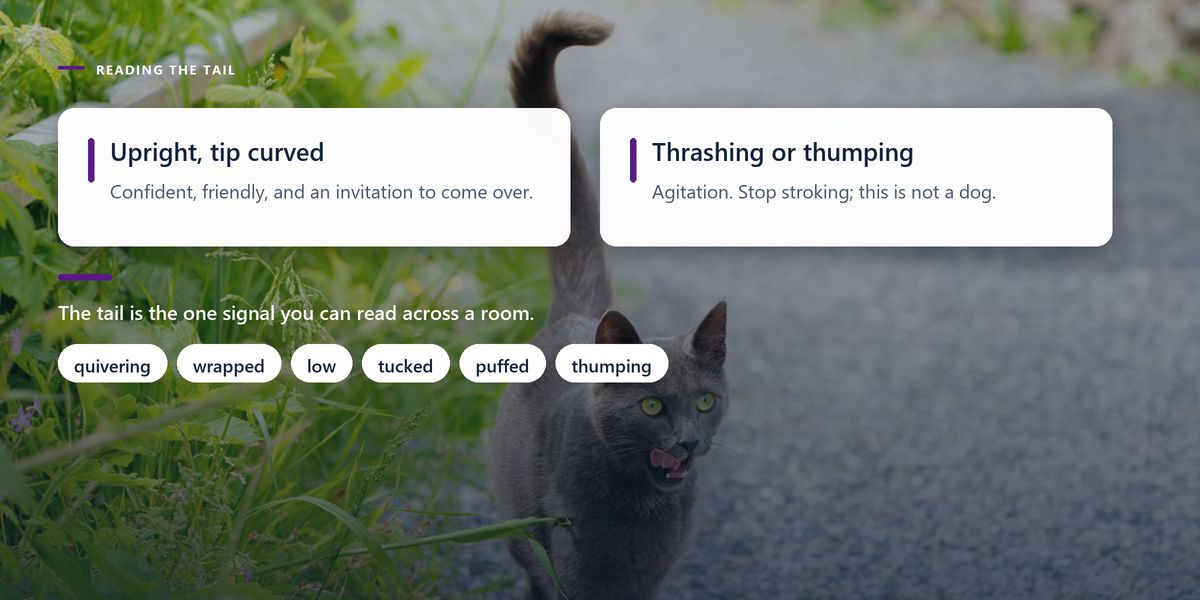
The tail is the most reliable indicator of a cat's state, and it is unusually easy to read once you know what to look for.
Ears rotated sideways or flattened back signal fear or irritation, and they are an early warning that comes before any swipe. Ears forward and relaxed mean a comfortable, interested cat.
Dilated pupils in normal light indicate arousal — excitement, fear or hunting mode. Narrowed pupils in a relaxed cat generally indicate contentment, though light levels obviously affect this too.
The slow blink is the most charming and best-evidenced signal. A cat that looks at you and blinks slowly is signalling that it is comfortable, and research suggests cats respond positively when humans slow-blink back. It is one of the few pieces of cross-species communication you can actually initiate.
Purring is widely assumed to mean contentment and frequently does. It is also produced by cats that are frightened, injured, giving birth or dying, which suggests it functions partly as self-soothing rather than purely as a signal of pleasure.
The practical consequence matters: a purring cat at the vet is not necessarily comfortable, and a purring cat that is otherwise hunched, quiet and off its food may well be unwell. Read purring alongside posture and behaviour rather than on its own.
| Behaviour | Common assumption | Usual reality |
|---|---|---|
| Going outside the litter tray | spite or laziness | medical issue, dirty tray, or wrong location |
| Knocking things off surfaces | mischief | investigation and attention that reliably works |
| Sudden zoomies at night | madness | crepuscular activity pattern and pent-up energy |
| Kneading with paws | unknown | a retained kittenhood comfort behaviour |
| Bringing prey home | a gift | instinct; the home is a safe place to bring it |
| Sitting on your keyboard | attention seeking | warm, elevated, and it always gets a reaction |
The standard guidance on litter trays is one per cat plus one spare, placed in quiet, separate locations away from food and water, with unscented litter and daily cleaning. A large share of household toileting problems resolve on that change alone — and any sudden change in toileting warrants a vet visit first, since urinary problems are common and can be serious.
Cats scratch to maintain their claws, to stretch the muscles along the back and shoulders, and to leave both visual and scent marks. It is not optional behaviour that can be trained away, and it should not be.
What you can control is where. Cats generally prefer a tall, stable post they can stretch fully upright against — many commercial posts are too short and too wobbly to be attractive. Place them where the cat already scratches and beside sleeping spots, since scratching frequently follows waking.
If a cat is scratching furniture, the usual answer is that the alternative is inadequate or in the wrong place, not that the cat needs correcting.
Cats are territorial in a way that dogs are not, and much of what looks like odd behaviour is about controlling space.
Vertical space matters enormously. Shelves, the top of a wardrobe and cat trees give a cat somewhere to observe from and to retreat to, which reduces stress considerably — especially in multi-cat households, where height provides separation that floor space cannot.
Multi-cat homes also need duplicated resources in separate locations: food, water, trays, beds and hiding places. Cats that appear to tolerate each other may still be competing for a single resource, and that competition is behind a large share of spraying and inter-cat tension.
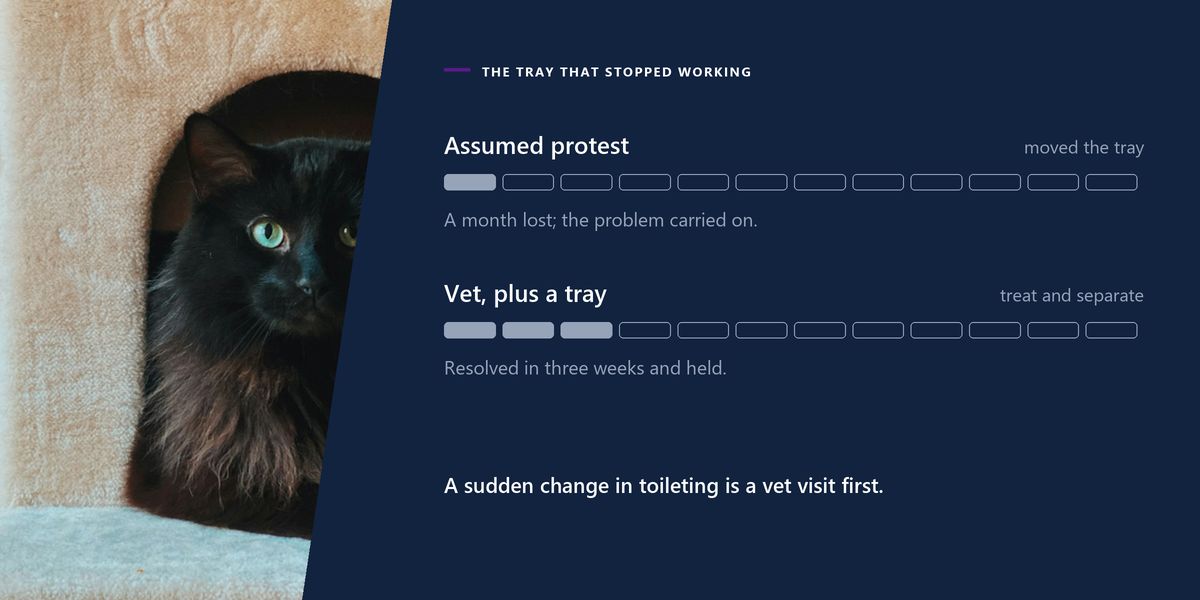
A six-year-old cat began urinating on a bath mat after four uneventful years. The owner assumed it was a protest at a new work schedule and tried moving the tray.
A vet visit found early signs of a urinary tract problem, which was treated. The behaviour did not stop entirely, because by then the cat had begun associating the tray with discomfort.
The full solution was medical treatment plus a second tray in a quieter room, unscented litter and a deeper tray. It resolved within three weeks. The assumption of protest had delayed treatment by nearly a month.
Cats conceal illness effectively, so subtle changes matter. Hiding more than usual, reduced appetite, altered toileting, over-grooming a particular area, or sudden irritability all warrant a vet visit. A cat that stops eating for more than a day or two needs prompt attention, since fasting can cause serious liver complications in cats specifically.
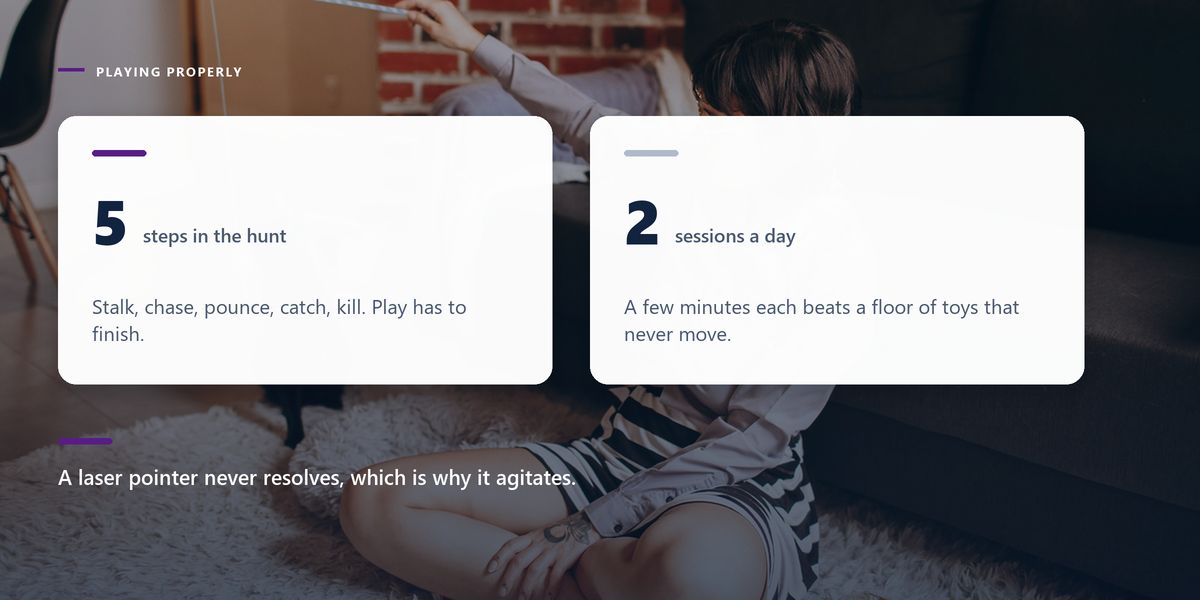
Cat play is predatory sequence: stalk, chase, pounce, catch, kill. Play that never allows a catch is frustrating rather than satisfying, which is why laser pointers can leave a cat agitated — the prey never resolves.
Use a wand toy, let them catch it periodically, and finish with something tangible. Two short sessions a day of a few minutes each does more for behaviour than any amount of toys left on the floor, which cats largely ignore because they do not move.
Read the tail first, and remember a moving tail means agitation. Return slow blinks. Do not treat purring as proof of contentment. Provide one litter tray per cat plus one, in quiet locations. Give tall stable scratching posts where the cat already scratches, plenty of vertical space, and play that ends in a catch.
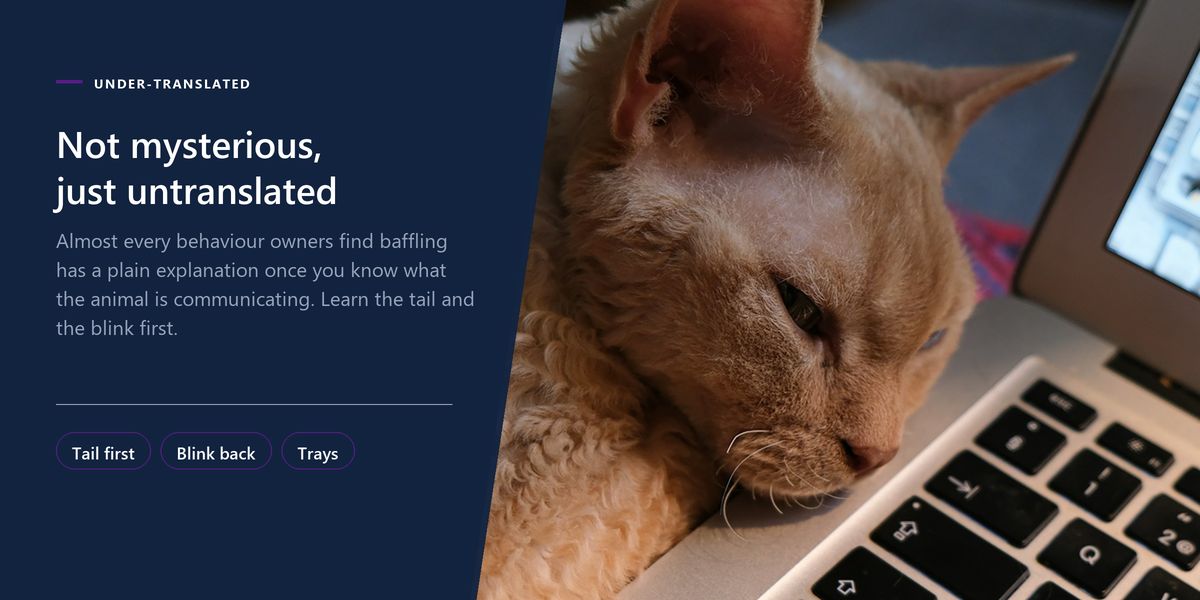
Cats are not mysterious so much as under-translated. Almost every behaviour that frustrates owners has a straightforward explanation once you know what the animal is actually communicating.
Learn the tail and the blink first. They will change how you read your cat within a week.
Tap a star to share what you thought.
No ratings yet
In cats, a thrashing or thumping tail signals agitation rather than pleasure — the opposite of a dog. It is an early warning that the cat wants the interaction to stop, and ignoring it is where many scratches come from.
No. Cats also purr when frightened, injured, in labour or seriously unwell, which suggests it partly functions as self-soothing. Read purring alongside posture, appetite and general behaviour rather than treating it as proof of contentment.
Most commonly a medical problem, a tray that is not clean enough, or an unsuitable location. See a vet first, since urinary issues are common and can be serious, then review the setup: one tray per cat plus one, quiet locations, unscented litter.
Provide better alternatives rather than trying to stop the behaviour, which is a genuine need. Use tall, stable posts the cat can stretch fully against, placed where they already scratch and near sleeping spots.
A friendly signal cats use to show they are comfortable, and one of the few you can return. Research suggests cats respond positively when humans narrow their eyes and blink slowly at them.
Cats are naturally most active around dawn and dusk, and indoor cats often have energy left over. Two short structured play sessions using a wand toy, each ending with a catch, usually reduces night-time activity considerably.
Sign in to join the conversation.
Loading responses…
Have a story, idea, or something valuable to share? Join The Blog Story for free, publish your content, reach more readers, and earn a share of advertising revenue from eligible content.
Create quality content. Grow your audience. Grow your earning potential.