Stargazing for Complete Beginners: What You Can See Without a Telescope
Buy the telescope last. Your eyes and a dark field will show you more than you expect.

6 min read
—Not yet rated
Buy the telescope last. Your eyes and a dark field will show you more than you expect.
The standard beginner's path into astronomy involves buying a telescope, spending an evening failing to point it at anything, and putting it in a cupboard for eleven years.
The problem is not the person or usually even the telescope. It is that a telescope shows a very small patch of sky at high magnification, which is close to useless if you cannot yet find anything.
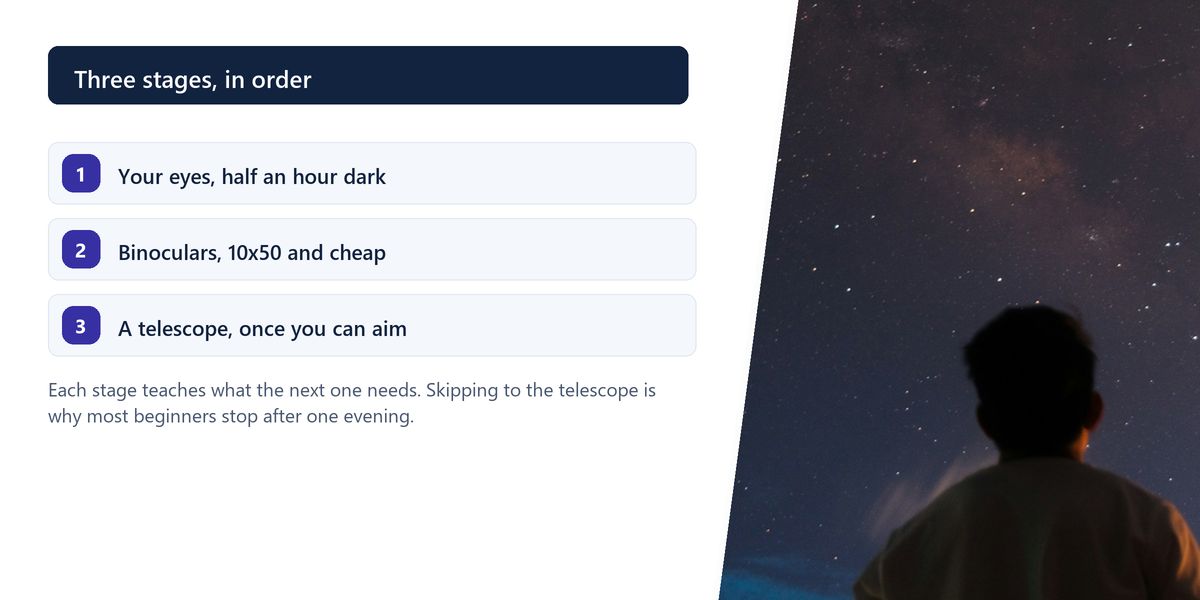
Start with your eyes, add binoculars if you enjoy it, and buy a telescope only once you know your way around. The night sky is considerably more accessible than it looks.
Dark adaptation is the most underrated part of stargazing and it is free. Human eyes take roughly twenty to thirty minutes to reach usable night vision, and a single glance at a phone screen resets much of it.
Go outside, avoid all white light, and wait. The difference between five minutes and thirty is dramatic — stars appear that simply were not visible before, and the faint band of the Milky Way becomes apparent from a genuinely dark site.
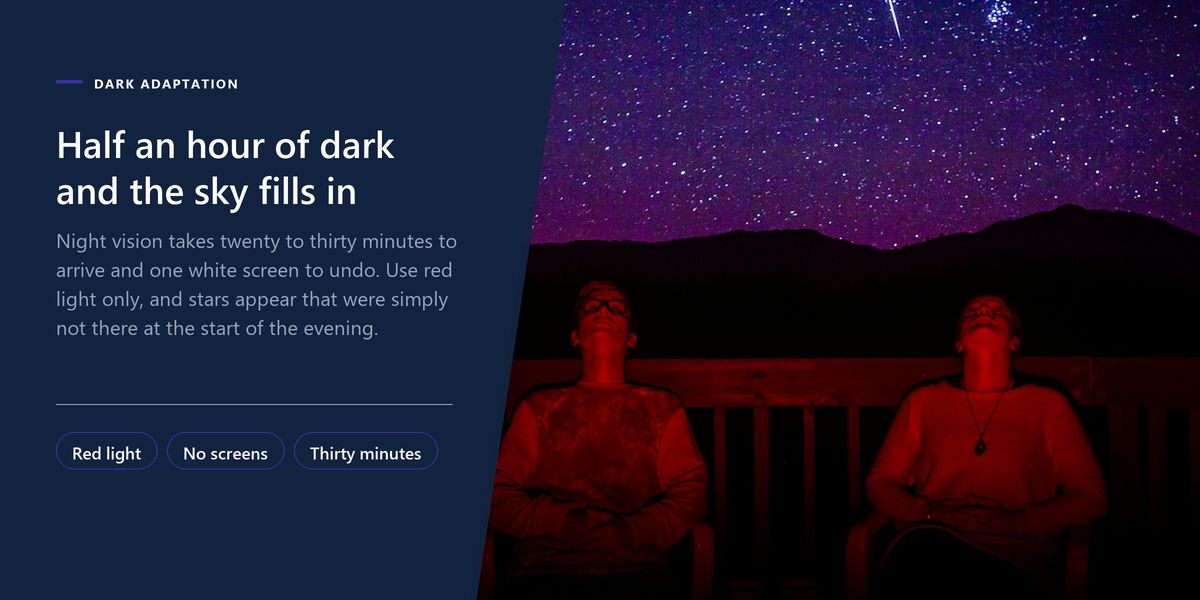
If you need light, use red, which affects night vision far less. Most astronomy apps have a red night mode, and a torch with red film over it costs nothing.
Light pollution is the main limitation for most people, and it is worth being realistic. From a city centre you might see a few dozen stars; from a genuinely dark rural site, thousands, plus the Milky Way as an obvious structure.
You do not need a dark-sky reserve to start. A local park away from direct streetlights, a garden with a wall blocking the worst glare, or simply looking at the brightest objects works fine. The Moon, the bright planets and the major constellations are visible from almost anywhere.
When you can travel somewhere dark, do it once early. Seeing what the sky actually looks like is motivating in a way that reading about it is not.
Nobody learns eighty-eight constellations. Experienced observers learn a handful of obvious patterns and use them as signposts to everything else.
In the northern hemisphere, the Plough — part of Ursa Major — is the essential starting point, and its two end stars point directly at Polaris, the north star. From Polaris you can orient yourself in any season. Orion dominates winter evenings and is unmistakable, and its belt points one way towards Sirius, the brightest star in the night sky, and the other towards the Hyades and Pleiades clusters.
In the southern hemisphere, the Southern Cross and the two bright pointer stars serve the same navigational purpose, and the Magellanic Clouds are visible from dark sites as faint patches — companion galaxies to our own.
Planets are among the most rewarding objects for beginners because they are bright, easy to find and visibly change position over weeks.
| Object | How to recognise it | What you can see |
|---|---|---|
| Venus | extremely bright, near sunrise or sunset | phases, through binoculars |
| Jupiter | very bright, steady, high in the sky | four moons, even in binoculars |
| Saturn | steady, yellowish, moderately bright | rings, in a small telescope |
| Mars | distinctly reddish, brightness varies a lot | a small disc when close to Earth |
| Stars | twinkle noticeably | points of light at any magnification |
The twinkling distinction is genuinely useful. Stars are effectively point sources, so atmospheric turbulence makes them scintillate. Planets present a tiny disc, which averages that out, so they shine steadily. If it is bright and not twinkling, it is almost certainly a planet.
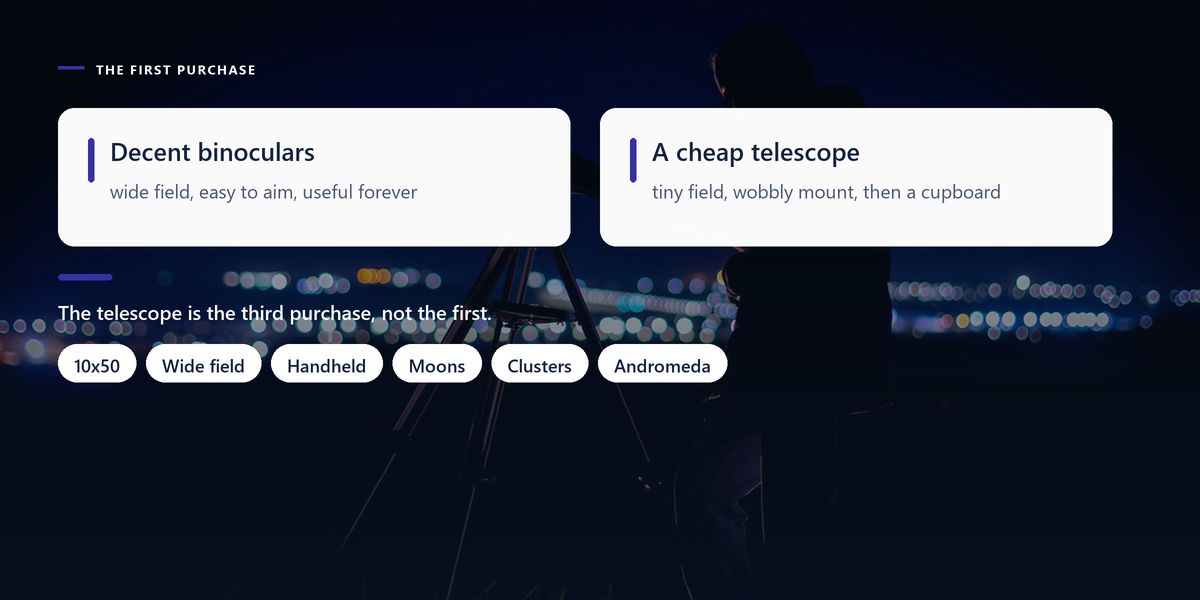
Buy binoculars before a telescope. A pair of 10x50s costs a fraction of a usable telescope, shows the Moon's craters, Jupiter's moons, star clusters and the Andromeda galaxy, and is easy to point. They also remain useful forever, whereas a cheap telescope is frequently the reason people conclude astronomy is not for them.
Sky-identification apps are genuinely transformative for beginners — point a phone at the sky and it names what you are looking at. Use them, with two adjustments.
Turn on red night mode so you do not destroy your dark adaptation, and put the phone away periodically. The learning happens when you recognise a pattern yourself rather than reading a label, and the sky becomes far more interesting once you can navigate it unaided.
A father bought a large telescope as a Christmas present after his daughter expressed interest in space. They took it out twice, could not locate anything beyond the Moon, and found the image shook badly on its unstable mount.
The telescope went into a cupboard. Two years later they tried again with a pair of borrowed binoculars, a printed star chart and one clear evening in a dark field.
They found Jupiter and its moons within twenty minutes, then the Pleiades, then the Andromeda galaxy. The telescope came back out the following month and, with a better sense of where things were, proved perfectly usable. It had never really been the equipment.
Never look at the Sun through binoculars, a telescope or a camera viewfinder without proper certified solar filtration. Doing so can cause permanent blindness within a fraction of a second. Improvised filters, sunglasses and exposed film are not safe, and solar viewing needs equipment specifically designed and certified for it.
Standing still outside at night is much colder than walking, and cold is the most common reason a session ends early. Dress substantially warmer than the temperature suggests, including a hat and something to stand on if the ground is cold.
A reclining chair transforms unaided-eye observing, since looking up for long periods is genuinely uncomfortable otherwise. And check the moon phase before planning a night out — a bright moon washes out faint objects entirely, which is why serious observers plan around new moon.
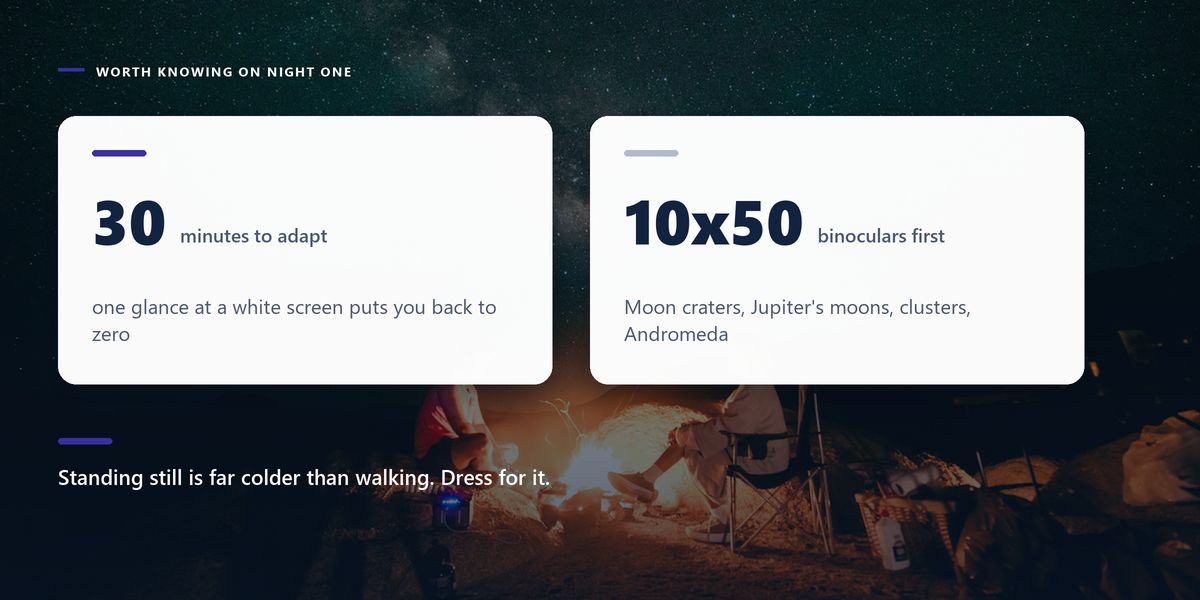
Allow half an hour for dark adaptation and use only red light. Learn two or three landmark patterns and navigate from them. Distinguish planets by their steady light. Buy binoculars first and a telescope only once you know the sky. Start with the Moon, Jupiter, the Pleiades and Orion, and dress far warmer than you expect.
The thing that surprises most beginners is how much is visible with no equipment at all, and how quickly the sky becomes navigable once a few landmarks are learned.
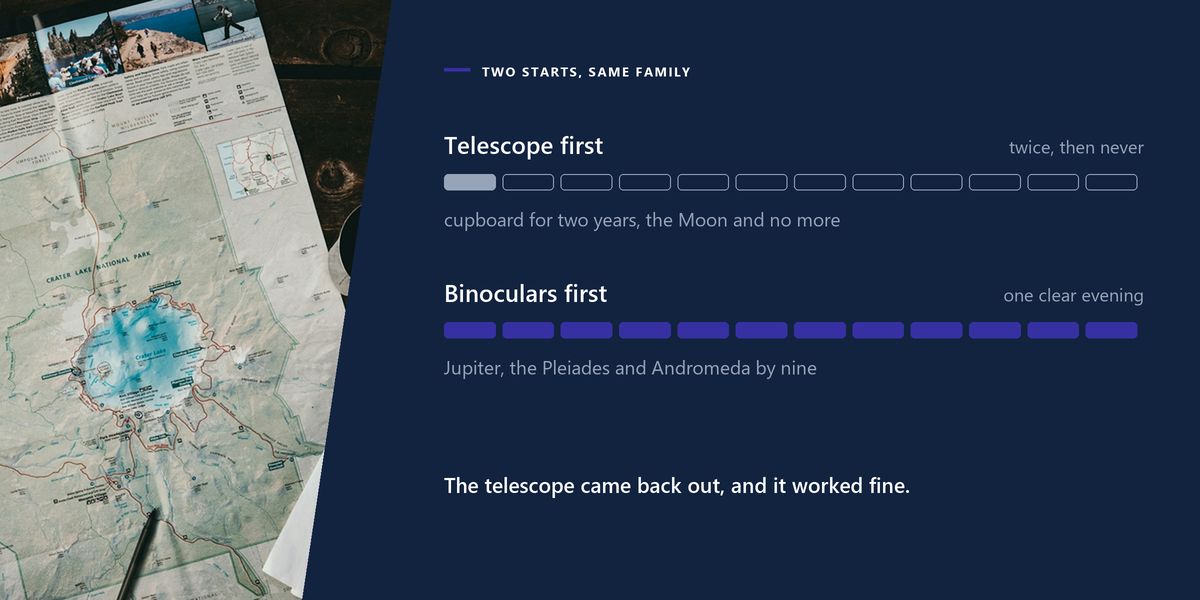
Give it three clear evenings before deciding whether it interests you. Almost everyone who gets past the first one keeps going.
Tap a star to share what you thought.
No ratings yet
No, and starting with one is why many beginners give up. A telescope shows a very small area at high magnification, which is difficult to use before you can navigate the sky. Begin with your eyes, then binoculars.
Roughly twenty to thirty minutes for usable night vision, and a single glance at a white phone screen undoes much of it. Use red light if you need illumination, since it affects dark adaptation far less.
Stars twinkle noticeably because they are effectively point sources disturbed by the atmosphere, while planets present a tiny disc and shine steadily. A bright object that is not twinkling is almost certainly a planet.
The Moon along the terminator rather than when full, Jupiter and its four visible moons, the Pleiades cluster, the Orion Nebula, and the Andromeda galaxy from a dark site. All are visible with the eye or binoculars.
A 10x50 pair is a widely recommended starting point — bright enough for astronomy, light enough to hold steady, and useful in daylight too. They cost a fraction of a usable telescope and show a great deal.
Yes, with lower expectations. The Moon, bright planets, the major constellations and satellite passes are visible from almost anywhere. Getting to a genuinely dark site once early is worth doing, because it shows what is actually up there.
Sign in to join the conversation.
Loading responses…
Have a story, idea, or something valuable to share? Join The Blog Story for free, publish your content, reach more readers, and earn a share of advertising revenue from eligible content.
Create quality content. Grow your audience. Grow your earning potential.