The Seasonal Home Maintenance Checklist That Prevents Expensive Repairs
Almost every large repair bill started as a small job somebody postponed.

6 min read
—Not yet rated
Almost every large repair bill started as a small job somebody postponed.
The expensive repairs in a home almost never begin as expensive repairs. A gutter blocks in October, water runs down a wall all winter, and by spring there is damp in a bedroom and a bill with an extra digit in it.
That is the pattern for most of it. Small, cheap, boring jobs done on time prevent large, urgent, expensive ones — and the reason they do not get done is not cost or difficulty. It is that nobody remembers when.
So this is a calendar rather than a list of skills. Most of it takes a few minutes and needs no tools.
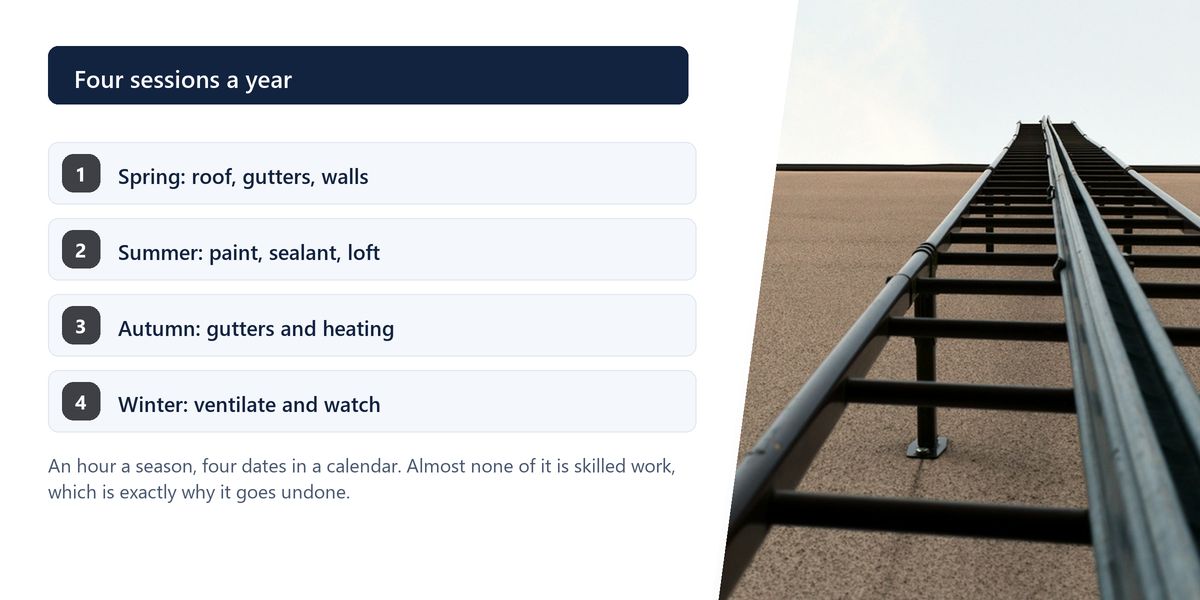
Winter is when a building takes its heaviest load — water, frost, wind — and spring is when the damage is visible and still cheap to fix.
Dry, warm weather is when exterior work is actually possible, and it is the best time to deal with anything involving paint, sealant or getting on a ladder.
Repaint or treat exterior woodwork before it deteriorates rather than after. Reseal around windows and doors where the sealant has cracked or shrunk. Check that soil and paving outside are below the damp-proof course, since raised ground levels are a very common and very fixable cause of rising damp.

Summer is also when to deal with anything you have been ignoring in a loft or garage, because those spaces are unbearable in both extremes and pleasant for about six weeks a year.
Autumn is the most important session of the year, because everything you do now determines how the building handles winter.
| Job | Why it matters | Frequency |
|---|---|---|
| Clear gutters again | leaves fall after your spring clean | every autumn |
| Bleed radiators | cold spots mean trapped air and wasted heat | once heating restarts |
| Check heating works | before you need it, not during a cold snap | every autumn |
| Insulate exposed pipes | burst pipes are a winter classic | check yearly |
| Clear drains and gullies | leaf blockages cause overflow and damp | every autumn |
| Check draughts | cheap to fix, immediate effect on bills | yearly |
Find your stopcock now, label it, and turn it off and on once a year to make sure it still works. Discovering that a seized stopcock will not close while water is coming through a ceiling is a genuinely bad twenty minutes, and it is entirely avoidable.
Winter is mostly about monitoring rather than working. The two things worth active attention are condensation and pipes.
Condensation is the most common cause of household mould, and it is a ventilation problem rather than a cleaning problem. Wiping mould off a window frame without addressing why the moisture is there guarantees its return. Use extractor fans when cooking and showering, open windows briefly each day even when it is cold, and avoid drying laundry indoors on radiators without ventilation.
For pipes, keep some heat on during a cold snap even if you are away — a frozen pipe that bursts while nobody is home is one of the most expensive events a house can have.
Confidence is useful; knowing the boundary is more useful. Gas work, electrical work beyond changing a fitting, anything structural, and anything requiring you to be on a roof are jobs for people with training, insurance and the right equipment.
The economics are also clearer than they look. A professional gutter clean costs a fraction of repairing a damp wall, and a boiler service costs far less than an emergency callout in January. Paying for prevention is almost always cheaper than paying for repair, which is the entire argument of this article.
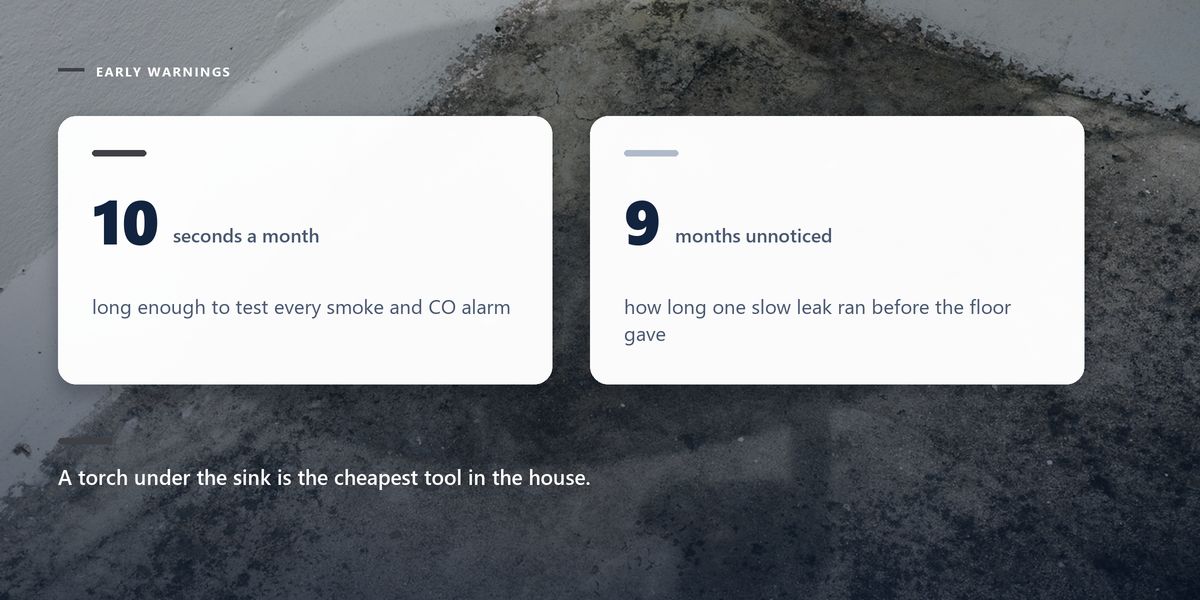
A homeowner noticed a faint musty smell in a downstairs cupboard one autumn and assumed it was the cupboard being a cupboard. It persisted through winter and she stopped noticing it.
The following summer a floorboard flexed underfoot. A slow leak from a joint behind the cupboard had been running for roughly nine months, rotting the joist beneath and spreading into the adjacent room.
The repair — joists, flooring, replastering and a fortnight of disruption — came to about four thousand pounds. The original leak was a failed compression joint, replaceable in ten minutes for the cost of a sandwich, if anyone had looked with a torch.
Never ignore a smell of gas, a burning smell from an electrical outlet, or a carbon monoxide alarm. These are not maintenance items to schedule. Leave, ventilate if it is safe to do so, and call the relevant emergency service immediately.
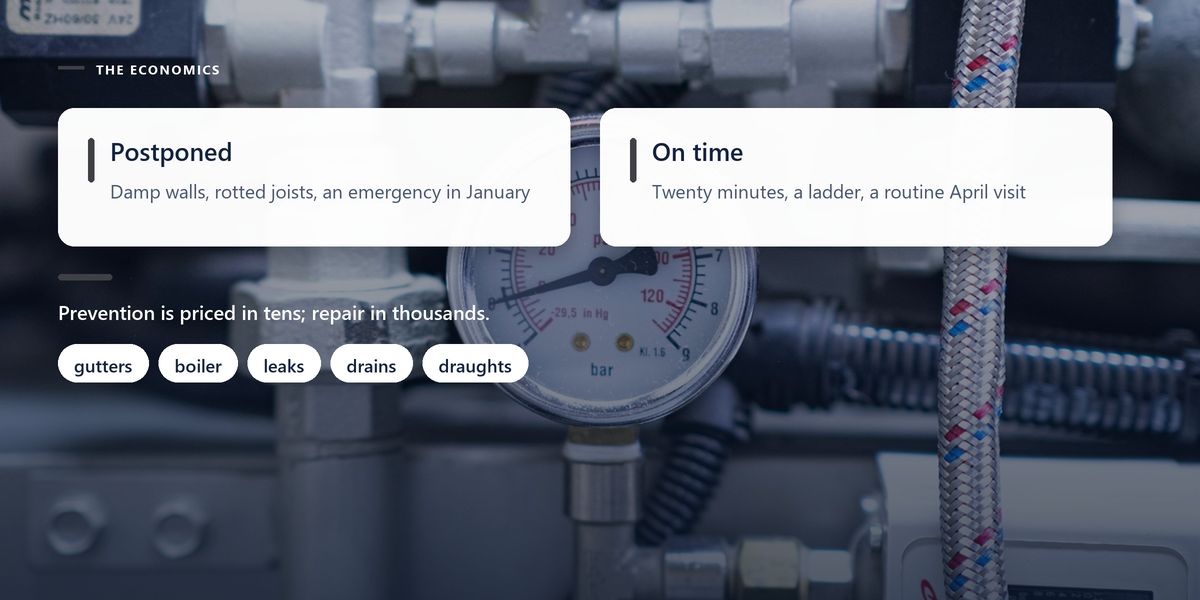
Clear gutters in spring and autumn. Service the boiler in spring. Do exterior sealing and painting in summer. Prepare heating, drains and pipes in autumn. Ventilate through winter to prevent condensation. Test alarms monthly, check under sinks with a torch, and know where your stopcock is.
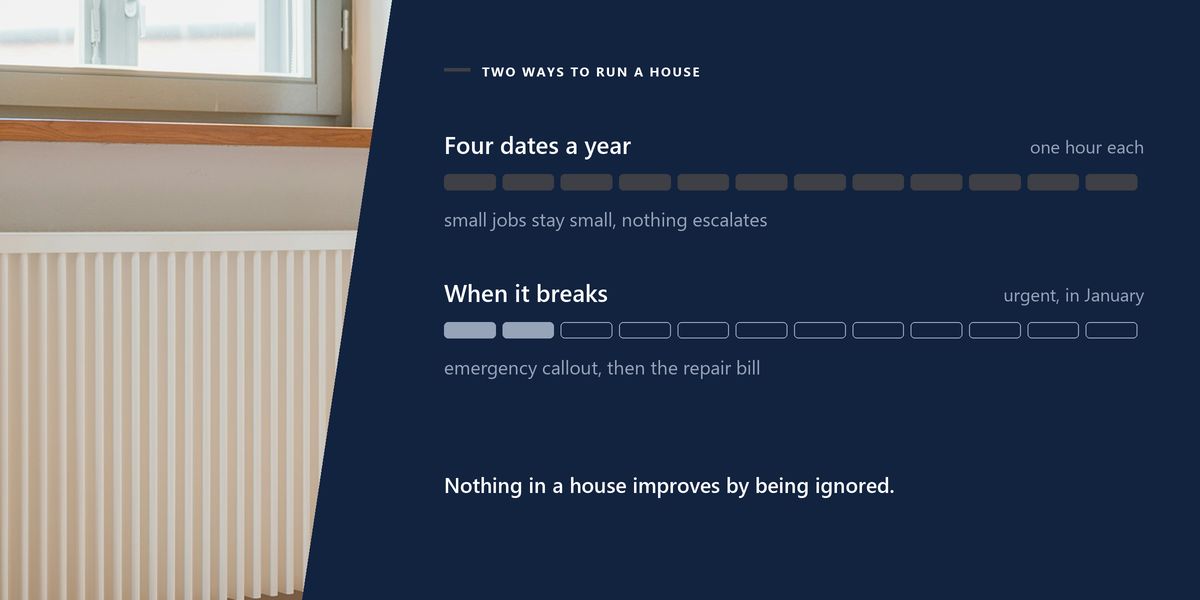
None of this is skilled work, and almost none of it is urgent on the day you do it — which is precisely why it does not get done until it becomes both.
Put four dates in a calendar, one per season, and give each an hour. It is the cheapest insurance a house has.
Tap a star to share what you thought.
No ratings yet
Twice a year for most homes — once in spring after winter debris and once in autumn after leaf fall. Blocked gutters overflow against walls, and persistently wet walls are one of the most common causes of interior damp.
Spring or early summer. Engineers have availability, prices are often lower, and a fault found then is an inconvenience rather than an emergency. Booking in October means competing with everyone whose heating has just failed.
Usually condensation rather than a leak. Warm moist air meets a cold surface and deposits water. The fix is ventilation and reducing indoor moisture — extractor fans, brief daily window opening, and not drying laundry indoors without airflow.
Monthly, using the test button, and replace the units entirely around every ten years since the sensors degrade. Carbon monoxide alarms should be tested on the same schedule and replaced according to their stated lifespan.
Gas work, electrical work beyond replacing a light fitting, anything structural, and anything requiring roof access. These need training, insurance and proper equipment, and the consequences of getting them wrong are disproportionate.
Because a burst pipe is measured in minutes. Find it, label it, and turn it off and on once a year to confirm it has not seized — discovering a stuck stopcock during a flood turns a manageable incident into a serious one.
Sign in to join the conversation.
Loading responses…
Have a story, idea, or something valuable to share? Join The Blog Story for free, publish your content, reach more readers, and earn a share of advertising revenue from eligible content.
Create quality content. Grow your audience. Grow your earning potential.