Landing Your First Developer Job: What Actually Moves the Needle
The market rewards evidence. Most candidates supply claims instead.

7 min read

—Not yet rated
The market rewards evidence. Most candidates supply claims instead.
The hardest part of a first developer job is that everyone wants experience, and experience requires a job. It is a genuinely difficult position, and most advice about it is either vague encouragement or a list of technologies to learn.
Here is the thing that reframes it. A hiring manager filling a junior role is not looking for expertise. They are trying to answer one question: will this person become productive without consuming more senior time than they are worth?
Everything below is about answering that question with evidence rather than assertion.

The most common portfolio problem is not quality. It is that everything in it is a tutorial someone followed, and every hiring manager has seen that exact application several hundred times.
What distinguishes a portfolio is that the project solves a problem the candidate actually had. It does not need to be original or clever. A tool that tracks something for your sports club, a scraper that watches for something you care about, a small app your family actually uses — any of these tells a much richer story than another clone of a well-known product.
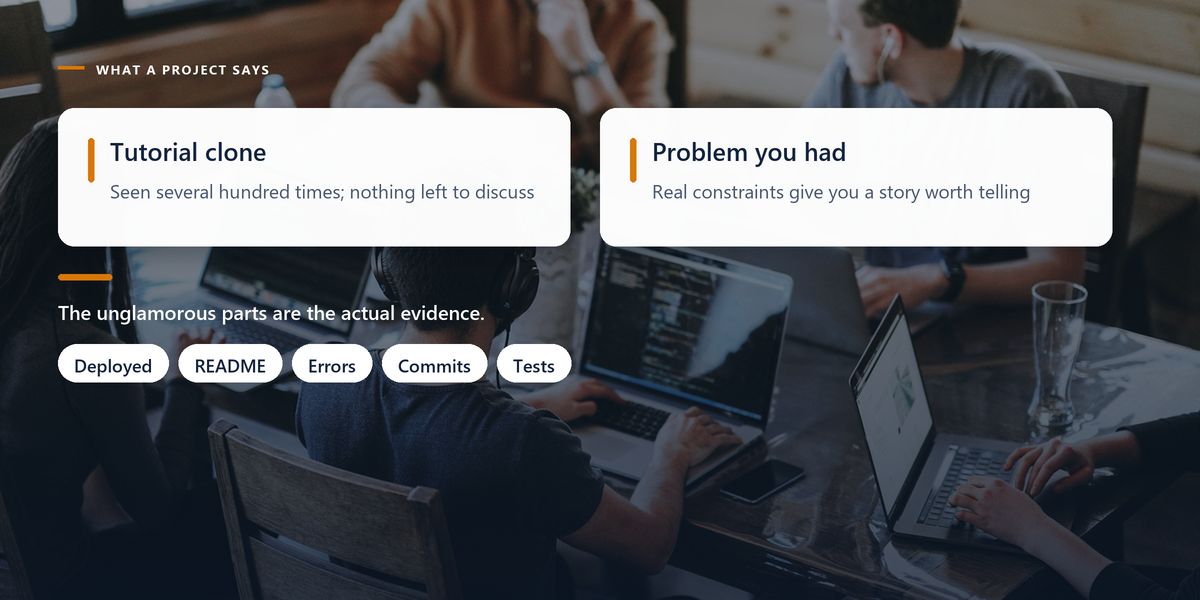
It also gives you something to talk about. When an interviewer asks about a technical decision, you can describe the constraint you hit and what you tried, because you genuinely hit it. That conversation is what the interview is for.
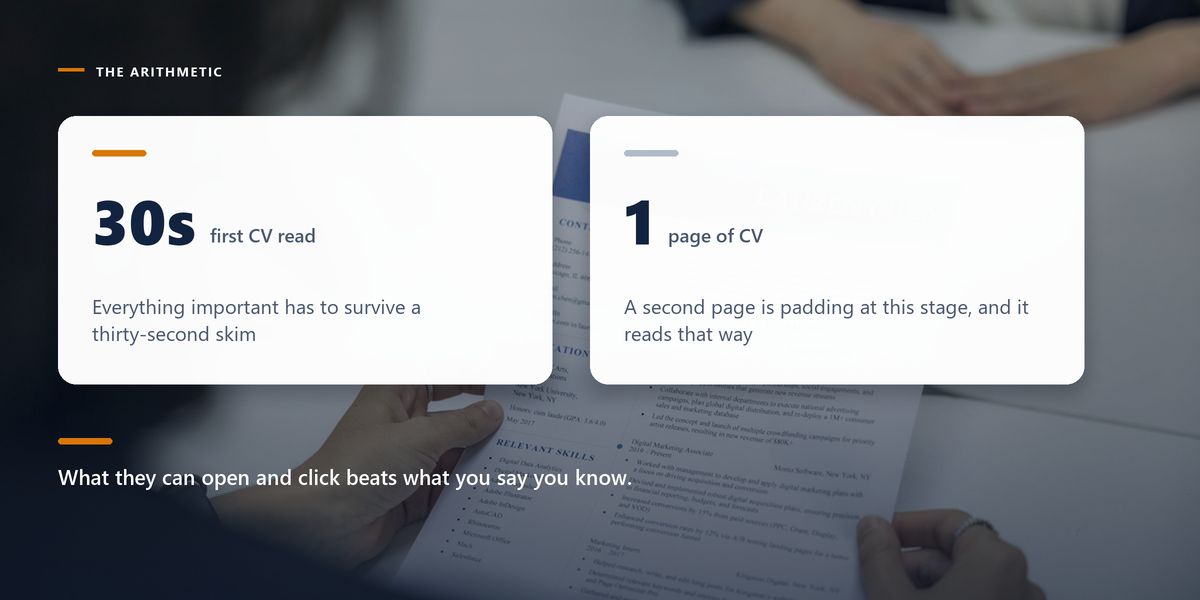
Assume it gets thirty seconds on the first pass. Everything important must survive that.
Put a short summary at the top saying what you build and what you are looking for. Put projects above education if your education is not recent and relevant. Link directly to live projects, not only to a profile page. Keep it to one page, because at this stage a second page is padding and reads that way.
For each project, say what it does, what you built it with, and — most importantly — one specific thing that was hard. 'Built a booking tool; handling overlapping reservations across timezones took three attempts' is worth more than a paragraph of adjectives, because it demonstrates that you met a real problem.
Apply to fewer roles with tailored applications rather than many with a generic one. Twenty considered applications that reference the specific company and role outperform two hundred identical ones, and take less total time. Volume is the strategy that feels productive while producing nothing.
Public job boards are the most competitive channel, and for junior roles the competition is brutal — hundreds of applications for a single opening, most of them never read by a human.
| Channel | Competition | Worth the effort? |
|---|---|---|
| Large public job boards | extremely high | yes, but not as your main channel |
| Company career pages directly | high | yes — often a smaller pile |
| A referral from someone you know | very low | by far the highest return |
| Local meetups and communities | low | slow, and it compounds |
| Open source contributions | low | strong evidence, slow to pay off |
| Recruiters specialising in juniors | moderate | worth a conversation |
Referrals are disproportionately effective, and the word puts people off because it sounds like it requires connections you do not have. It does not. It requires being visible somewhere developers are — a local meetup, a community, a project you contribute to regularly — for long enough that people know what you are working on.
Most candidates prepare by memorising answers. Most interviewers are trying to observe how you think, because that is what predicts whether you will be able to work on unfamiliar code.
In a technical exercise, say what you are considering out loud. Ask clarifying questions before writing anything. State your assumptions. If you are stuck, describe where you are stuck and what you would try next — that is a far better signal than silence followed by a perfect memorised answer.
The honest 'I have not used that, but here is how I would find out' is a stronger response than a confident wrong one. Interviewers notice bluffing, and it costs more than the gap it was covering.
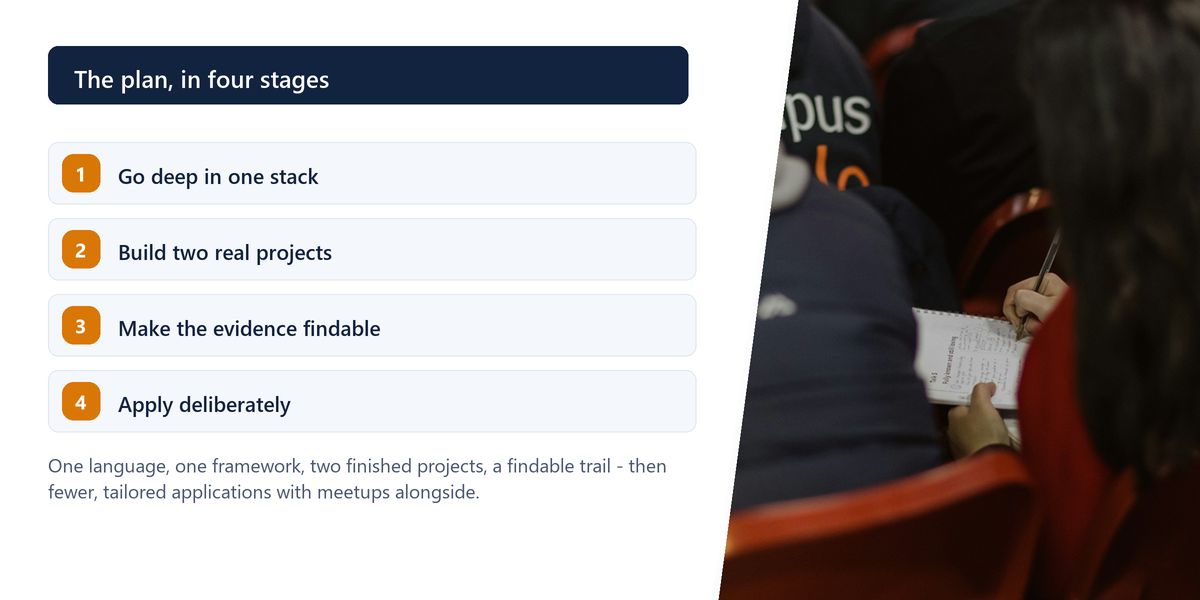
This part is genuinely hard and rarely discussed honestly. You will send many applications and hear nothing back from most. That is not a series of individual judgements on your ability; it is a consequence of volume at the entry level.
Two things help. First, track your applications so you can see patterns rather than a blur — if you get interviews but no offers, that is a different problem from getting no interviews, and it needs a different fix. Second, set a rhythm you can sustain: a fixed number of applications a week and continued building, rather than frantic bursts followed by weeks of demoralisation.
A career-changer spent four months applying to roughly 200 junior positions with a generic CV and three tutorial projects. He received two rejections and no other replies.
He changed approach for eight weeks. He built one substantial project solving a real problem from his previous industry, wrote a thorough README, deployed it, and wrote a short post about the hardest technical decision in it. He attended two local meetups a month.
He then applied to sixty roles, tailoring each application and mentioning the project's relevance where it fit. He got eleven interviews and three offers. The technical skills had barely changed in those eight weeks; the evidence had.
The certification trap catches a lot of career changers. Another course feels like progress, is comfortable, and defers the uncomfortable part — building something imperfect in public and applying before you feel ready. Beyond a solid foundation, employers weigh certificates far less than a project they can open in a browser.
Depth in one stack beats shallow familiarity with six. Pick one language and one framework that are widely hired for in your area, and go deep enough to build real things with them.
Alongside that, the fundamentals transfer everywhere and are what senior people actually assess: how HTTP works, how data is stored and queried, how version control works in a team, how to read an error message, and how to debug something you did not write. These matter more, and last longer, than any framework.
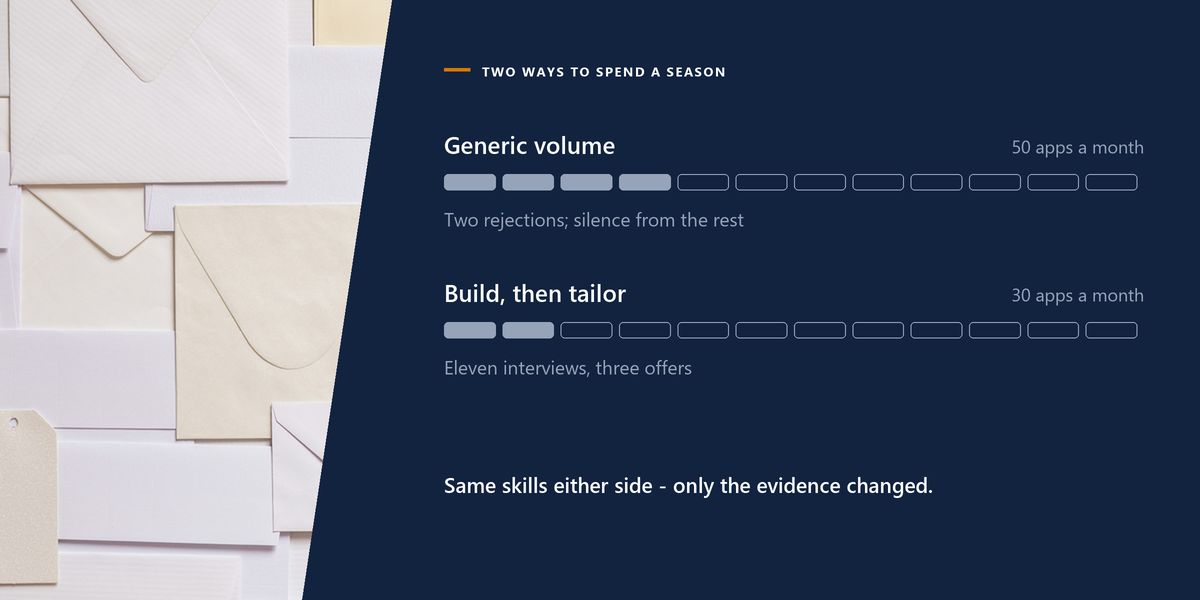
Build two finished, deployed projects that solve real problems and write good READMEs. Keep the CV to one page with projects prominent and a specific hard problem named. Prefer referrals and direct applications to mass job-board submissions. In interviews, think out loud and say honestly what you do not know. Sustain a steady rhythm rather than sprinting and stalling.
The gap between candidates who get hired and those who do not is rarely knowledge. It is evidence — something a hiring manager can look at, click on, and ask you about.
Build the evidence. Three focused months of that will do more than another year of courses, and it is a great deal more interesting. Once you are in, our guide to code reviews covers the part of the job most new developers find hardest.
Tap a star to share what you thought.
No ratings yet
No. Many teams hire on demonstrated ability, and self-taught developers and career changers are common. A degree helps with some larger employers and with visa requirements in some countries, but evidence of what you can build carries more weight in most hiring processes.
Two or three that are genuinely finished and deployed, not a long list of half-built ones. Depth matters more than quantity, because the interview conversation will go deep on one of them and shallow projects run out of substance quickly.
They can provide structure and accountability, which some people need. What they cannot provide is the evidence employers weigh most: finished projects you can discuss in detail. Treat a course as a starting point rather than the qualification itself.
What the project does, why you built it, how to run it locally, a link to the live version, and one honest note about what you would change. It is frequently the first thing a reviewer reads and sometimes the only thing.
Build tools you personally need, contribute to open source projects you use, take on small freelance or volunteer work for a local organisation, and document all of it. These produce the same discussable material a first job would.
How you reason through an unfamiliar problem, whether you ask clarifying questions, how you respond when stuck, and whether you can explain a decision. Recall of syntax is much less important than the thinking they can observe.
Say so directly, then explain how you would find out and what you would try first. Interviewers detect bluffing reliably, and it costs far more credibility than the gap it was intended to hide.
Enough that rejection stops feeling personal, and few enough that each one is tailored. Twenty considered applications typically outperform two hundred generic ones. If you are getting interviews but no offers, that is a different problem to solve than getting no interviews at all.
Sign in to join the conversation.
Loading responses…
Have a story, idea, or something valuable to share? Join The Blog Story for free, publish your content, reach more readers, and earn a share of advertising revenue from eligible content.
Create quality content. Grow your audience. Grow your earning potential.