Insurance Explained Without the Jargon: What You Need and What You Do Not
Insure what would be financially catastrophic. Self-insure the rest.

5 min read

—Not yet rated
Insure what would be financially catastrophic. Self-insure the rest.
Insurance is sold with fear and bought under time pressure, usually at the checkout, which is close to the worst possible condition for evaluating a financial product.
Underneath the paperwork, though, it is a straightforward trade. You pay a known small amount regularly so that an unknown large amount does not fall on you all at once. Whether that trade is good depends entirely on how large the potential loss is relative to what you could absorb.
This is a general explanation of how to think about it. Rules, products and legal requirements differ substantially by country, so treat this as a framework rather than as advice.
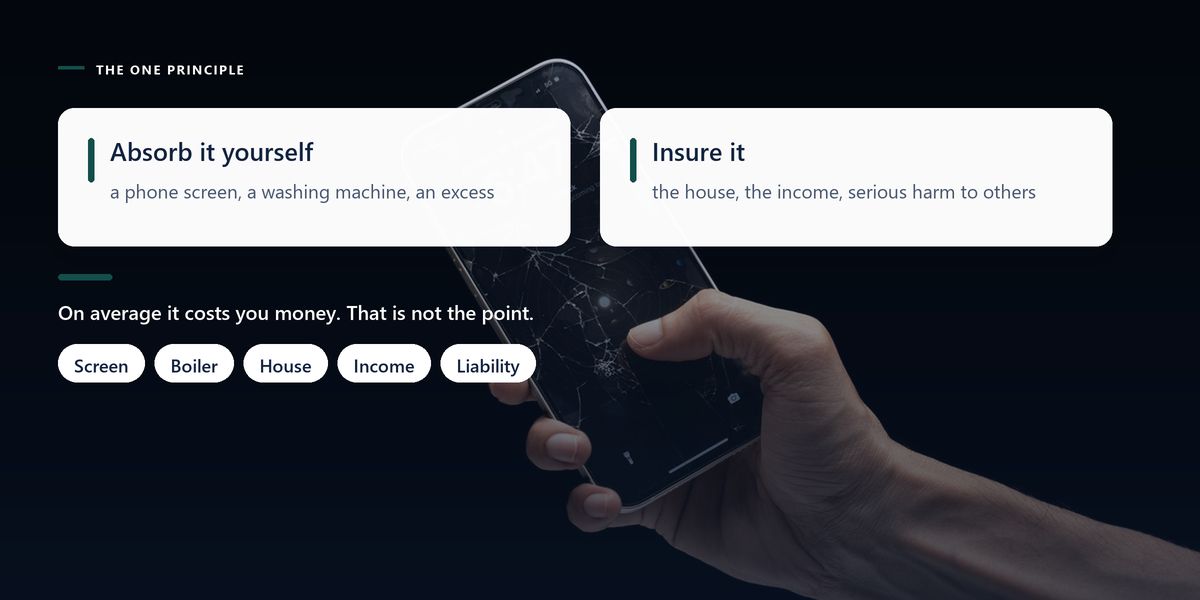
Insure against losses you could not comfortably absorb. Do not insure against losses you could.
That single rule sorts most decisions immediately. Losing your income for a year would be financially devastating for most households, so protecting against it is sensible. A phone screen costing a hundred and fifty to replace is annoying, not devastating, so paying a monthly premium plus an excess to cover it is usually poor value.

Insurers are, necessarily, profitable. Across all customers they take in more than they pay out — that is what funds the business. So on average, buying insurance costs money. You buy it not to come out ahead on average, but to avoid the outcomes that would ruin you.
| Product | Typical value | Why |
|---|---|---|
| Extended appliance warranty | poor | high margin; the loss is affordable anyway |
| Mobile phone insurance | usually poor | premiums plus excess often approach the phone's cost |
| Travel insurance sold at the till | poor | cheaper standalone, often duplicating existing cover |
| Identity theft cover | mixed | much of it duplicates free protections you already have |
| Payment protection add-ons | usually poor | narrow definitions and many exclusions |
| Standalone key or luggage cover | poor | small losses, high relative cost |
The common feature is that these all cover losses most households could absorb, at a price reflecting that they are sold at a moment of anxiety rather than after comparison.
Set your excess deliberately rather than accepting the default. Choosing the highest excess you could pay tomorrow without difficulty lowers your premium meaningfully, and it aligns the policy with what insurance is actually for — you are covering the catastrophe, not the inconvenience.
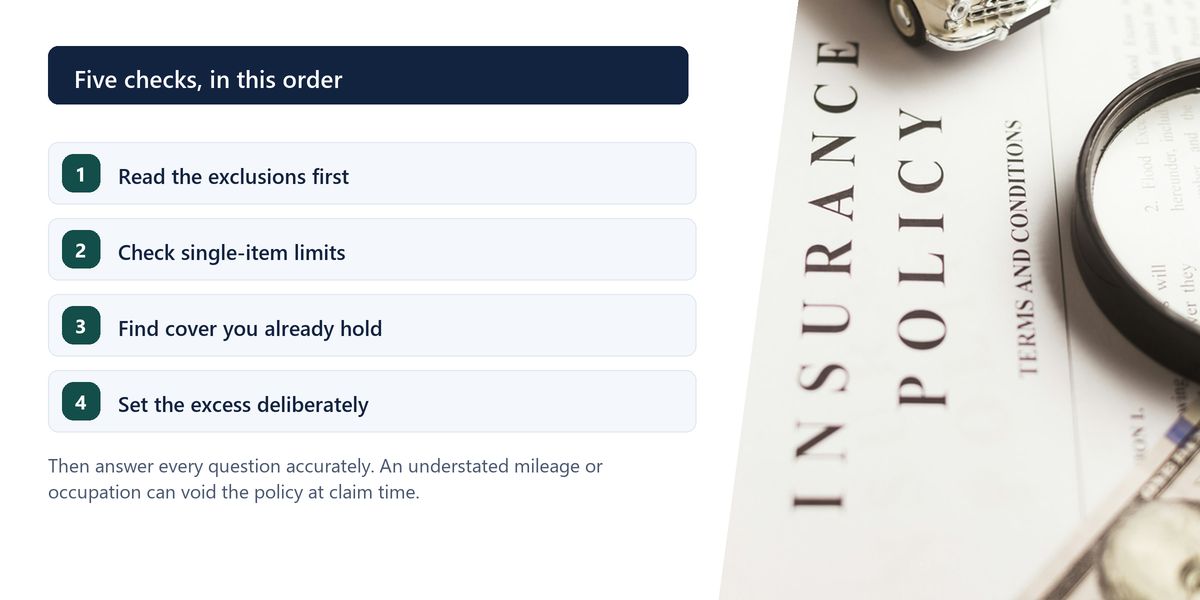
Everyone compares prices and almost nobody reads what is excluded, which is precisely backwards. The exclusions are the product; the price only tells you what you are paying for something you have not yet defined.
Recurring places where policies do not do what people assume:
Duplication is a quiet and common waste. Bank accounts frequently include travel or phone cover as a package benefit. Credit cards may provide purchase protection and travel accident cover. Home contents policies often cover possessions away from the home.
Before buying anything new, check what you already hold. A surprising number of people pay separately for cover they are already entitled to and never claim on because they have forgotten it exists.
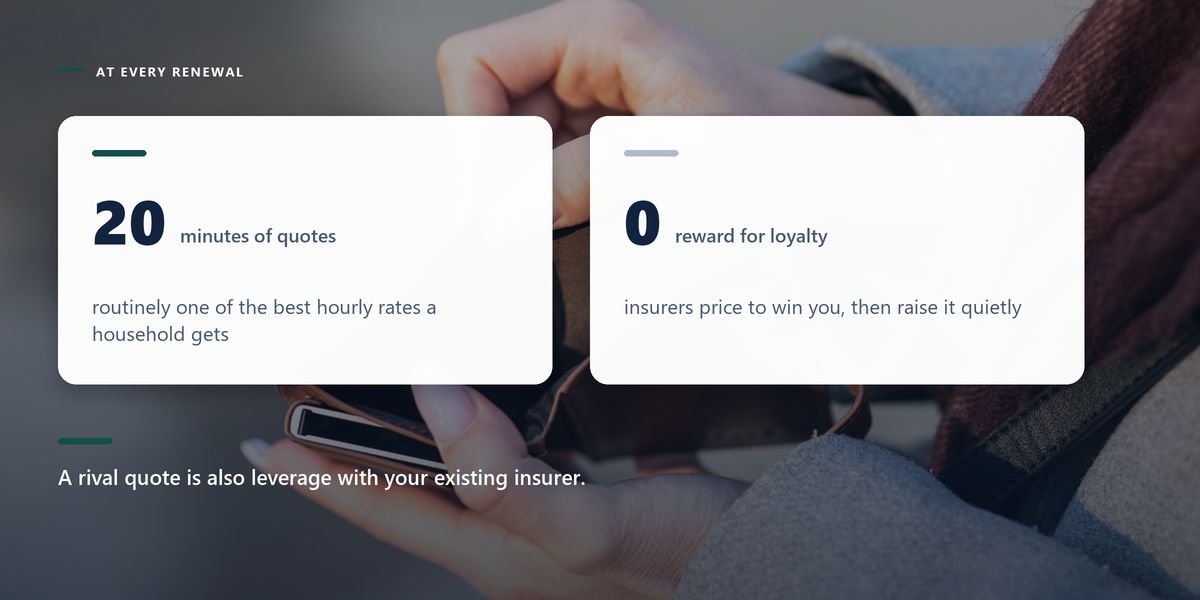
In many markets, insurers price to acquire new customers and then increase premiums for existing ones who do not switch. Automatic renewal is convenient and it is frequently expensive.
Checking the market at every renewal is one of the highest hourly returns available to a household — routinely a substantial saving for perhaps twenty minutes of comparison. Where switching is inconvenient, the same quote is often useful leverage for renegotiating with your existing insurer.
A family made a claim on their home contents policy after a break-in, expecting to be reimbursed for jewellery worth around six thousand pounds among other items.
The policy had a single-article limit of fifteen hundred pounds for any individual item unless specified separately, plus a lower overall limit for valuables. Nothing had been specified, because nobody had read that section when the policy was set up online in about eleven minutes.
The settlement was a fraction of the loss. The policy had worked exactly as written, and specifying the items would have cost very little extra had anyone known to do it.
Never understate risk on an application to lower a premium — mileage, occupation, medical history, who else drives the car. If it emerges at claim time, the insurer may reduce the payment or void the policy entirely, which leaves you with no cover precisely when you needed it and, in some cases, wider consequences.
Insure what would be financially catastrophic and absorb what would not. Set the excess as high as you could comfortably pay. Read exclusions and single-item limits before comparing prices. Check for cover you already hold through banks and cards. Shop the market at every renewal, and always answer questions accurately.
Insurance is not an investment and is not meant to pay off. It is a way of converting a small, predictable cost into protection against an outcome you could not survive financially.
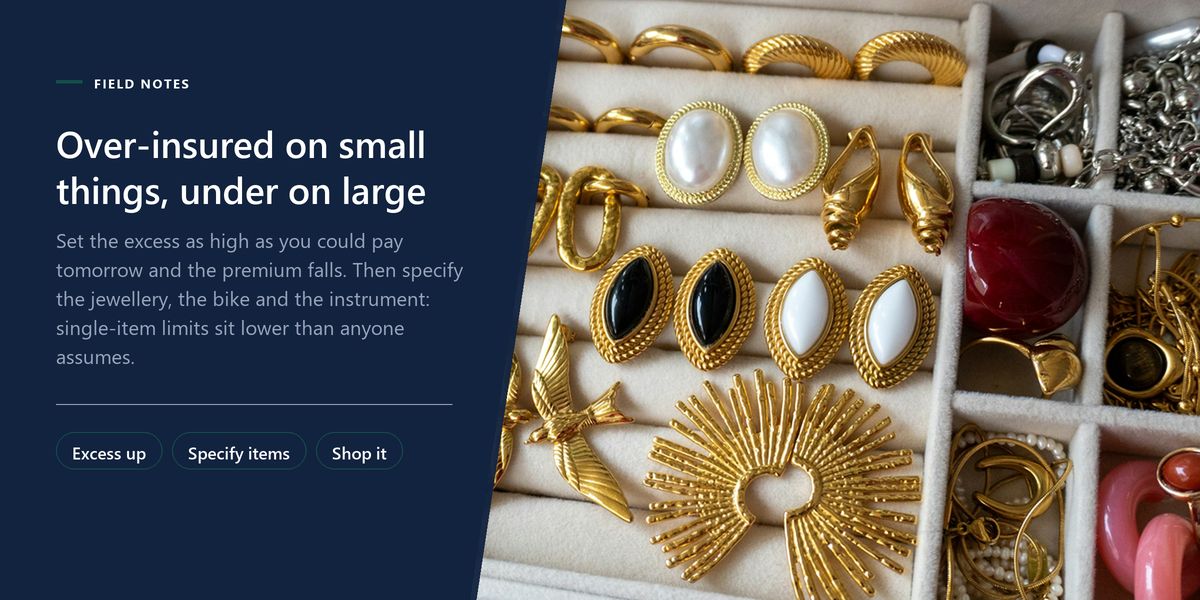
Judged that way, most people are over-insured on small things and under-insured on the large ones — particularly their own ability to earn. That is the imbalance worth correcting first.
Tap a star to share what you thought.
No ratings yet
Anything legally required where you live, plus cover for losses you could not absorb: rebuilding your home, medical costs where healthcare is not publicly funded, your income if others depend on it, and third-party liability. Small, affordable losses generally are not worth insuring.
Usually not. These products carry high margins and cover losses most households could absorb, and they are typically sold at the checkout when there is no opportunity to compare. Setting aside the equivalent money yourself normally works out better.
The excess is the amount you pay towards any claim before the insurer contributes. Setting it as high as you could comfortably pay tomorrow lowers your premium and correctly aligns the policy with catastrophic losses rather than minor ones.
Most often because of exclusions the policyholder never read — undeclared pre-existing conditions, single-item limits, unoccupancy clauses, wear and tear, or business use of a personal vehicle. Reading the exclusions before comparing prices prevents most of these.
Rarely. Many insurers price attractively for new customers and increase premiums for those who stay. Comparing the market at each renewal typically produces a meaningful saving for around twenty minutes of effort, or gives you leverage to renegotiate.
The insurer may reduce a payout or void the policy entirely when the discrepancy emerges, which is usually at claim time. That leaves you uninsured exactly when you needed cover, and can create further difficulties obtaining insurance afterwards.
Sign in to join the conversation.
Loading responses…
Have a story, idea, or something valuable to share? Join The Blog Story for free, publish your content, reach more readers, and earn a share of advertising revenue from eligible content.
Create quality content. Grow your audience. Grow your earning potential.