How to Price a Software Product Without Guessing
Price is a product decision, not a spreadsheet exercise — and most founders set it far too low.

6 min read

—Not yet rated
Price is a product decision, not a spreadsheet exercise — and most founders set it far too low.
Most software founders set their first price in about twenty minutes. They look at two competitors, pick a number slightly below the cheaper one, and move on to building features.
It is understandable — pricing feels like a finance task and building feels like the real work. But price is the single fastest lever a software business has. A 20% increase, with no change to the product, goes almost entirely to the bottom line. Very few product changes do that.
This is a practical guide to choosing a model and a number, and to changing them later without damaging the business.
In software, cost-plus pricing makes almost no sense. Marginal cost per customer is near zero, so adding a margin to it produces a number unrelated to what the product is worth.
The useful question is what the customer gains. A tool saving a team six hours a week is worth a multiple of what those hours cost. A tool preventing one compliance incident a year is worth a great deal more than its hosting bill.

This is also why the same product can reasonably be priced very differently for different segments. Software sold to a freelancer and to an enterprise creates wildly different amounts of value, which is the honest justification behind tiered pricing.
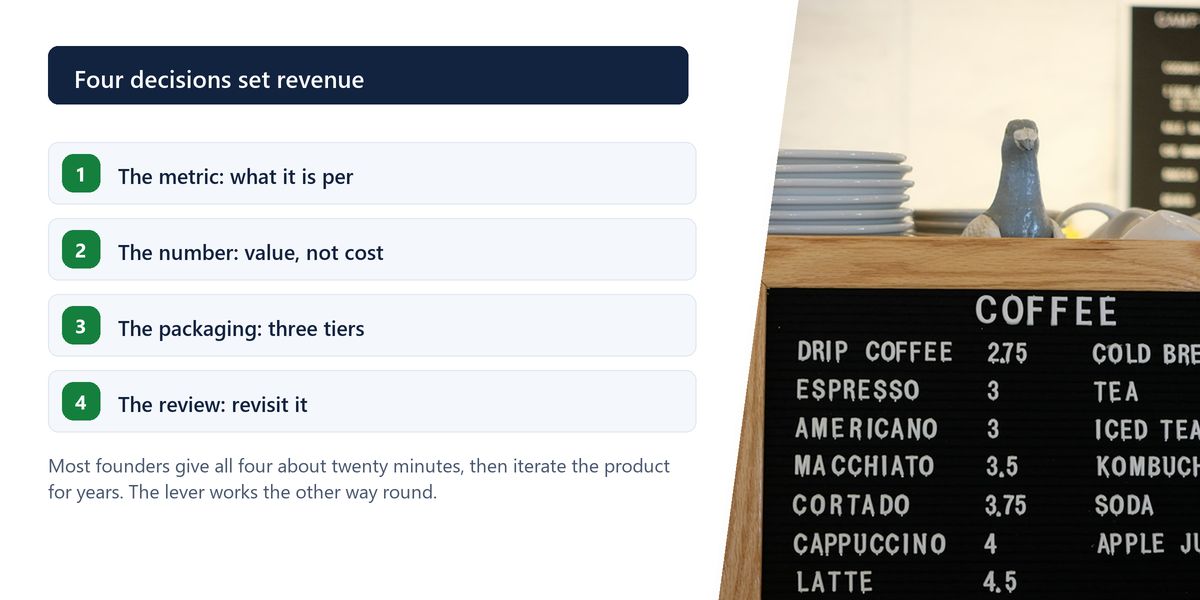
The pricing metric — what the price is per — matters more than the amount, because it determines whether your revenue grows with the customer's success or fights against it.
A good metric has three properties: it correlates with the value the customer receives, the customer can predict it, and it grows as they get more from the product.
| Metric | Works when | Fails when |
|---|---|---|
| Per user | value scales with team size | customers restrict access to save money |
| Per usage | usage tracks value closely | bills become unpredictable and scary |
| Flat rate | value is similar across customers | large accounts underpay dramatically |
| Per feature tier | needs differ clearly by segment | the split is arbitrary and feels punitive |
| Per outcome | the outcome is measurable and attributed | attribution is disputed |
The per-user trap is worth naming. If your product becomes more valuable the more people in an organisation use it, per-user pricing gives customers a direct incentive to limit adoption — which reduces the value they get, which makes them more likely to leave. Charging per user for a collaboration product means charging customers to succeed with it.
There is no formula, but there is a reliable process.
If every prospect says yes without hesitating, raise the price. A healthy price produces some resistance — roughly, you want to lose a minority of deals on price. Losing none means you are funding your customers' margins out of your own.
Three tiers is the practical default, and the reason is that tiers should map to genuinely different customer situations rather than to arbitrary feature splits.
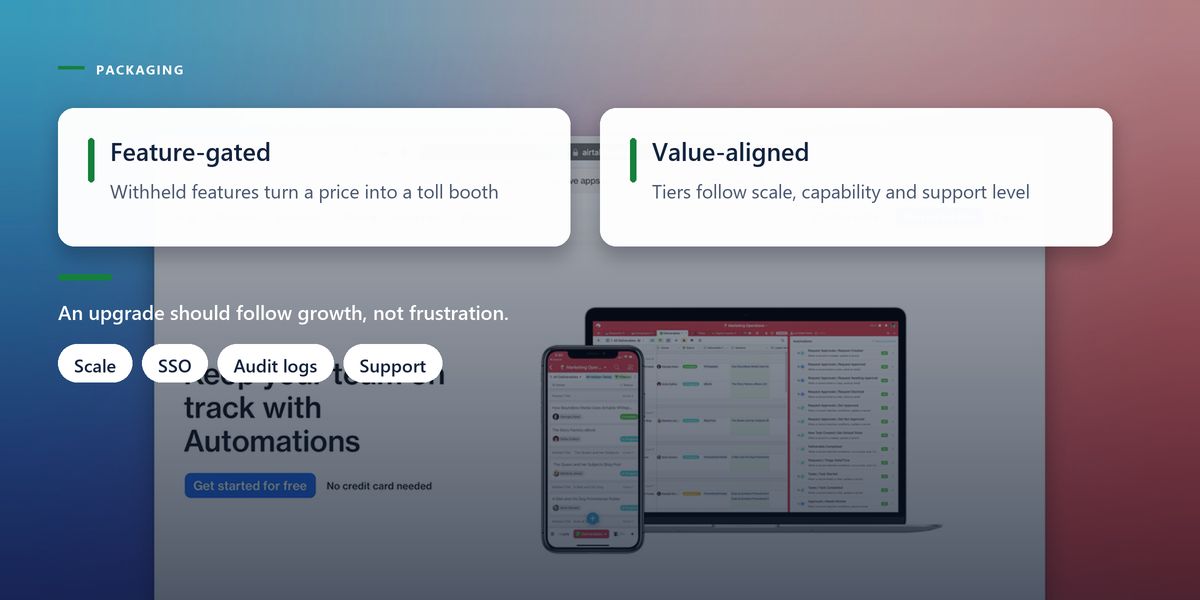
The most common packaging mistake is holding back features people already need in order to force an upgrade. Customers detect this quickly, and it converts a pricing decision into a trust problem.
Better tier boundaries follow real differences: scale (how much they use it), capability (features only larger organisations need, such as single sign-on, audit logs and permissions), and support level. Each is something a customer recognises as fair.
Free plans work when the product has network effects or when usage naturally grows into paid limits. They work badly when free users consume meaningful support and infrastructure while never converting. A time-limited trial is often the better tool — it creates the same evaluation opportunity with a defined end.
Nearly every software business is underpriced, and nearly every founder dreads the increase. It is more manageable than it feels, provided you handle it deliberately.
A two-person team ran a scheduling tool at 9 dollars a month. Their customers were small clinics. Growth was steady, revenue was not, and support was consuming most of their week.
They interviewed twenty customers about the problem's cost. Nearly every clinic had previously paid a part-time administrator to do the same coordination, at a cost hundreds of times higher than the subscription.
They launched three tiers at 29, 59 and 129 dollars, kept every existing customer at their old rate permanently, and added the audit trail larger clinics had been requesting. New-customer conversion fell by roughly a fifth. Revenue per new customer more than tripled. Six months later, monthly revenue had more than doubled and the support load per unit of revenue had fallen sharply, because larger customers asked fewer basic questions.
Competing on price is the weakest position available to a small software business. Someone can always charge less, and price-sensitive customers churn first, complain most and refer least. Competing on fit, on a specific segment, or on service is more defensible and much more pleasant to operate.
Pricing gives you feedback if you look for it. Four signals recur.
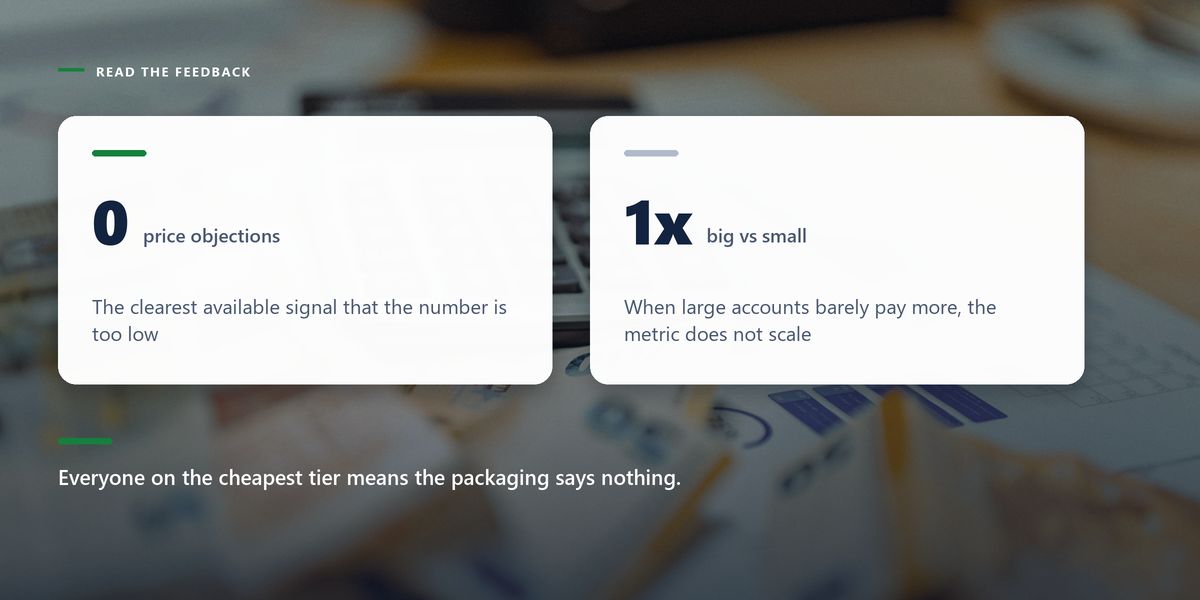
Nobody ever objects to the price — it is too low. Customers churn immediately after a renewal invoice — the value is not visible enough at the moment they pay. Your largest customers pay barely more than your smallest — your metric does not scale with value. Everyone chooses the cheapest tier — your packaging is not communicating what the higher tiers are for.
Price against the value delivered rather than your costs. Choose a metric that grows with customer success and avoid charging for adoption. Quantify the value, anchor against the status quo, start high, and watch the objection rate. Use three tiers based on real differences. Raise prices deliberately, grandfather existing customers, and expect a little churn.
Pricing is not a number you settle once and stop thinking about. It is a product decision that deserves the same iteration as anything you build, and it is the one you can change in an afternoon.
Most software businesses would benefit from a price review before their next feature. The evidence is usually right there in what customers were paying before you existed.
Tap a star to share what you thought.
No ratings yet
Start from the value the customer receives — hours saved, revenue enabled, risk avoided — and anchor against what they currently spend solving the problem another way. Cost-plus pricing makes little sense in software because marginal cost per customer is close to zero.
It is what the price is charged per — users, usage, a flat rate, or an outcome. It matters more than the amount because it determines whether your revenue grows alongside the customer's success or gives them a reason to limit their use of the product.
Only when value genuinely scales with team size. For collaboration products it can backfire, because customers restrict access to control cost, get less value as a result, and become more likely to churn.
If nobody ever objects to it. A healthy price produces some resistance and loses a minority of deals. Universal, immediate acceptance almost always means you are leaving significant money on the table.
Three is the practical default. Fewer leaves money on the table across different customer sizes; more creates decision paralysis. The tiers should map to genuinely different situations such as scale, capability needs and support level.
Only if the product has network effects or if free usage naturally grows into paid limits. Otherwise a time-limited trial usually serves the same evaluation purpose without the ongoing support and infrastructure cost of users who will never convert.
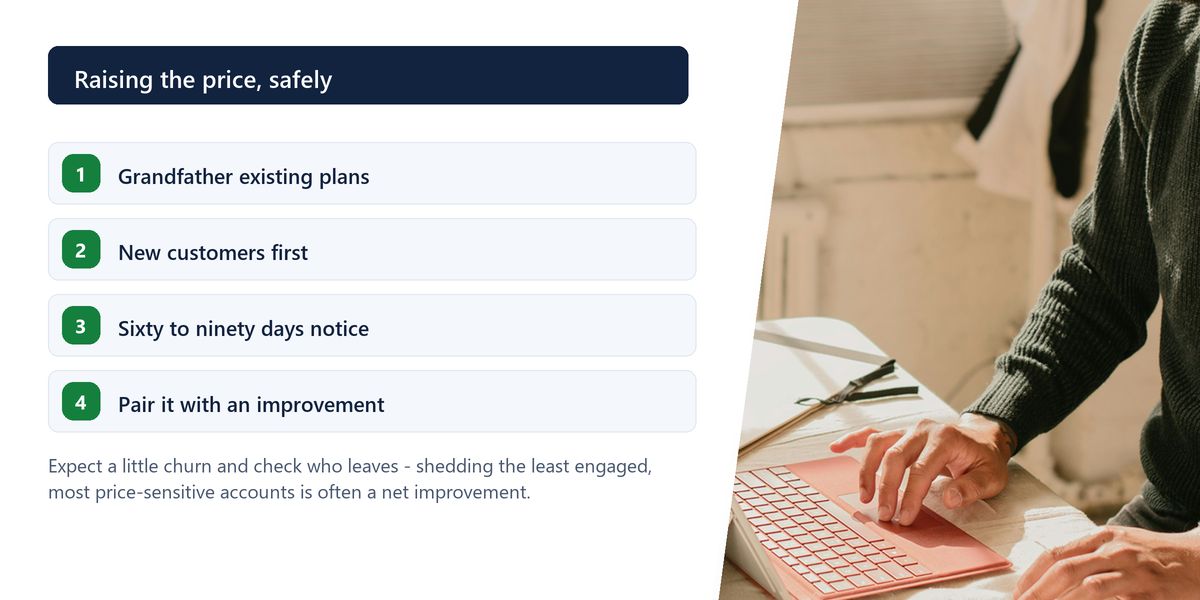
Grandfather existing customers, apply the new price to new sign-ups first and watch conversion, give sixty to ninety days notice for any change to existing accounts, and pair the increase with a visible improvement.
Rarely. Competing on price is the weakest position for a small business — someone can always undercut you, and price-sensitive customers churn first and refer least. Competing on fit for a specific segment is more defensible.
Sign in to join the conversation.
Loading responses…
Have a story, idea, or something valuable to share? Join The Blog Story for free, publish your content, reach more readers, and earn a share of advertising revenue from eligible content.
Create quality content. Grow your audience. Grow your earning potential.