Cricket Explained for Newcomers: The Rules That Actually Matter
Two teams, two innings, and a great deal of vocabulary that sounds worse than it is.

6 min read
—Not yet rated
Two teams, two innings, and a great deal of vocabulary that sounds worse than it is.
Cricket has a reputation for being incomprehensible, and it is somewhat undeserved. The core of the game is genuinely simple — one team scores runs, the other tries to stop them and get them out, then they swap.
What makes it feel impenetrable is the vocabulary. Silly mid-on, a maiden over, a nightwatchman, being caught behind off a googly. It sounds like an elaborate joke, and every term has a straightforward meaning.
Here is enough to follow a match, in the order that makes it make sense.
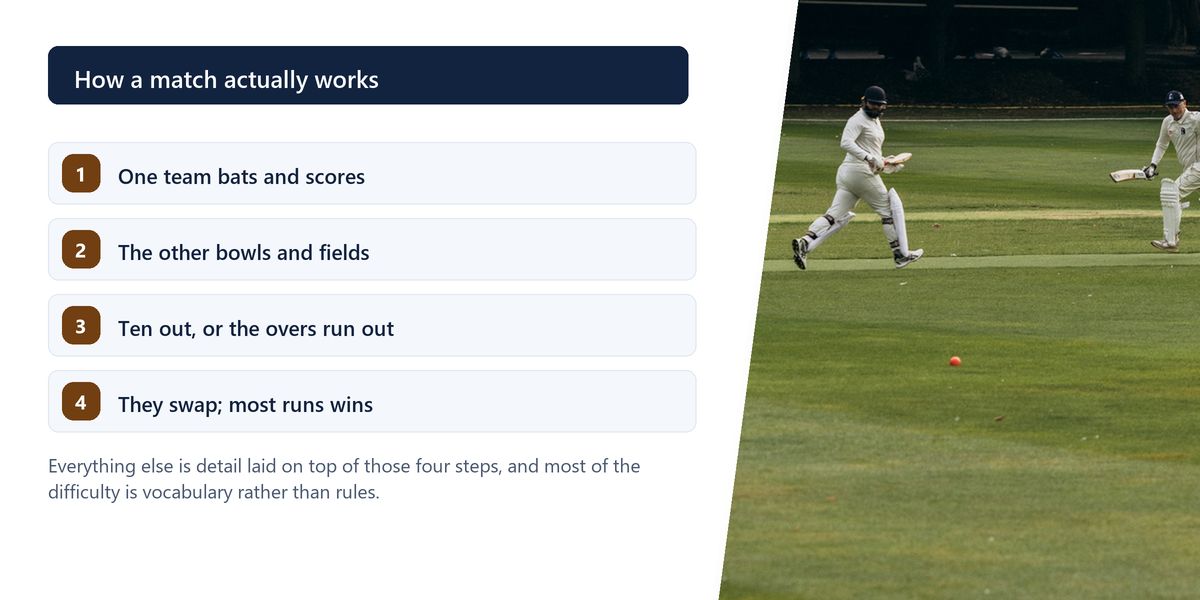
Two teams of eleven. One bats, trying to score runs; the other bowls and fields, trying to dismiss the batters. When ten of the batting side are out — or a set number of overs is completed — the innings ends and the teams swap roles.
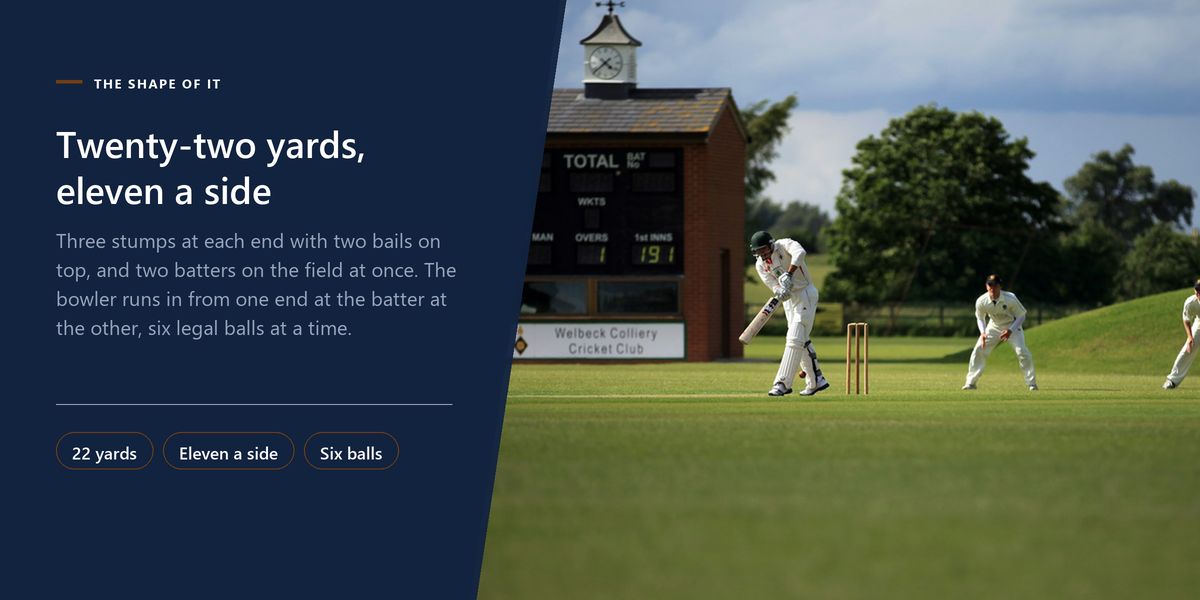
In the middle of the field is the pitch, a strip 22 yards long with three wooden stumps at each end, topped by two small bails. Two batters are on the field at once, one at each end. The bowler delivers from one end towards the batter at the other.
The team with more runs at the end wins. That really is the whole objective.
A no-ball is worth knowing because it carries a penalty run and gives the batter a free hit in the shorter formats, which is often a decisive moment in a close match.
There are ten technically, and three account for the overwhelming majority.
| Dismissal | What happens | How common |
|---|---|---|
| Bowled | the ball hits the stumps and dislodges a bail | very common |
| Caught | a fielder catches the ball before it bounces | the most common of all |
| Leg before wicket (LBW) | the ball hits the batter's leg and would have hit the stumps | common, and often debated |
| Run out | the stumps are broken while batters are running | occasional, often dramatic |
| Stumped | the keeper breaks the stumps while the batter is out of their ground | occasional |
LBW is the one newcomers find confusing, and the principle is simple: a batter cannot use their body to block a ball that would otherwise have hit the stumps. The umpire judges where the ball pitched, where it struck the batter, and whether it was heading for the stumps — which is why the decision is often close and now frequently reviewed with ball-tracking technology.
An over is six legal deliveries bowled by one bowler from one end. After that, a different bowler bowls the next over from the opposite end, and the fielding side rearranges accordingly.
A bowler cannot bowl two overs in succession, and in the limited-overs formats each bowler has a maximum number of overs they may bowl in total. This is why captaincy matters — deciding who bowls when, and holding your best bowler back for the crucial phase, is a genuine tactical skill.
A maiden over is one in which no runs are scored. In the longer format it is a small victory for the bowler; in the shortest format it is remarkable.
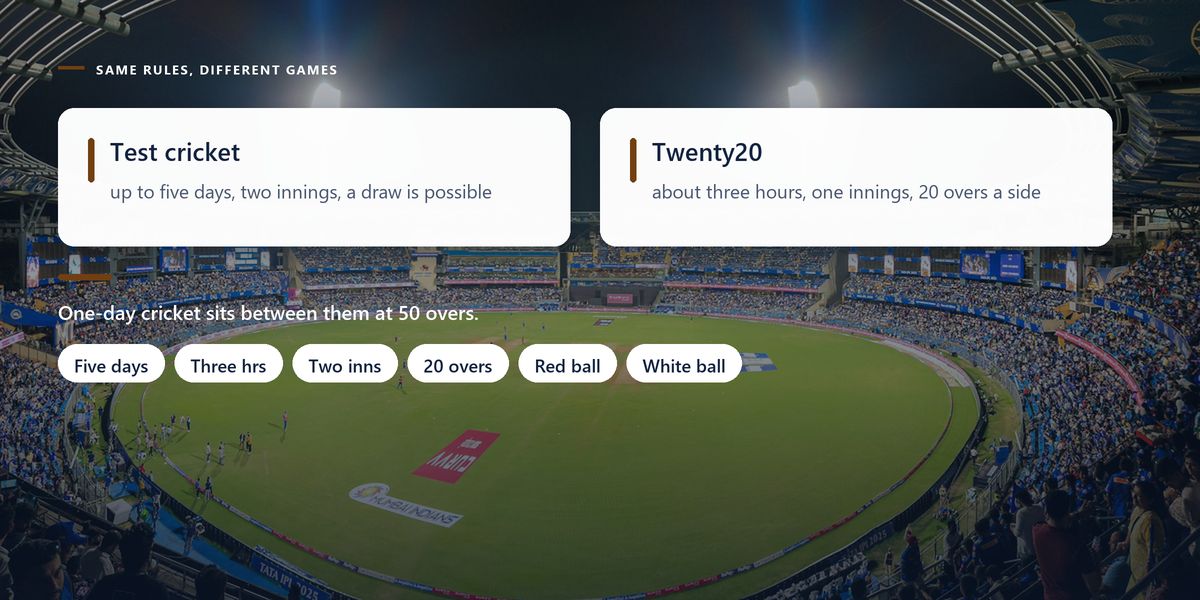
Watch a T20 match first if you are new. It lasts about three hours, has constant scoring and aggressive shot-making, and the tactics are visible rather than slow-burning. Test cricket is the richer game and asks a great deal more patience of a newcomer who does not yet know what to look for.
This is the source of much confusion, because the same sport is played over five days and over three hours, and they feel like different games.
The draw in Test cricket confuses people accustomed to sports that always produce a winner. If neither side has been dismissed twice and time expires, the match is drawn — and a team batting defensively to secure a draw from a losing position is one of the format's genuine dramas.
A few terms will come up constantly and are worth knowing in advance.
A friend of a long-time supporter attended a Test match knowing nothing, and spent the first session largely baffled — long periods with no runs, a field that rearranged constantly, and applause for things that appeared to be nothing happening.
The explanation that changed it was simple: a Test innings is a negotiation. The bowling side is trying to create one mistake, and the batting side is trying to survive until the bowlers tire. Nothing happening is the contest.
By the afternoon she was following which bowler was tiring and why the field kept changing. The rules had never been the barrier; the point of the slow passages had.
Do not judge cricket by five minutes of a Test match. The long format's appeal is cumulative — pressure builds over hours and a single dismissal can be the product of an entire session of work. Watching briefly and concluding nothing happens is a bit like judging a novel by one paragraph in the middle.
Field placement is the most readable tactical layer. A captain crowding fielders close to the batter is attacking, expecting an edge or a catch; spreading them to the boundary is defensive, conceding singles to prevent boundaries. Watching the field change tells you what the fielding captain believes is about to happen.
Also watch the ball itself. It is red or white depending on the format, and it changes through an innings — shiny and hard early, allowing swing and pace; soft and rough later, favouring spin. Much of a match's rhythm follows the condition of the ball.
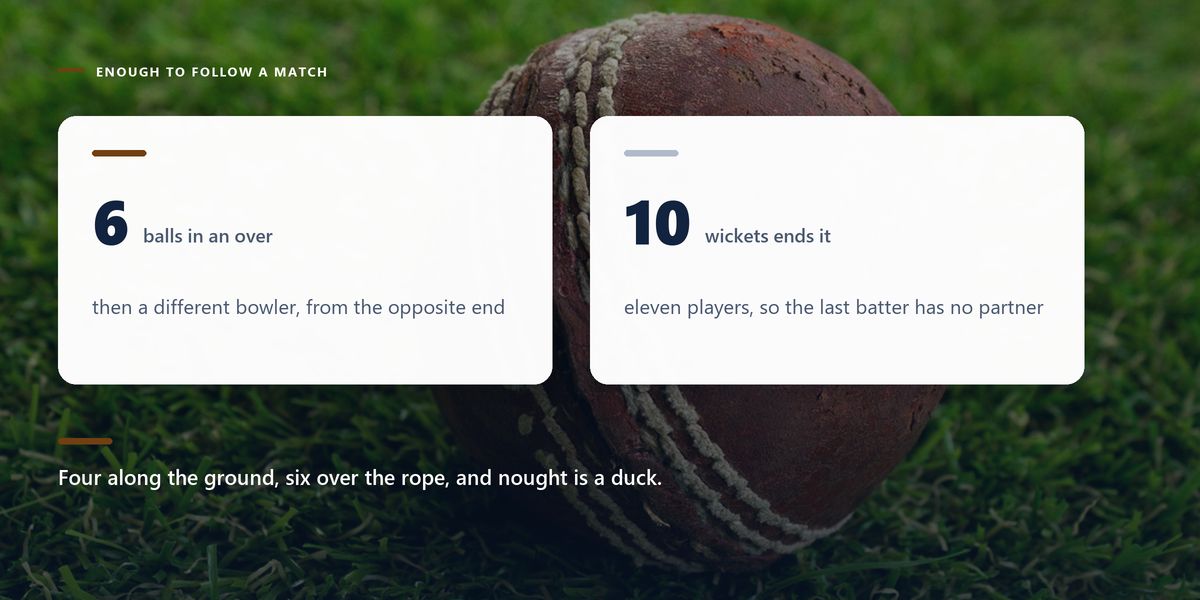
Two teams of eleven; one bats and scores runs, the other bowls and fields. Runs come from running, fours and sixes. Bowled, caught and LBW cause most dismissals. An over is six deliveries, and bowlers alternate ends. Three formats span five days to three hours, and the vocabulary is the only genuinely hard part.
Cricket rewards knowing what to look for more than most sports, which is why it feels closed to newcomers and absorbing to anyone who gets past the first hour.
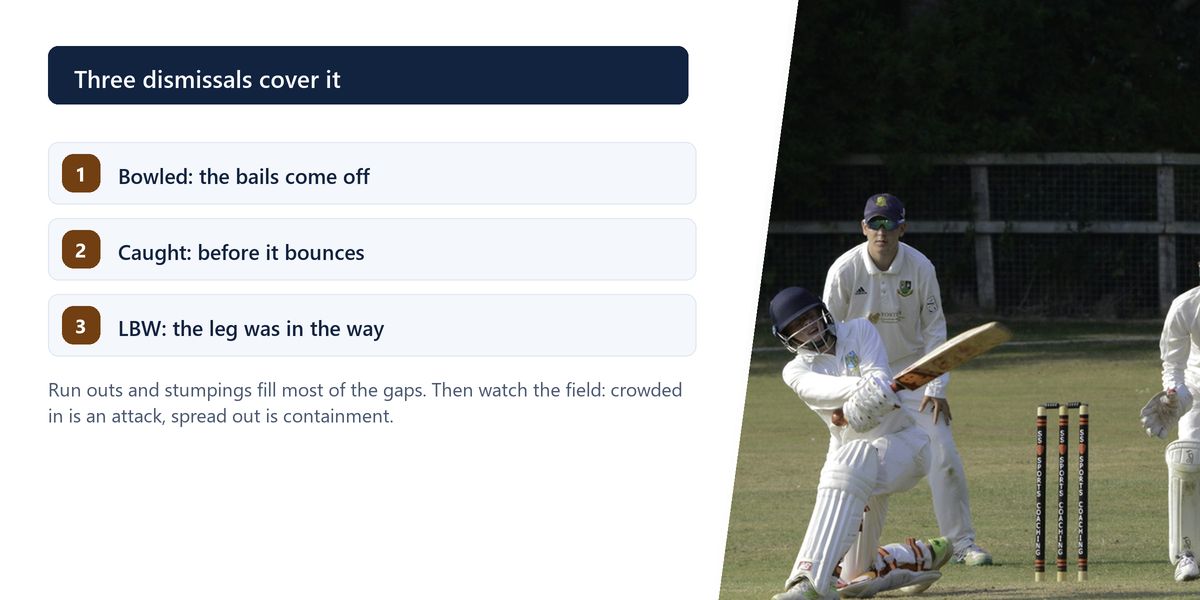
Start with a T20, learn the three main dismissals, and watch where the fielders stand. That is enough to follow anything.
Tap a star to share what you thought.
No ratings yet
One team bats and tries to score runs while the other bowls and fields, trying to dismiss them. When ten batters are out or the allotted overs are used, the teams swap roles. The side with more runs at the end wins.
By running between the two ends after hitting the ball, with each completed exchange counting as one run; by hitting the ball to the boundary along the ground for four; or over it without bouncing for six. Extras are also awarded for illegal deliveries.
Leg before wicket. A batter is out if the ball strikes their body — usually the leg — when it would otherwise have gone on to hit the stumps. The umpire judges where it pitched, where it struck and whether it was heading for the stumps.
Six legal deliveries bowled by one bowler from one end of the pitch. After an over, a different bowler bowls the next one from the opposite end, and no bowler may bowl two overs in succession.
In Test cricket, if the allotted time expires before one side has dismissed the other twice, the match is drawn regardless of the scores. A team batting defensively to survive for a draw from a losing position is one of the format's real dramas.
Twenty20. It lasts about three hours, features constant scoring and aggressive play, and the tactics are immediately visible. Test cricket is richer but asks considerable patience from someone who does not yet know what to look for.
Sign in to join the conversation.
Loading responses…
Have a story, idea, or something valuable to share? Join The Blog Story for free, publish your content, reach more readers, and earn a share of advertising revenue from eligible content.
Create quality content. Grow your audience. Grow your earning potential.