Composition Rules That Genuinely Improve Your Photographs
Better photographs usually come from moving your feet, not from better equipment.

6 min read

—Not yet rated
Better photographs usually come from moving your feet, not from better equipment.
Everyone has taken a photograph of something genuinely beautiful and found the image flat and disappointing. The scene was extraordinary; the picture is a picture of a hillside.
The gap is almost never the camera. It is that the eye edits automatically — ignoring the bin at the edge of the view, focusing on what interests you, adjusting for brightness — and a camera records everything, indiscriminately, in a rectangle.
Composition is the practice of doing deliberately what your eye was doing for free. These are the decisions that matter most.
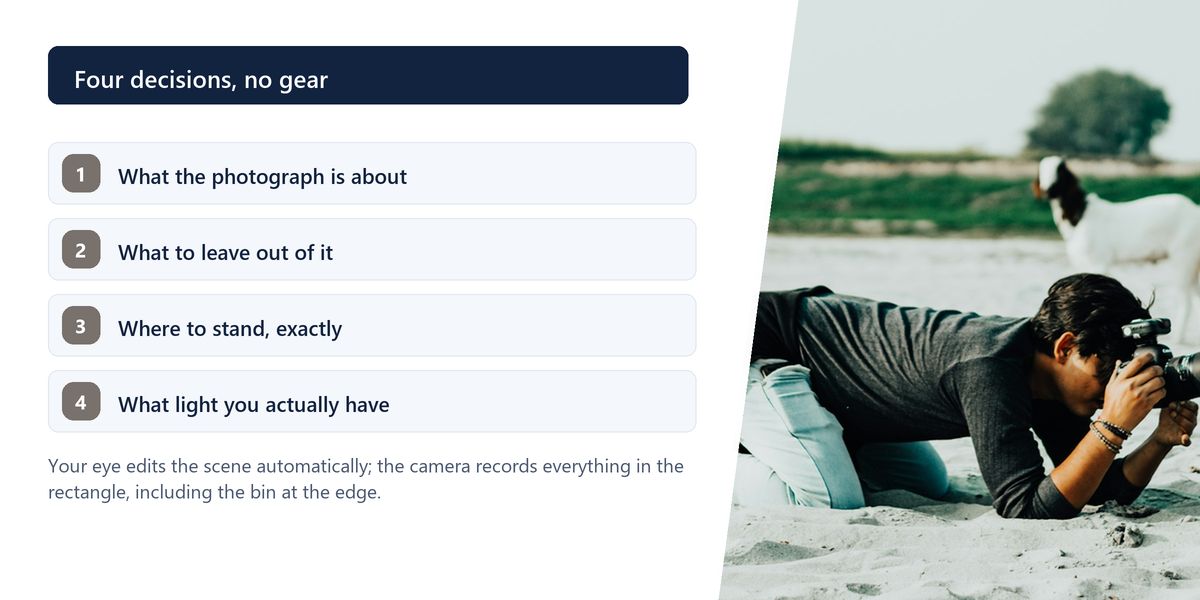
The most common weakness in amateur photographs is that they contain everything the photographer could see and are therefore about nothing in particular.
Before pressing the shutter, name the subject in one short phrase. The light on the water. The old man's hands. The shape of that doorway. Then arrange the frame so a stranger would identify the same thing without being told.
If you cannot name it, the photograph will not communicate it either. This single question improves more photographs than every technical adjustment combined.
Your eye ignores the background because it is not interested in it. The camera has no such filter.
This is the source of an enormous proportion of ruined photographs: a bright object at the edge pulling attention, a pole apparently growing from someone's head, a chaotic clutter of shapes behind a portrait, a stray hand or foot at the frame edge.
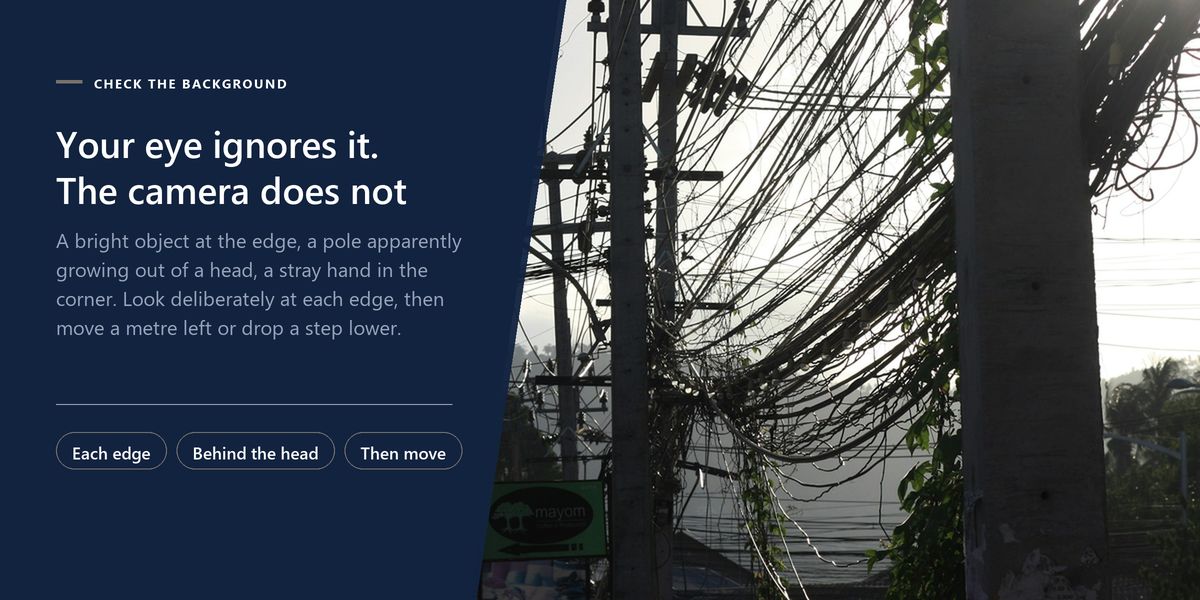
The fix takes two seconds. Before shooting, look deliberately at each edge of the frame and at the space behind your subject, then move — a metre to the left, or a step lower — until the background supports the subject rather than competing with it.
The rule of thirds — imagining the frame divided into a three-by-three grid and placing key elements along the lines or at their intersections — is the first composition rule everyone learns, and it is a useful starting point rather than a law.
What it usefully prevents is the reflexive habit of centring everything, which tends to produce static images. Off-centre placement creates space for a subject to look into or move into, which reads as more dynamic.
Central composition is powerful too, and deliberately so — symmetry, confrontation, formality. The point is not that off-centre is correct, but that placement should be a choice rather than a default.
| Technique | What it does | Where to find it |
|---|---|---|
| Leading lines | guides the eye toward the subject | roads, fences, rivers, shadows, railings |
| Framing | creates depth and focuses attention | doorways, arches, branches, windows |
| Layers | creates a sense of three dimensions | foreground object, subject, background |
| Negative space | isolates and emphasises the subject | sky, water, plain walls, fog |
| Repetition | creates rhythm and pattern | windows, columns, crowds, tiles |
| A break in a pattern | creates immediate focus | one different element among many |
Take the photograph you first saw, then take five more. Move closer, crouch, go around the other side, wait for someone to walk into the frame. The first composition is almost never the best available one — it is simply the one you happened to be standing in when you noticed the scene.
It is worth saying plainly: a well-composed photograph in bad light is usually worse than a simple one in beautiful light.
Soft light — overcast days, the hour after sunrise and before sunset, open shade — flatters almost everything. Harsh midday sun creates hard shadows, blown highlights and squinting subjects, and it is the least forgiving light there is for people.
Also notice the direction. Light from behind the camera is flat and unremarkable. Light from the side reveals texture and shape. Light from behind the subject creates rim lighting and silhouettes, and it is where a great deal of dramatic photography comes from.
The most useful habit any photographer can build is noticing light before noticing subjects — which is why photographers seem oddly interested in weather.
Most photographs improve by removing something. A tighter crop, a step forward, a lower angle that hides a cluttered horizon, waiting until a distracting person leaves the frame.
The instinct to include everything is understandable and usually wrong. A photograph of one interesting thing is stronger than a photograph of a scene containing that thing among nine others.
This is also the cheapest improvement available in editing: cropping. Being willing to crop aggressively, including to unusual proportions, salvages a great many otherwise cluttered images.

Composition guidelines describe what usually works, not what always works, and every one of them is broken deliberately by good photographers constantly.
Dead-centre subjects create confrontation and formality. Tilted horizons create instability, which is right for certain subjects and simply looks like a mistake for most. Cutting off part of a subject can be powerful or careless depending entirely on whether it appears intentional.
The workable distinction is whether the break serves the photograph. A rule broken with purpose reads as a choice; the same break made accidentally reads as an error, and viewers can tell the difference more reliably than photographers expect.
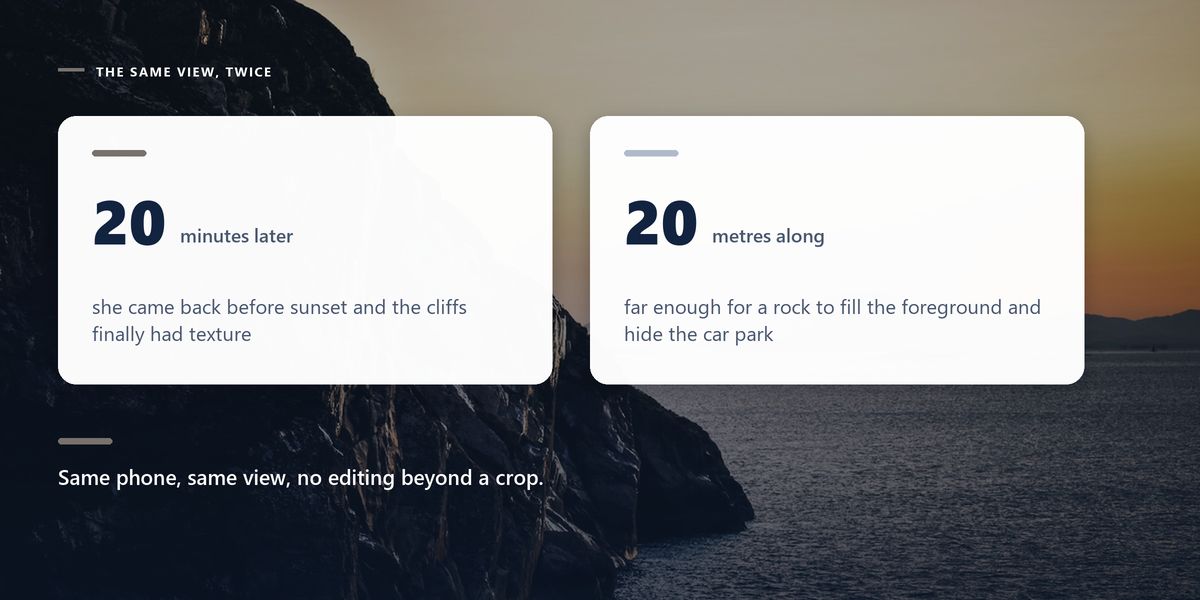
A walker photographed a coastal view at midday: harsh overhead sun, a flat grey sea, a bright sky that rendered as white, and a car park visible at the left edge of the frame.
She returned to the same spot in the hour before sunset. The low light raked across the cliffs and revealed their texture, the sea took on colour, and she moved twenty metres along the path so a rock formation filled the foreground and hid the car park entirely.
Same phone, same view, no editing beyond a crop. The second photograph is one she had printed. The variables were the light and where she stood.
Do not rely on editing to rescue composition. Cropping helps and exposure can be adjusted, but a distracting background, a missed moment or bad light cannot be meaningfully fixed afterwards. Getting it right in the frame is faster than any amount of editing and produces better results.
Portraits have a few additional considerations that make a disproportionate difference. Focus on the eyes — an image where the eyes are sharp reads as successful even if other elements are soft, and the reverse is rarely true.
Shoot from roughly eye level or slightly above for most people, since a low angle looking up is unflattering to almost everyone. Give the subject something to do or to look at rather than asking them to pose, because the moment just after a directed pose is usually more natural than the pose itself.
And get closer than feels comfortable. Almost every beginner portrait would improve by filling more of the frame with the person.

Name your subject before shooting. Check the background and frame edges deliberately. Place the subject as a decision rather than by default. Use lines, framing and negative space. Prioritise good light over clever composition. Simplify, move your feet, and take several versions of every photograph.
The photographers whose work you admire are not, for the most part, using equipment you could not afford. They are paying attention to light, standing somewhere better, and excluding more than you would.
The good news is that all three are free, and the improvement from applying them is visible within a single afternoon.
Tap a star to share what you thought.
No ratings yet
Knowing what the photograph is about. If you can name the subject in one short phrase and arrange the frame so a stranger would identify the same thing, most other decisions become straightforward.
Because your eye edits automatically — ignoring clutter, adjusting for brightness and focusing on what interests you — while the camera records everything within a rectangle. Composition is doing deliberately what your eye was doing for free.
Imagining the frame divided into a three-by-three grid and placing key elements along those lines or at their intersections. Its main value is preventing the reflex to centre everything, which tends to produce static images. It is a starting point, not a law.
Rarely, at the level most people are working at. Light, subject choice, background awareness and where you stand affect an image far more than the camera does. A better camera mostly helps in low light and with fast subjects.
Soft, directional light — overcast days, open shade, and the hour after sunrise or before sunset. Harsh midday sun creates hard shadows and blown highlights, and it is particularly unflattering for photographing people.
Focus on the eyes, shoot from roughly eye level or slightly above, get closer than feels comfortable, and give the subject something to do rather than asking them to pose. The moment just after a pose is usually more natural than the pose.
Sign in to join the conversation.
Loading responses…
Have a story, idea, or something valuable to share? Join The Blog Story for free, publish your content, reach more readers, and earn a share of advertising revenue from eligible content.
Create quality content. Grow your audience. Grow your earning potential.