Buying and Caring for Jewellery You Will Keep for Decades
Metal, setting and honest paperwork matter far more than the shop's lighting.

6 min read
—Not yet rated
Metal, setting and honest paperwork matter far more than the shop's lighting.
Jewellery is bought under unusually poor conditions for making a decision. The lighting is designed to flatter, the vocabulary is unfamiliar, the price is high, and there is frequently an emotional occasion attached.
Which is a shame, because the things that determine whether a piece lasts thirty years are neither mysterious nor difficult. They are the metal, the setting, the hardness of the stone and whether the paperwork says what the assistant said.
This is a guide to those, plus how to look after what you already own — which is where most damage actually happens.
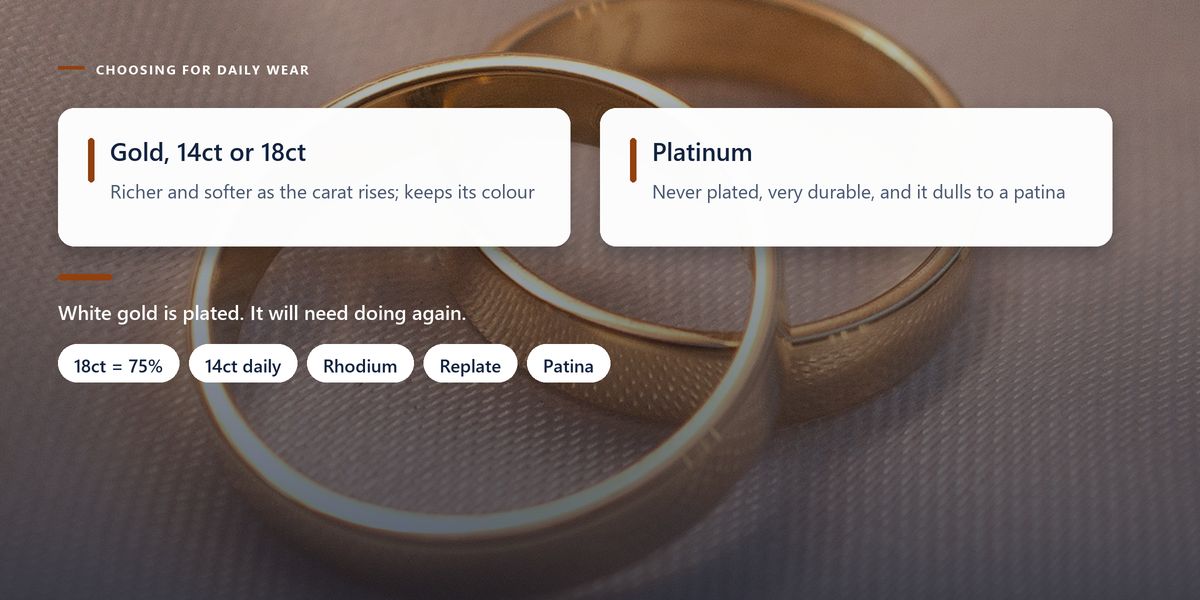
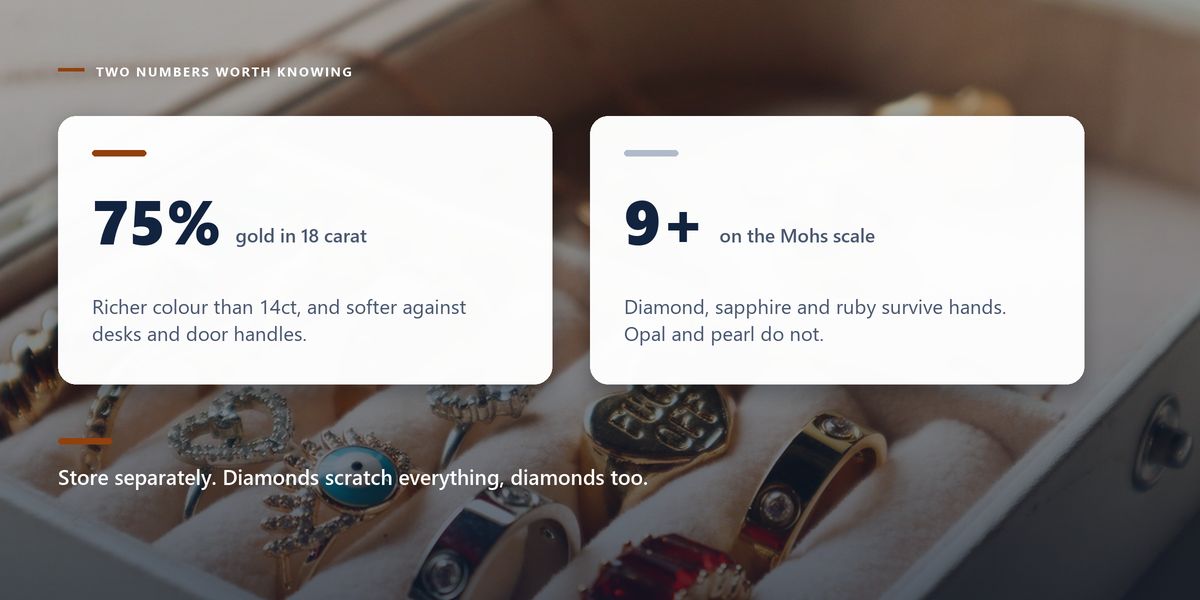
Pure gold is 24 carat and far too soft for most jewellery, so it is alloyed with other metals for strength. The carat number tells you the proportion: 18 carat is 75% gold, 14 carat about 58%, 9 carat about 37.5%.
Higher carat means richer colour and more value in the metal, and also softer and more prone to scratching. For a ring worn every day, 14 or 18 carat is the practical range; 22 carat is beautiful and will show wear quickly on a piece that meets desks and door handles.
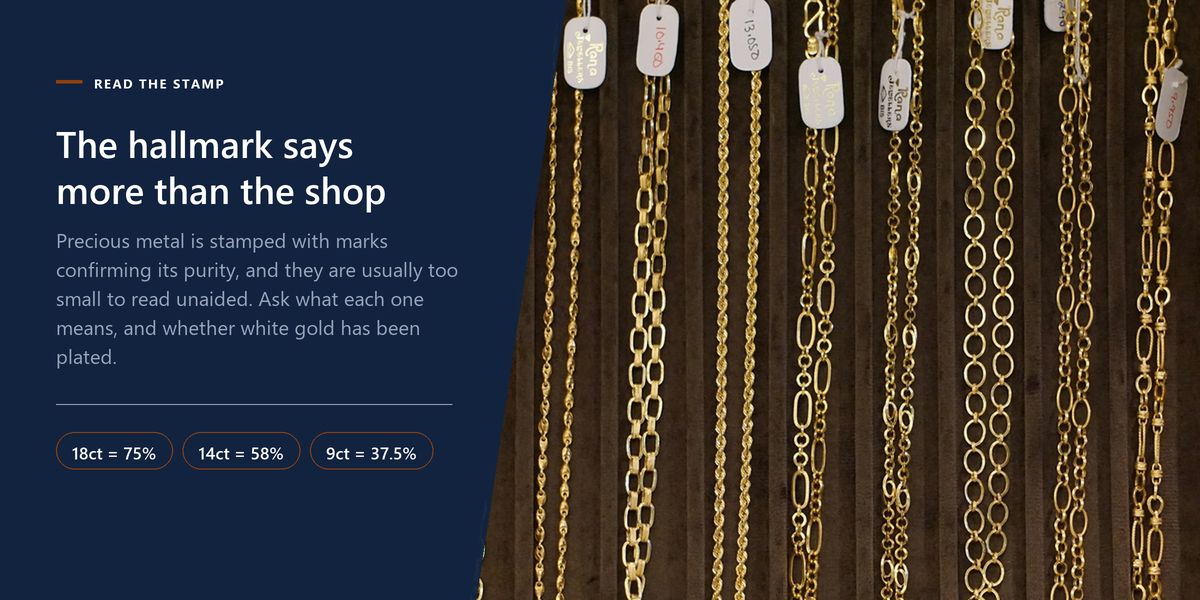
White gold deserves a specific warning. It is yellow gold alloyed with white metals and almost always plated with rhodium to achieve that bright white finish. Rhodium wears off over a few years, revealing a warmer tone underneath, and needs replating periodically. Nobody mentions this at the point of sale often enough.
| Metal | Strengths | Trade-offs |
|---|---|---|
| 18ct gold | rich colour, durable enough for daily wear | scratches over time, higher cost |
| 14ct gold | harder, more affordable, good for rings | slightly paler colour |
| Platinum | very durable, hypoallergenic, never plated | heavier, more expensive, develops a patina |
| White gold | bright white, lighter than platinum | rhodium plating wears and needs redoing |
| Sterling silver | inexpensive, versatile | tarnishes, soft, not ideal for daily rings |
| Titanium/steel | very hard, low cost | cannot usually be resized |
One practical note about platinum: it does not lose metal when scratched so much as displace it, developing a soft matte patina over years. Some people love this and some have it polished back periodically — but it is a different ageing process from gold, and worth knowing before you choose.
The single most useful fact when buying a stone for daily wear is its position on the Mohs hardness scale, which runs from 1 to 10 and describes scratch resistance.
Diamond sits at 10. Sapphire and ruby are 9 and are excellent for everyday rings. Emerald is around 7.5 to 8 but is typically full of internal fractures, which makes it far more fragile than the number suggests. Opal, pearl and turquoise are considerably softer and belong in earrings or pendants rather than in a ring worn while washing up.
Match the stone to how the piece will be worn. A soft or included stone in an everyday ring will chip, and it is not a manufacturing fault — hands meet worktops, door frames and keyboards constantly. Keep the delicate stones for earrings, pendants and occasional pieces.
How a stone is held matters as much as the stone. A high solitaire setting shows a stone beautifully and exposes it to every knock. A bezel setting, where metal surrounds the stone's edge, protects it substantially and is the sensible choice for anyone with an active job or hobby.
Prongs are the most common failure point in fine jewellery. They wear down gradually and then a stone is simply gone one afternoon, usually unnoticed. Having prongs checked by a jeweller every year or two is a small cost against losing a stone entirely.
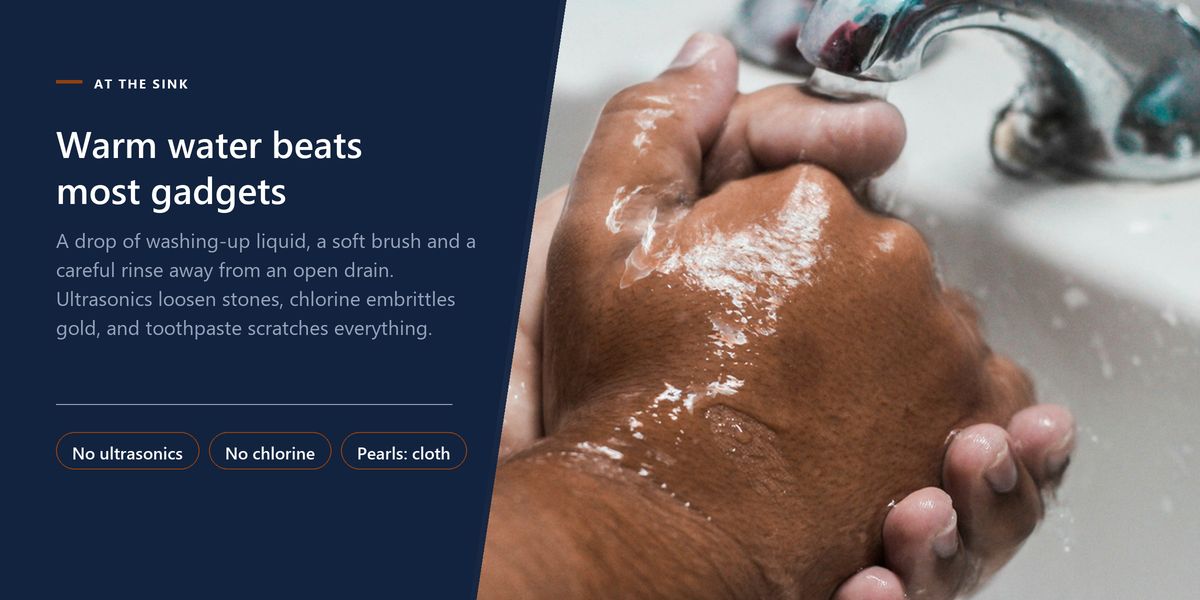
For most gold and platinum pieces with hard stones, warm water, a drop of washing-up liquid and a soft toothbrush is genuinely the right method. Rinse carefully — ideally not over an open drain — and dry with a soft cloth.
What to avoid matters more. Ultrasonic cleaners can loosen stones and will damage emeralds, opals and pearls. Chlorine attacks the alloys in gold and can cause it to become brittle over time, which is why rings should come off before swimming pools and hot tubs. Toothpaste and baking soda are abrasive and scratch soft metals and stones.
Pearls need particular care: wipe with a soft damp cloth only, put them on after perfume and hairspray rather than before, and store them separately since almost everything else will scratch them.
A woman received an engagement ring with a high six-prong setting and a diamond she loved. She worked in a garden centre and wore it constantly, including while lifting trays and handling tools.
Within four years she had lost the stone twice — once found in a plant pot, once not. The second replacement was covered by insurance, and her jeweller pointed out that the prongs had worn thin both times.
The setting was rebuilt as a bezel, which sits flush and protects the stone's edges entirely. Six years later it has needed nothing. The original setting had not been faulty; it had simply been the wrong choice for her hands.
Standard home contents insurance frequently caps the value of individual items well below what fine jewellery is worth, and may not cover loss outside the home at all. Check the single-item limit, get valuables specified on the policy, and keep a recent valuation and photographs. Doing this after a loss is not possible.
Choose 14 or 18 carat gold or platinum for daily wear, and understand that white gold needs periodic replating. Match stone hardness to how the piece will be worn, and prefer protective settings for active hands. Check hallmarks and independent certification. Clean with soap and water, avoid chlorine and ultrasonic cleaners, and insure properly.
Jewellery is one of the few things you can buy that a grandchild might still wear. What decides whether that happens is not how much it cost, but whether the metal, stone and setting matched the life it was going to have.
Ask what a piece is made of and how it should be looked after, in the shop, before buying. A good jeweller will be pleased you asked.
Tap a star to share what you thought.
No ratings yet
14 or 18 carat. Higher carat gold has richer colour and more metal value but is softer and scratches more readily, while 9 carat is harder but contains much less gold. For a ring worn daily, 14 to 18 carat balances durability and appearance well.
White gold is yellow gold alloyed with white metals and plated with rhodium for its bright finish. That plating wears off over a few years, revealing the warmer metal beneath. A jeweller can replate it, and it will need doing again periodically.
Diamond, sapphire and ruby are hard enough for everyday rings. Emeralds are typically heavily included and more fragile than their hardness suggests, and opal, pearl and turquoise are soft enough that they belong in earrings or pendants instead.
Warm water with a little washing-up liquid and a soft toothbrush suits most gold and platinum pieces with hard stones. Avoid ultrasonic cleaners, chlorine, and abrasives like toothpaste, and treat pearls with only a soft damp cloth.
Often only up to a low per-item limit, and sometimes not at all outside the home. Check the single-item cap, have valuable pieces specified on the policy, and keep a current valuation and photographs before anything happens.
Every one to two years for anything with set stones. Prongs wear down gradually and a loose stone is usually only noticeable once it has gone, so a short inspection is far cheaper than a replacement.
Sign in to join the conversation.
Loading responses…
Have a story, idea, or something valuable to share? Join The Blog Story for free, publish your content, reach more readers, and earn a share of advertising revenue from eligible content.
Create quality content. Grow your audience. Grow your earning potential.