Better Coffee at Home Without Buying an Espresso Machine
Freshness, ratio and grind decide almost everything. Equipment decides much less.

5 min read
—Not yet rated
Freshness, ratio and grind decide almost everything. Equipment decides much less.
There is a common progression in home coffee. Someone buys a nicer machine, then a nicer one, and remains vaguely disappointed — while a friend with a cheap plastic cone and a bag of fresh beans keeps producing something better.
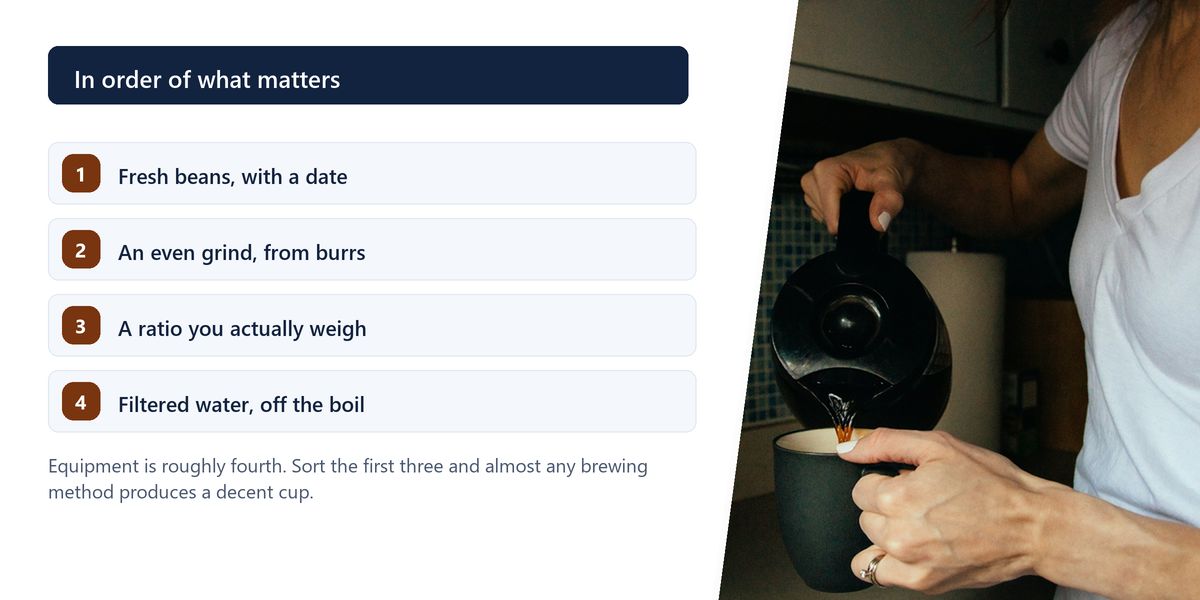
The uncomfortable arithmetic is that equipment is roughly the fourth most important variable. Ahead of it, in order: how fresh the coffee is, how evenly it is ground, and whether you measure anything at all.
Fix those three and almost any brewing method produces good coffee. Ignore them and no machine will save you.
Coffee is an agricultural product that goes stale, and the timeline is much shorter than most packaging implies. Roasted beans are at their best from roughly a few days to a month after roasting, and pre-ground coffee loses a great deal within minutes to hours of grinding.
This is why supermarket coffee with a best-before date eighteen months out tastes flat regardless of what you do to it. It is not bad coffee; it is old coffee, and staleness is not recoverable.
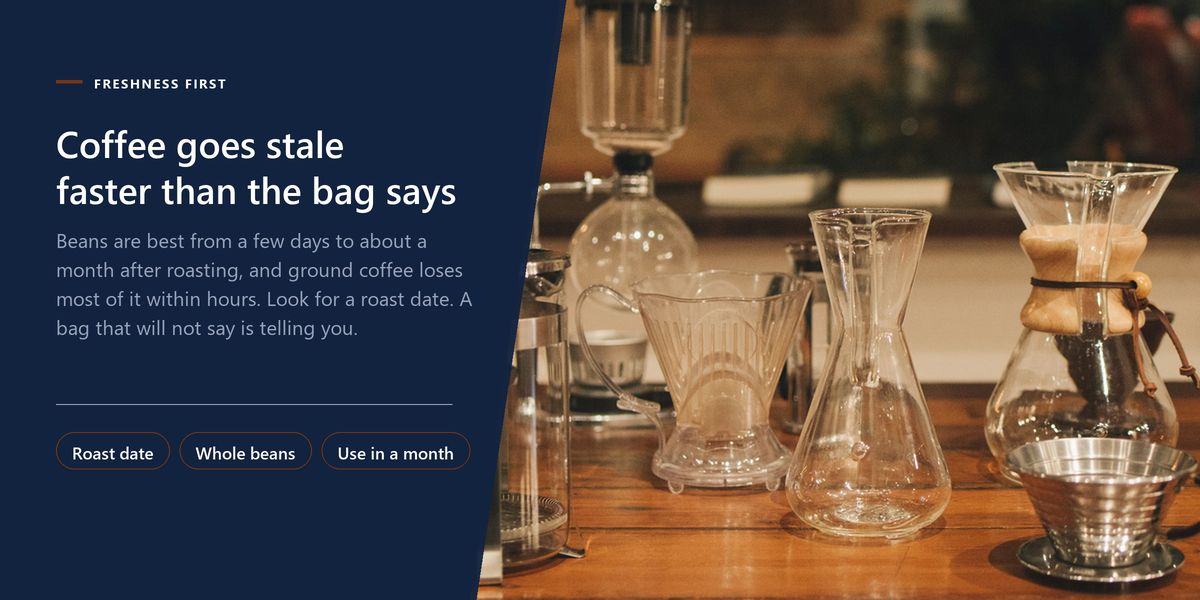
Look for a roast date rather than a best-before date on the bag. If a roaster will not tell you when it was roasted, that is information in itself.
If you buy one thing, buy a burr grinder rather than a better brewer. Blade grinders chop unevenly, producing a mixture of dust and boulders — the dust over-extracts and tastes bitter while the boulders under-extract and taste sour, in the same cup, at the same time.
A burr grinder crushes to a consistent size, which is what makes even extraction possible. A modest hand grinder outperforms an expensive machine fed pre-ground coffee, and it is the single upgrade people most consistently say they wish they had made first.
Scoops vary, beans vary in density, and the same scoop of two different coffees is not the same amount. A cheap kitchen scale removes the biggest source of inconsistency for very little money.
A ratio of roughly 1:16 by weight — 60 grams of coffee per litre of water, or about 15 grams for a 240ml mug — is a sound starting point for filter methods. From there, adjust to taste: more coffee for a stronger cup, less for a lighter one.
| Method | Grind | Ratio | Brew time |
|---|---|---|---|
| French press | coarse | 1:15 | 4 minutes, then plunge |
| Pour over (cone) | medium | 1:16 | 2 to 3 minutes |
| AeroPress | medium-fine | 1:14 | 1 to 2 minutes |
| Moka pot | fine, not espresso-fine | 1:10 | until it sputters |
| Cold brew | very coarse | 1:8, then dilute | 12 to 18 hours |
Change one variable at a time and taste the difference. Adjusting grind, dose and time together tells you nothing about which one mattered. Most people find a good cup within three or four deliberate adjustments.
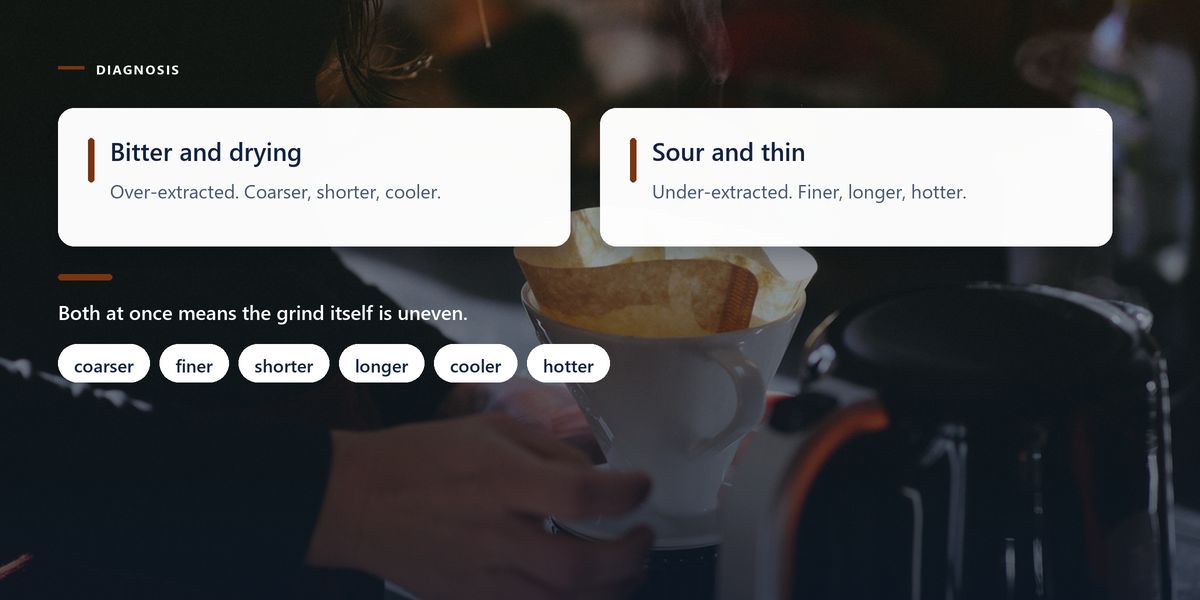
Almost every disappointing cup falls into one of two categories, and the fix is opposite in each case.
This is usually over-extraction — too much has been pulled out of the grounds. Grind coarser, brew for less time, or use slightly cooler water. Bitterness is also what stale, dark-roasted coffee tastes like, so consider the beans too.
This is under-extraction — not enough has come out. Grind finer, brew for longer, or use hotter water. Sourness is frequently mistaken for the coffee being too acidic and treated with more milk, which does not address the cause.
If a cup is somehow both bitter and sour at once, the grind is uneven — which brings you back to the grinder.
A brewed coffee is about 98% water, so heavily chlorinated or very hard tap water is tasted directly. A simple filter jug is usually enough; distilled or fully softened water is actually worse, since some mineral content is needed for extraction.
For temperature, just off the boil is right — around 92 to 96 degrees Celsius. Boiling water poured straight onto grounds scorches them, and waiting thirty seconds after the kettle clicks off is the entire technique.
A home cook received a well-reviewed filter machine as a gift and found the coffee consistently disappointing — thin and slightly sour, no matter the setting.
He was using supermarket pre-ground coffee from a bag opened six weeks earlier, and measuring by eye with a tablespoon.
He kept the machine and changed two things: a bag of beans with a roast date from a local roaster, and a hand grinder set slightly finer, dosed on a kitchen scale. The improvement was immediate and larger than any machine upgrade would have produced.
Storing beans in the freezer is widely recommended and mostly counterproductive for daily use. Repeatedly removing a bag causes condensation on the beans, which accelerates staling. An airtight container at room temperature, away from light, is better for coffee you will finish within a month.
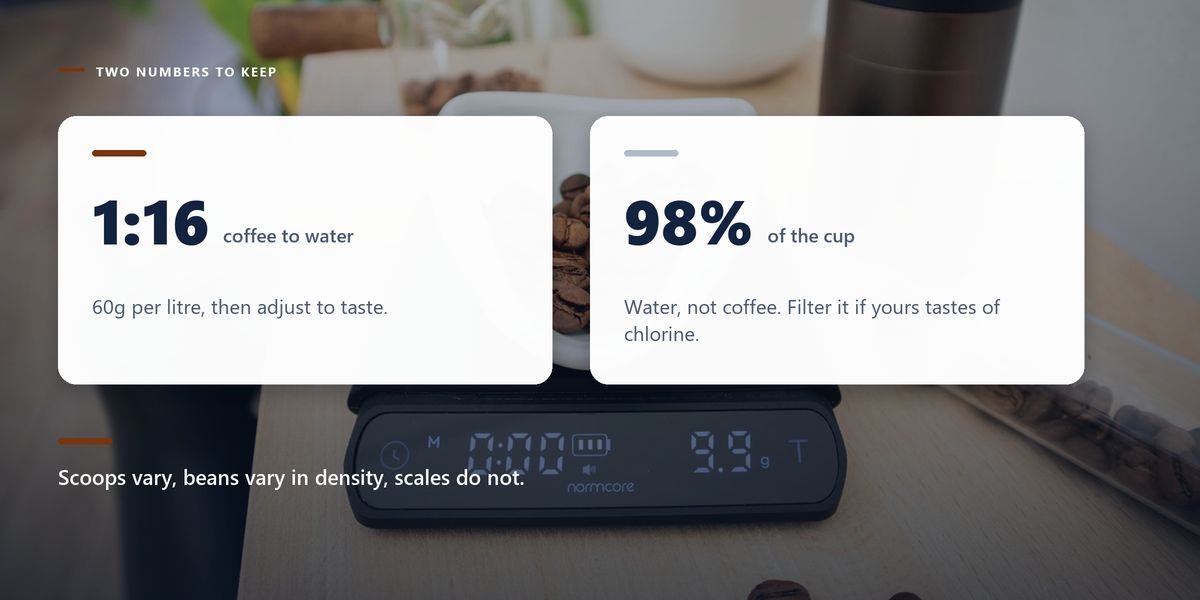
Buy whole beans with a roast date and finish them within a month. Get a burr grinder before a better brewer. Weigh coffee and water and start near a 1:16 ratio. Use filtered water just off the boil. Adjust grind coarser for bitterness, finer for sourness, one variable at a time.
Good coffee at home is not a gear problem, which is inconvenient for anyone who enjoys buying gear. It is a freshness problem, a consistency problem and a measurement problem — all three cheap to fix.
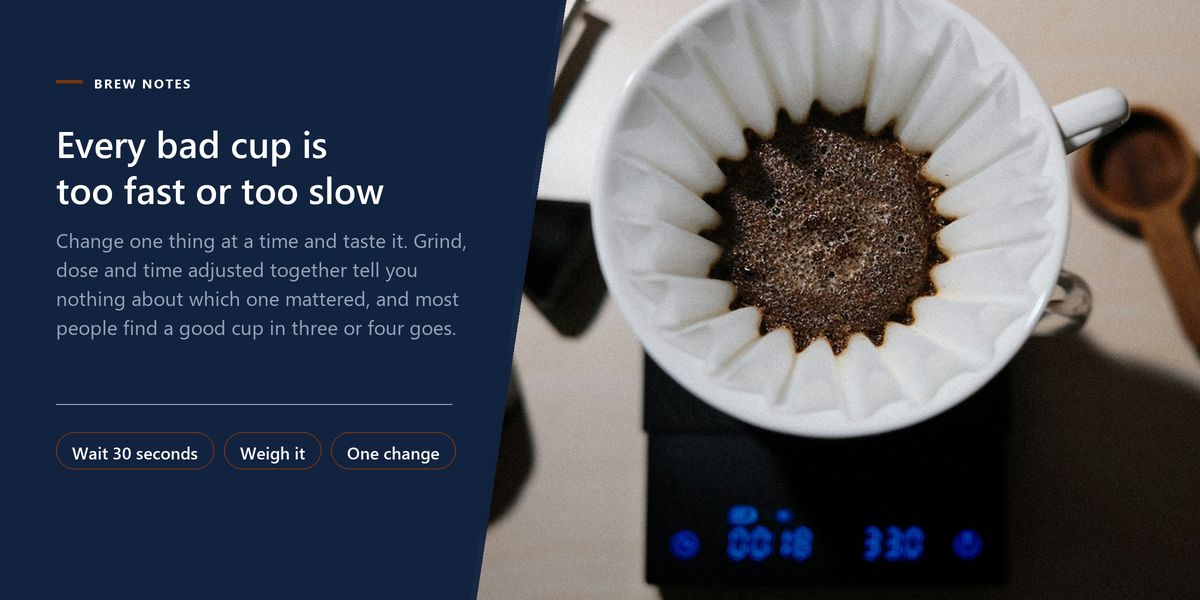
Start with beans and a grinder. If you still want the machine afterwards, at least it will finally have something worth brewing.
Tap a star to share what you thought.
No ratings yet
A burr grinder. Grind consistency determines how evenly the coffee extracts, and no brewer compensates for unevenly chopped grounds. A modest hand grinder with fresh beans beats an expensive machine using pre-ground coffee.
Roughly a few days to a month after roasting for whole beans stored airtight at room temperature. Ground coffee stales dramatically faster — within minutes to hours — which is why grinding just before brewing makes such an obvious difference.
Around 1:16 by weight for filter methods — about 60 grams of coffee per litre, or 15 grams for a standard mug. Adjust from there to taste, but weigh both so your adjustments are meaningful.
Usually over-extraction: the grind is too fine, the brew too long, or the water too hot. Grind coarser and shorten the brew. Very dark or stale beans also taste bitter regardless of technique.
Usually under-extraction: the grind is too coarse, the brew too short, or the water too cool. Grind finer or brew longer. Sourness is often misread as excessive acidity and covered with milk, which does not fix the cause.
Not for coffee you will drink within a month. Repeatedly taking a bag in and out causes condensation on the beans, which speeds up staling. An airtight container at room temperature away from light is better for everyday use.
Sign in to join the conversation.
Loading responses…
Have a story, idea, or something valuable to share? Join The Blog Story for free, publish your content, reach more readers, and earn a share of advertising revenue from eligible content.
Create quality content. Grow your audience. Grow your earning potential.