

—Not yet rated
Loading…
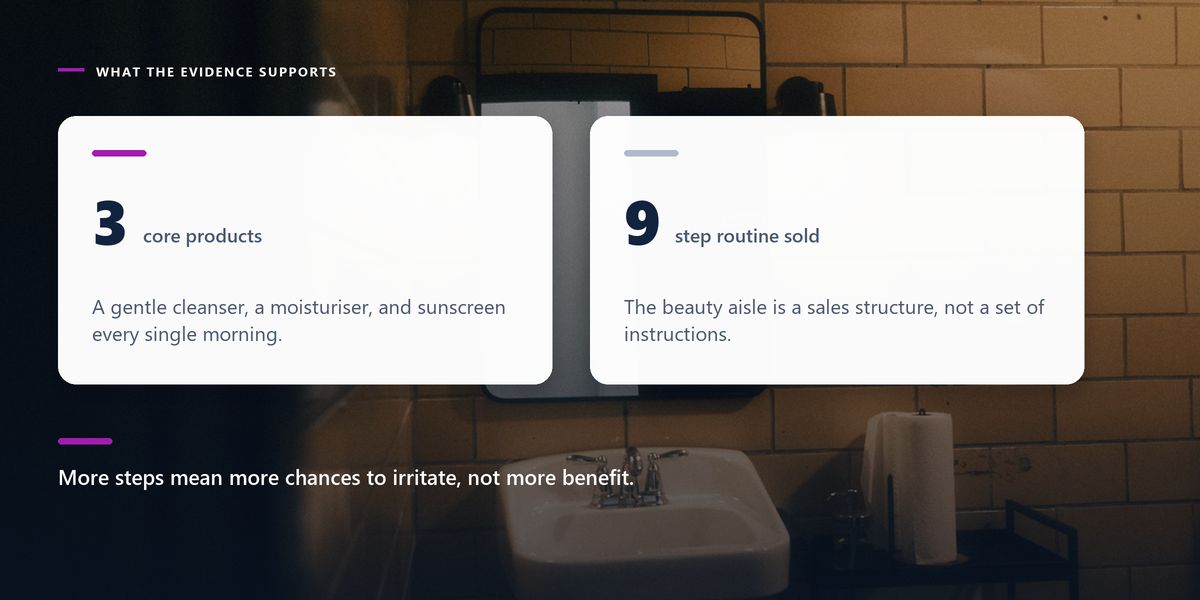
Walk into any beauty aisle and the implied message is that good skin requires a nine-step routine, four serums and a device. It is a remarkably effective sales structure, and it bears very little relationship to what the evidence actually supports.
The uncomfortable summary for an industry this large is that three products do most of the work, one of them costs very little, and the most effective one is not a treatment at all.
Here is the short version, what genuinely adds to it, and how to add anything without irritating your face.
The purpose is to remove dirt, oil, sunscreen and makeup without stripping the skin. The tight, squeaky feeling many people associate with cleanliness is actually a damaged barrier, and it prompts skin to overproduce oil in response.
Once or twice a day is enough. A gentle, non-foaming or mildly foaming cleanser suits most people, and price correlates poorly with performance in this category.

Moisturiser supports the skin barrier, which is what keeps water in and irritants out. Oily skin still benefits — a lighter formulation, but the barrier does not care about your skin type.
Look for humectants such as glycerin or hyaluronic acid, plus something occlusive to hold water in. Ceramides and niacinamide are well supported and unglamorous, which is why they appear in inexpensive products as well as costly ones.
This is the one with the strongest evidence and the one most frequently skipped. Ultraviolet exposure is the dominant cause of visible skin ageing — wrinkles, pigmentation, loss of elasticity — and daily sunscreen is more effective at preventing those than any product sold to reverse them.
Broad spectrum, SPF 30 or higher, applied every morning, including in winter and on overcast days. Most people apply considerably less than the tested amount, so being generous matters more than the exact number on the bottle.
Beyond the basics, a small number of ingredients have genuinely good evidence behind them. The rest range from mildly useful to entirely cosmetic.
| Ingredient | What it is for | Notes |
|---|---|---|
| Retinoids | texture, fine lines, acne | strong evidence; start slowly, expect irritation |
| Vitamin C | brightness, pigmentation | unstable; use morning, store away from light |
| Niacinamide | redness, oil, barrier support | well tolerated, mixes well with most things |
| Salicylic acid | clogged pores, blackheads | oil-soluble, suits oily and acne-prone skin |
| Glycolic/lactic acid | surface texture, dullness | start weekly, not daily |
| Azelaic acid | redness, pigmentation, acne | gentle option for sensitive skin |
Add one new active at a time and use it for at least twelve weeks before deciding whether it works. Skin turnover and visible change are slow, and starting three products at once means that when something irritates you — and something will — you have no idea which one it was.
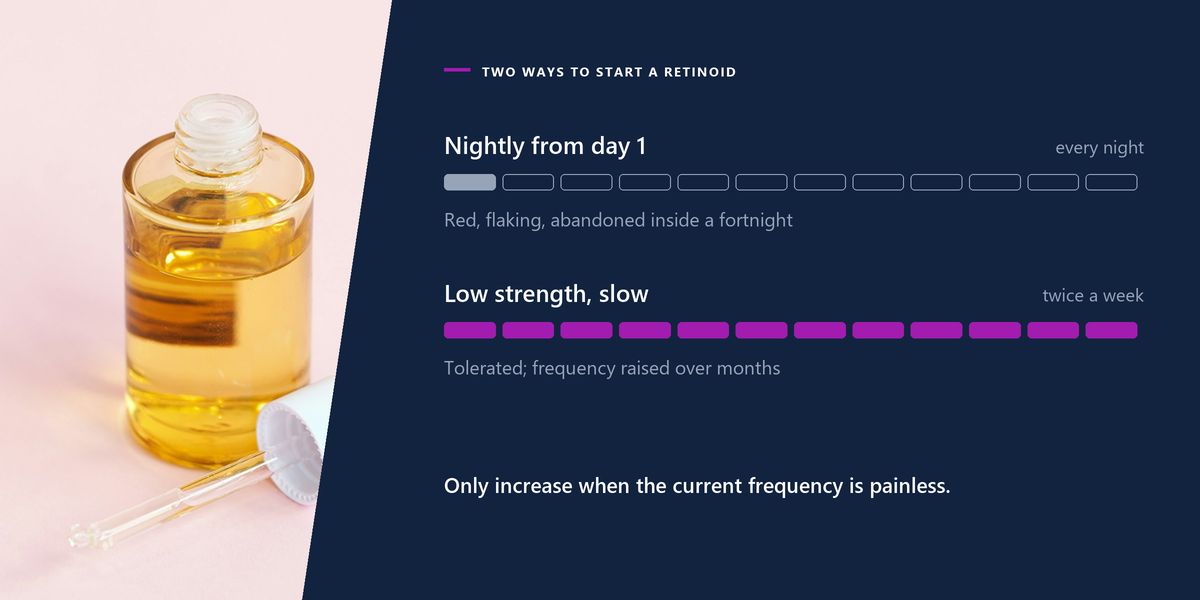
Retinoids have the best evidence of any topical anti-ageing ingredient and the highest rate of people abandoning them, because the standard experience of starting one is redness, flaking and irritation.
Almost all of that is avoidable by going slowly. Start with a low strength twice a week, on dry skin, at night, using a small amount. Moisturise afterwards, or even before if your skin is sensitive. Increase frequency only when the current frequency causes no irritation, over months rather than weeks.
And use sunscreen, which matters more with retinoids since they can increase sun sensitivity. A retinoid without daily sunscreen is close to self-defeating.
A university student had accumulated a nine-step evening routine from social media recommendations: two cleansers, a toner, three serums, an essence, a moisturiser and an oil. Her skin was persistently red, sensitive and reacting to things it never used to.
A dermatologist's advice was to stop everything except a gentle cleanser and a plain moisturiser for four weeks. The redness settled within about two.
She rebuilt slowly: cleanser, moisturiser, morning sunscreen, and — after six weeks — a low-strength retinoid twice a week. Four products, better skin, and roughly a quarter of the previous cost.
Persistent acne, sudden changes in a mole, rosacea and eczema are medical matters, not routine problems. Over-the-counter products can help mild cases and will not resolve moderate or severe ones. If something is painful, scarring, spreading or changing, see a doctor or dermatologist rather than another serum.
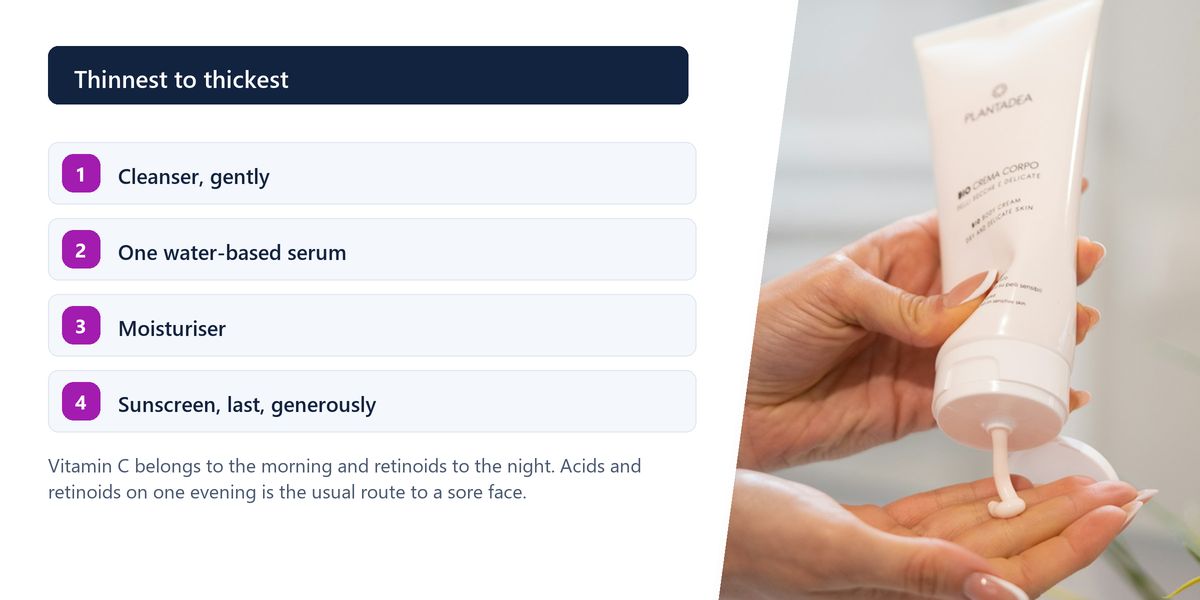
The general rule is thinnest to thickest: cleanser, then any water-based serum, then moisturiser, then sunscreen in the morning. Oils, if you use them, go last in the evening because they seal.
Split actives across morning and evening rather than layering everything at once. Vitamin C in the morning pairs naturally with sunscreen; retinoids belong at night. Exfoliating acids and retinoids on the same evening is a common route to an irritated barrier.
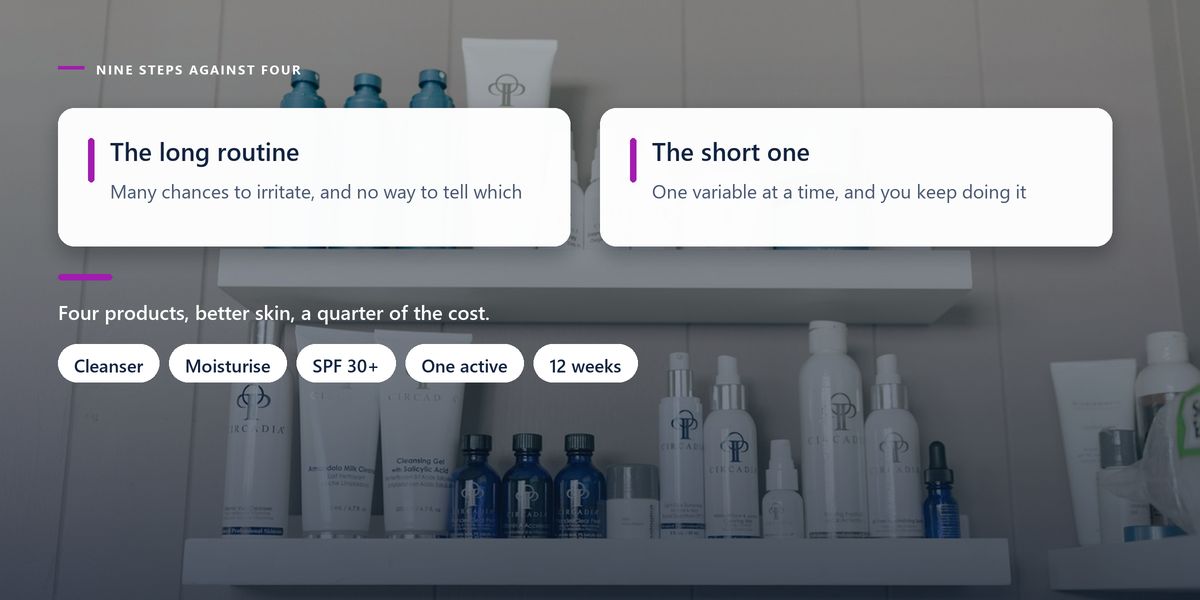
Use a gentle cleanser, a moisturiser suited to your skin, and broad-spectrum SPF 30 or higher every morning. Add one evidence-backed active at a time, introduce retinoids slowly, and give anything twelve weeks. Keep the routine short — more steps mean more opportunities to irritate.
The most effective skincare routine is unexciting, cheap by the standards of the industry, and mostly consists of doing three things consistently for years.
If you do only one, wear sunscreen. It outperforms every product marketed to undo what it prevents.
Tap a star to share what you thought.
No ratings yet
A gentle cleanser, a moisturiser and a broad-spectrum sunscreen of SPF 30 or higher used every morning. Those three cover most of what routine skincare can achieve, and everything beyond them is optional refinement.
Yes for daily outdoor exposure regardless of season, since UVA passes through cloud and glass and is the main driver of visible skin ageing. If you spend a whole day indoors away from windows, it matters much less.
Begin with a low strength twice a week, applied at night to dry skin in a small amount, followed by moisturiser. Increase frequency only once the current level causes no irritation, over months rather than weeks, and wear sunscreen daily.
Not reliably. Several of the best-evidenced ingredients — niacinamide, glycerin, ceramides, salicylic acid, retinoids — appear in inexpensive products. Formulation and consistency of use matter far more than price.
Not meaningfully. Collagen molecules are too large to penetrate the skin and reach where collagen is produced. Ingredients that stimulate your own collagen production, such as retinoids, are the approach with actual evidence.
Give it around twelve weeks. Skin turnover and visible change are slow, and judging a product after a fortnight usually leads to abandoning something that would have worked or crediting something that did not.
Sign in to join the conversation.
Loading responses…
Have a story, idea, or something valuable to share? Join The Blog Story for free, publish your content, reach more readers, and earn a share of advertising revenue from eligible content.
Create quality content. Grow your audience. Grow your earning potential.